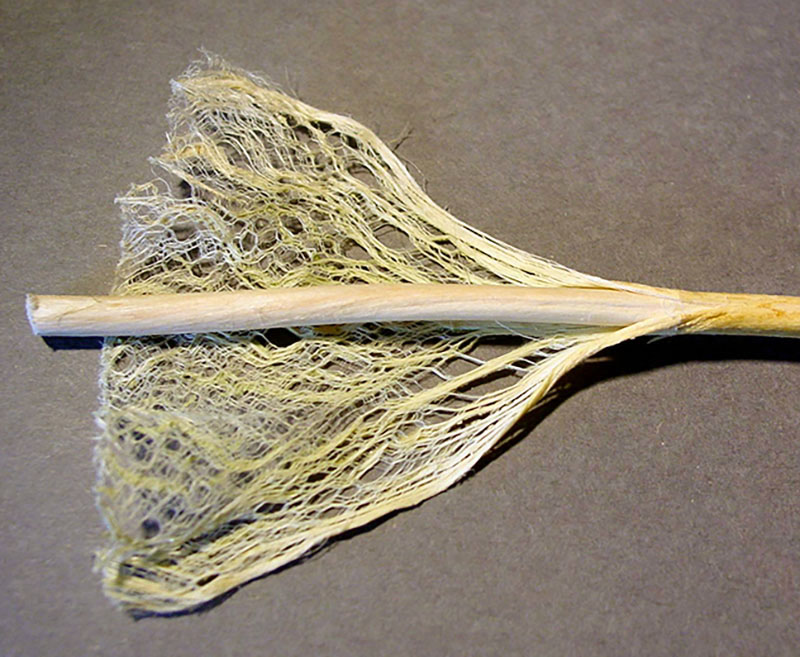
Textile fibre derived from the hemp plant Cannabis sativa, which also yields oilseeds, and leaves and flowers with psychoactive properties when cultivated differently. Hemp is a bast fibre, grown and processed in a similar way to flax (used for linen), though hemp fibres are longer, stiffer and difficult to dye. Strong, lightweight, shrink-resistant and moisture-absorbent, it is used for making garments as well as footwear, ropes, sacking, canvas and paper; in recent years it is also used to synthesise composites used in construction. Thought to have originated in Central Asia, it was cultivated in China as early as 2800 BCE and popularly used in various parts of the world across history. In the contemporary era hemp production has been affected by various legal restrictions on cannabis cultivation, production and trade.
More Definitions
Jati Dor
A local plant found in Odisha, its inner bark is used by the women of the Gadaba community to make…
India Ink
Also known as Chinese ink or Indian ink, it is a black pigment commonly used for draughtsmanship. A carbon-based ink…
Safflower Dye
A dye obtained from the flower petals of the safflower plant (Carthamus Tinctorius). While the petals also yield a yellow…
Sanganeri Paper
Handmade paper produced in Sanganer in Rajasthan. It is typically made using traditional methods and natural materials such as cotton…
photosensitive paper
Paper coated with a photosensitive emulsion, used for making photographic prints, usually in a darkroom. It is first exposed to…
Crepe
Also known as crape, it is a fabric characterised by a rumpled, crimped or rippled surface texture. These effects may…
Hanji Paper
A traditional Korean handmade paper produced using the inner bark of the paper mulberry tree native to Korea. It is…
Tusche
A greasy ink used in lithography, etching and silkscreen printing. In lithography, artists use it to create the desired image…