-
ChicagoImpart Encyclopedia of Art. "Dhauli Elephant ." September 27, 2023. https://imp-art.org/articles/dhauli-elephant/.
-
MLA"Dhauli Elephant ." Impart Encyclopedia of Art, Sep. 27, 2023, https://imp-art.org/articles/dhauli-elephant/.
-
HarvardImpart Encyclopedia of Art (2023) Dhauli Elephant . Available at: https://imp-art.org/articles/dhauli-elephant/ (Accessed: 16 October 2026).
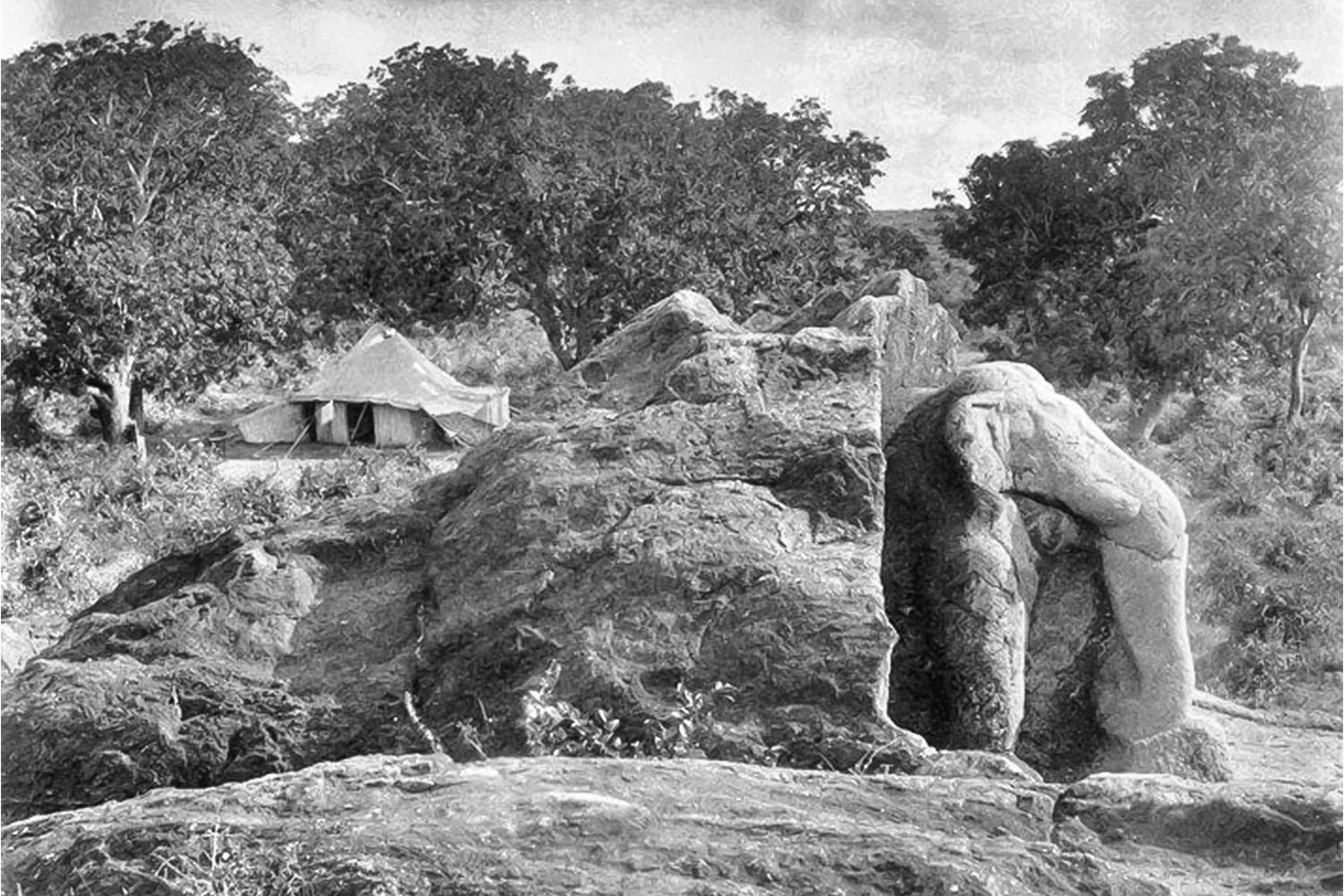
The earliest rock-cut sculpture in Odisha, India, the elephant at Dhauli, near Bhubaneswar, is notable for its naturalistic style. Discovered by Markham Kittoe, a British colonial officer, in 1837, it has been dated to 257 BCE, and is believed to have been carved by local artisans in the village with the patronage of Mauryan emperor Ashoka soon after the Kalinga War. The four-foot high sculpture constitutes the upper eastern face of a rock popularly known as Ashvathama, which has the Ashoka edicts inscribed on its lower, northern side.
Rendered in a supple, naturalistic style, only the front parts of the elephant — head, ears, trunk and forelegs — are visible, while the rest of its body appears to be engulfed in a mass of stone, such that the elephant looks as if it is either stuck within or emerging from the rock. Scholars have proposed that this might be symbolic of the halting of Ashoka’s war at Dhauli, the site of the Kalinga War, which led to his conversion to Buddhism. The softness of the elephant’s body stands in distinct variance from the regulated formalism of Mauryan animal capitals, pointing to the continuation of a different, perhaps more local sculptural tradition that came to find representation even in later Mauryan art, such as the elephant capital of the Sankisa Pillar and the Rampurva Bull.
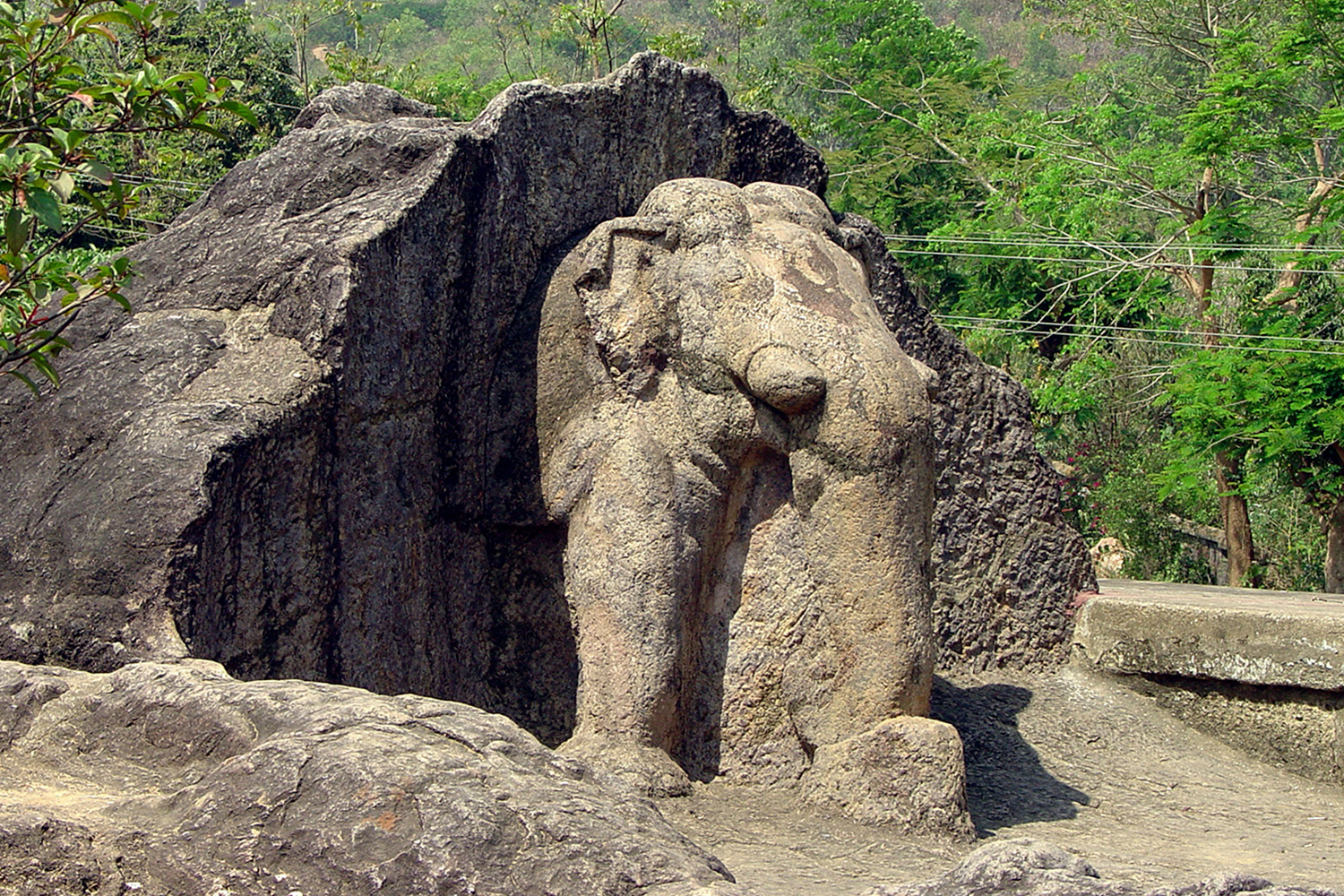
The Dhauli Elephant has significant religious symbolism and local lore associated with it. Elephants appear frequently in Buddhist literature, particularly the Jatakas and are considered to be symbols of both temporal and spiritual sovereignty. The word ‘seto’, meaning ‘the white one’, inscribed at the end of the Sixth Edict of Ashoka, is generally associated with the Elephant at Dhauli. According to Buddhist tradition, white or albino elephants embody purity and holiness and represent the penultimate incarnation of the Buddha before the Shakyamuni Buddha.
At the time of writing, the Dhauli Elephant has become a locally venerated work as well as a major tourist attraction, and helps draw attention and crowds to nearby structures, including the edicts, the Shanti Stupa, and temples and caves.
First published: 27 September 2023
Image Gallery
Bibliography
Geer, Alexandra van der., Geer, Alexandra Anna Enrica van der. Animals in Stone: Indian Mammals Sculptured Through Time. Netherlands: Brill, 2008.
“Indian Sculpture.” Britannica. Accessed February 21, 2023. https://www.britannica.com/art/South-Asian-arts/Visual-arts-of-India-and-Sri-Lanka-Ceylon
Patra, Benudhar. “Dhauli : An Early Historic Urban Centre of Orissa.” Orissa Review, July 2006. http://magazines.odisha.gov.in/Orissareview/july2006/engpdf/49-53.pdf.
Ray, Niharranjan. “Animal Symbols in Maurya Art: Formal and Cultural Significance.” Accessed January 31, 2023. https://himalaya.socanth.cam.ac.uk/collections/journals/bot/pdf/bot_1977_02_01.pdf
Sistla, Srinivas. “White One & a Matrix of Cloud, the Dhauli sculpture.” The New Indian Express. January 02, 2021. Accessed January 31, 2023. https://www.newindianexpress.com/opinions/2021/jan/27/white-one–a-matrix-of-cloud-the-dhauli-sculpture-2255502.html
Srinivasan, Doris Meth. “The Immobilised Elephant at Dhauli.” Journal of the Royal Asiatic Society (2022): 1–2. doi:10.1017/S1356186321000924.
Williams, Joanna. “The Eponymous Elephant of Elephanta.” Ars Orientalis 30 (2000): 51–58. http://www.jstor.org/stable/4629569
Feedback