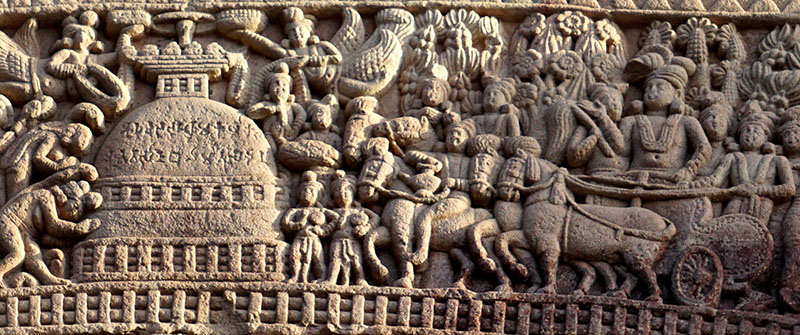
Ashoka (r. c. 268–c. 232 BCE) was the third king of the Maurya empire (c. 320–c. 185 BCE), and grandson of its founder Chandragupta Maurya. He led the empire to its cultural and territorial peak, covering most of the Indian subcontinent. He played a key role in the early spread of Buddhism in the subcontinent, including its establishment in Sri Lanka through a mission led by his son Mahinda. His public messages, as well as a social history of the time, are reflected in his royal edicts, inscribed on rocks and monumental pillars across the empire. Prominent among these is his propagation of dhamma as an ethic of moral conduct; recent scholarship suggests Ashoka’s dhamma, though derived from Buddhist ideas, was deliberately non-sectarian. Though he was a follower and patron of Buddhism, he did not institute it as the state religion, and broadly endorsed religious tolerance, making him somewhat distinctive among rulers of ancient South Asia.
Ashoka began his propagation of Buddhist principles, especially those of non-violence, after witnessing the devastation of his conquest of Kalinga early in his reign, though he was likely already a lay Buddhist before this. Ashoka’s relationship with Buddhism has been a major concern of Buddhist hagiographies and modern scholarship. The former, such as the second century Ashokavadana, portray him as an initially harsh, despotic king who later rejected violent expansionism and ruled as a benevolent, enlightened Buddhist. This view is complicated by historical scholarship, but continues to inform popular conceptions of Ashoka. He is well-known for reforms such as fairer sentencing for prisoners and support for public health and the protection of animals, which were informed by the ideals of dhamma; however, he largely continued to govern as per principles of statecraft encoded in the Sanskrit treatise Arthashastra, retaining the highly centralised, bureaucratic, and revenue-extracting state apparatus built under Chandragupta. After his death c. 232 BCE, Ashoka was succeeded by his grandsons Dasharatha and Samprati; the Maurya empire declined considerably after his reign.