-
ChicagoPathak, Davangi. "Medium as Message: An Interview with Artist Anoli Perera." Impart Perspectives, October 2, 2026. https://imp-art.org/perspectives/interviews/medium-as-message-an-interview-with-artist-anoli-perera/
-
MLAPathak, Davangi. "Medium as Message: An Interview with Artist Anoli Perera." Impart Perspectives, Oct. 2, 2026, https://imp-art.org/perspectives/interviews/medium-as-message-an-interview-with-artist-anoli-perera/. Accessed 15 Oct 2026.
-
HarvardPathak, D. (2026) Medium as Message: An Interview with Artist Anoli Perera, Impart Perspectives. Available at: https://imp-art.org/perspectives/interviews/medium-as-message-an-interview-with-artist-anoli-perera/ (Accessed: 15 October 2026).
Medium as Message: An Interview with Artist Anoli Perera
The pioneering Sri Lankan artist often takes an interventionist approach to political and social crises, changing materials and mediums to suit the message.
By Davangi Pathak
Link copied!
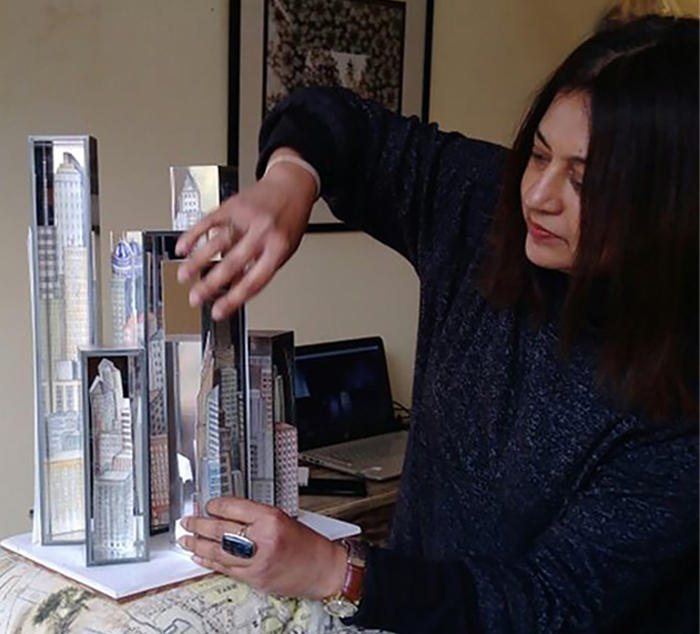
Artist at work. Courtesy Anoli Perera
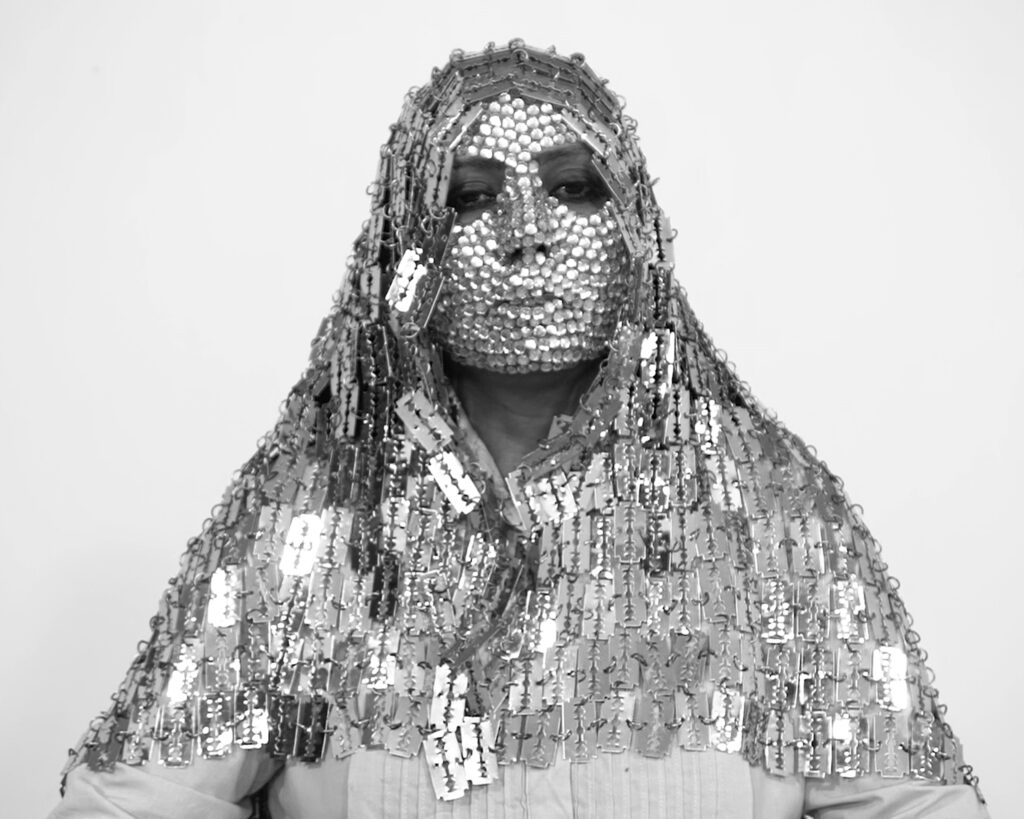
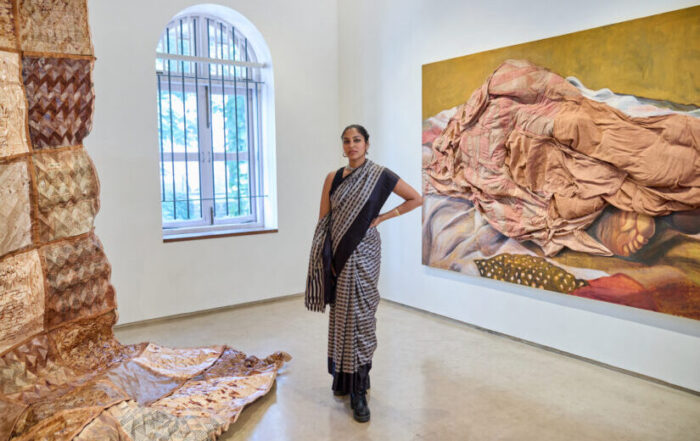
One of the key figures of the 90s Trend movement that heralded the ‘contemporary’ turn in Sri Lankan art, Colombo-based, multidisciplinary artist Anoli Perera locates her practice between craft and art. Known for her labour-intensive practice, Perera incorporates materials such as cloth, thread, lace, paper, and found objects in her work across mediums, using a bricolage approach. Be it painting, sculpture, installation art or video- and photo-performance, Perera weaves together fragments of personal and societal memories, using nostalgia to create layered narratives that move between the intimate and the political.
Born in 1962, Perera was in her impressionable 20s during the 1983 Sri Lankan Civil War, and not surprisingly, her work references both her own lived experiences, as well as the island nation’s complex past, to address collective anxieties and histories. She has often taken an interventionist stance through her art, centring questions around displacement, migration, borders, unchecked urbanisation and industrialisation, and other political and social shifts.
In this conversation, Perera reflects on her journey in the context of the changing art ecosystem in Sri Lanka and her efforts that helped it evolve through initiatives such as the Theertha International Artists’ Collective.
Davangi Pathak: Looking back at your career, what shifts, both conceptually and materially, have shaped your artistic trajectory since the 1990s?
Anoli Perera: I didn’t go to art school; I’m largely a self-taught artist. Although, I wouldn’t completely describe myself as “self-taught” because when I want to learn a particular, specialised technique, I take a class or a course. For instance, I have formal training in stone carving, but I have never attended a conventional art school.
I sometimes wonder whether art schools can influence the way you think because you are working within a particular pedagogical framework. In my case, I have never specialised in a particular artistic discipline, such as sculpture or painting. So I have developed a much more open and experimental relationship with a variety of materials and mediums.
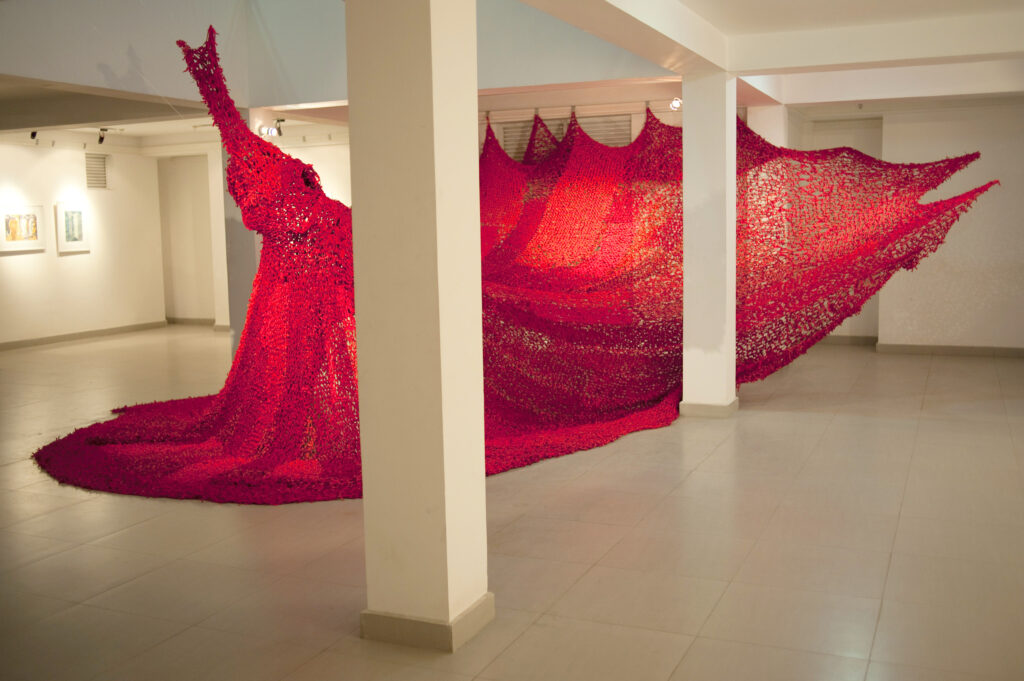
My academic background is actually in sociology and anthropology. I studied liberal arts, so my approach to art has always been quite interdisciplinary. When I have an idea, I tend to think about what material or combination of materials would best express that idea, rather than beginning with a particular medium.
I have always had a particular affection for fabric and cloth. That comes from my childhood. I grew up in a household with many women. I had four aunts on my maternal side and they were very skilled seamstresses, and I loved watching them sew and make things. That’s why working with fabric feels familiar; a reflection of how I was brought up.
In Sri Lanka, ready-made clothing became more common only later; before that, people often made their own clothes. I was formally trained in dressmaking and used to make my own clothes. Since then, I’ve continued to experiment with cloth, but I also like juxtaposing it with materials such as metal. I enjoy bringing two or three very different materials together and seeing what happens when they interact. I think that combination — of interdisciplinary thinking, personal history, and material experimentation — has been central to my practice over the years.
Pathak: What conceptual weight do materials carry for you? What mediums do you love to work with other than fabric or textiles?
Perera: I actually love stone carving. I learnt it while I was in Princeton in the United States, and I particularly loved working with alabaster. But when I returned to Sri Lanka, I couldn’t really continue because the stones available locally are much harder and don’t respond in the way I want them to. So although I love carving, it is not something I have been able to pursue consistently.
At different points, I’ve also worked extensively with metal and scrap metal, and later moved into photography, and video- and photo-performance. I think I’m drawn to whatever captures my imagination. I don’t really want to restrict myself to one medium, but I do think that kind of flexibility can sometimes pose a problem. Curators and institutions often prefer artists to have a very identifiable practice. It is easier to say, “This is the kind of work this artist makes.” But my practice has always been quite varied, and navigating that can get complicated.
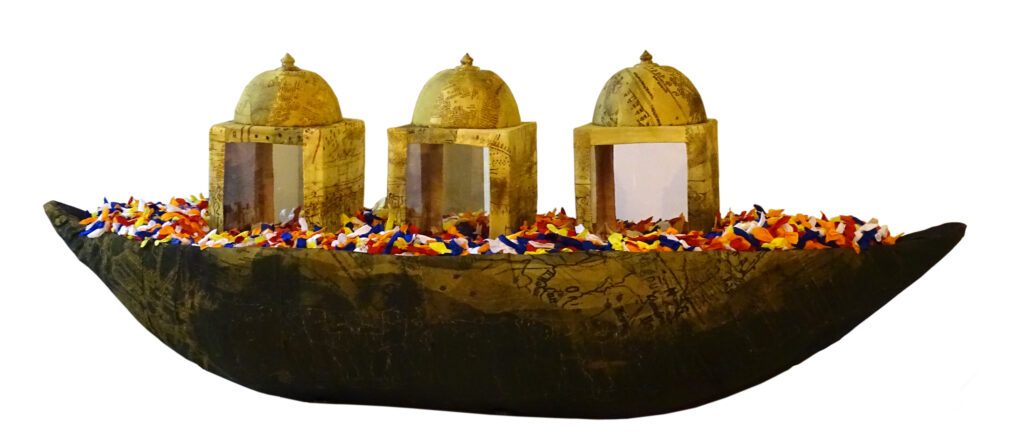
Fortunately, I was able to develop this way of working without being too concerned about how I would be positioned as an artist. When I was younger, particularly before the 2000s, the art market in Sri Lanka was almost non-existent. In a strange way, that gave us artists a certain freedom to experiment and make whatever we wanted. We were not constantly thinking about what might sell. I feel fortunate to have developed my practice during that period, and even now, I don’t really worry about the market.
I’m also interested in materials that carry their own histories. I often layer materials, and the material itself can become part of the narrative. For example, I have used crochet extensively because it has a particular history. In the colonial context, crochet was introduced and promoted as a feminine pastime — something that would keep women occupied and contained within the domestic sphere. That history interests me.
So when I use crochet as a material, I’m not simply interested in its visual quality. I’m also thinking about its history, gendered associations, domestic labour, and social structures embedded within the material. That, conceptually, becomes another layer in the work.
Pathak: The idea of ‘bricolage’ plays a central role in your work. What draws you to assembling fragments rather than constructing seamless narratives?
Perera: For me, bricolage is about bringing together many different elements within a single work, including text, images, objects, and materials. In that sense, everything becomes very layered and textual. Bricolage is related to collage, but I think there is an important difference. Collages can sometimes bring together very disparate elements in a random arrangement. In my work, the fragments are chosen and placed carefully because each one carries its own meaning and history. The material itself has a history, and when I bring it into a work, that history also becomes a part of the narrative I am presenting.
The same applies to text. A piece of writing has its own context, history, and associations. I use these different elements to build layers within the work, rather than creating one unified or seamless image.
I often want those layers to remain visible too. You can see the different fragments, materials, and histories coming together, and that accumulation is an important part of how my work communicates with a viewer.
Pathak: Your work often weaves personal memory into broader historical narratives. How do you navigate between them?
Perera: When I say that I draw from memory, I don’t necessarily mean that I am referring to particular incidents. Even when there is a specific experience behind a work, I’m usually not interested in mentioning names or documenting the event directly. What I take from my personal experiences are feelings, or a certain atmosphere; the imprint or impact of what happened that has lingered. That becomes the starting point.
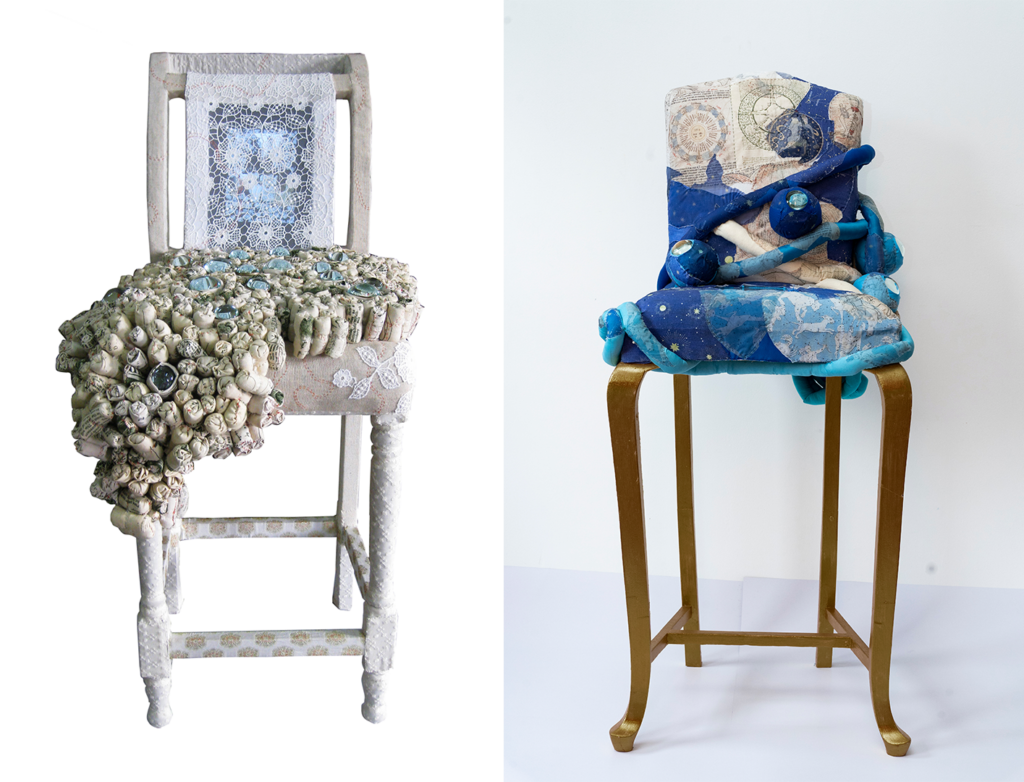
There have also been times when I have used more specific personal references. For example, I have incorporated my mother’s figure, as well as things associated with her, such as her wedding sari or wedding jacket. These objects carry the weight of emotional and familial stories.
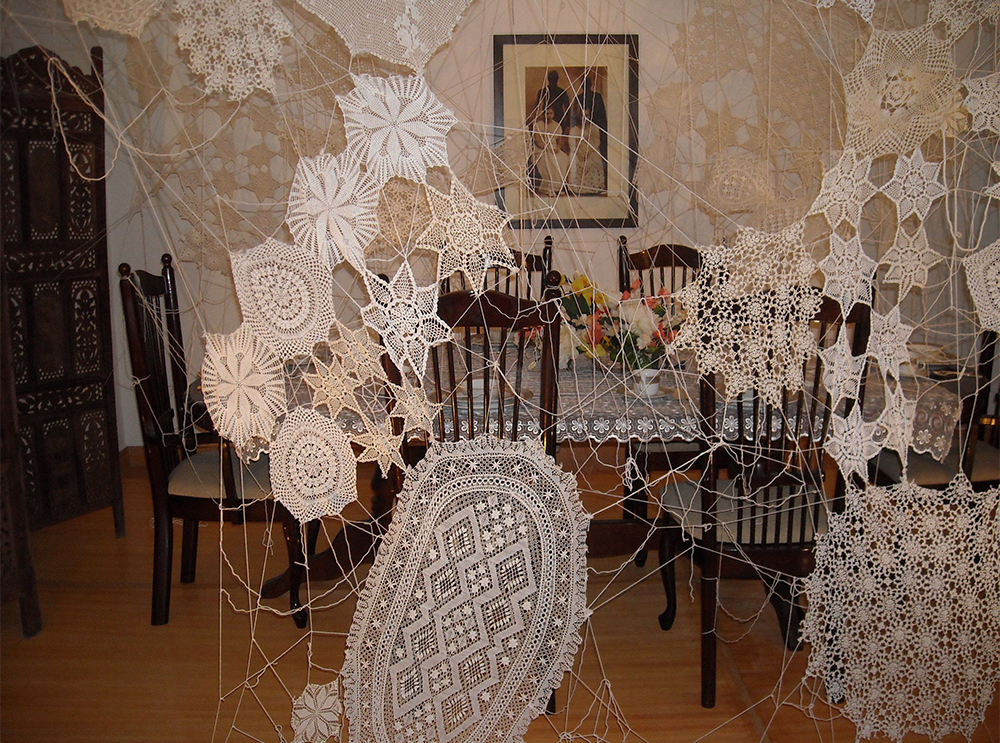
A lot of my work also comes from what I witnessed in domestic spaces and the position of women within it. I often draw from my own family background and the particular nuances of intimate spaces and experiences at home. For example, in Dinner for Six (2009), I was thinking about domesticity, the mother’s body, and the idea of the home as a comfort zone.
The ideas of the comfort zone and the “comfort body” continue to interest me. I keep returning to them, even in the work I’m making now. So, although the starting point may be personal, I’m interested in how those experiences lead to broader inquiries around domesticity, memory, gender, and the spaces we inhabit.
Pathak: In revisiting family archives and personal histories, how do you negotiate the ethics of representing intimate or inherited narratives?
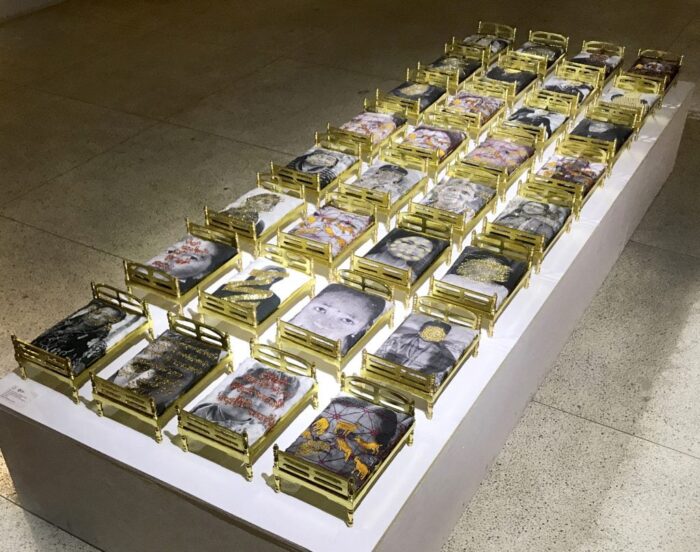
Perera: I did a work called Comfort Zone (2004), where I created an entire room or cubicle using crochet. There was a bed in the centre, surrounded by a kind of web, and the viewer could actually enter the space and sit on the bed.
For me, the bed represents comfort. As a child, my mother’s bed and my grandmother’s bed were places where we would spend time whenever we visited our grandparents. We could lie down, play, or simply hang around. But my grandfather’s bed was different — you wouldn’t just jump onto it because you would probably get scolded! [laughs] These small experiences are important because they tell us something about how we understand domestic spaces.
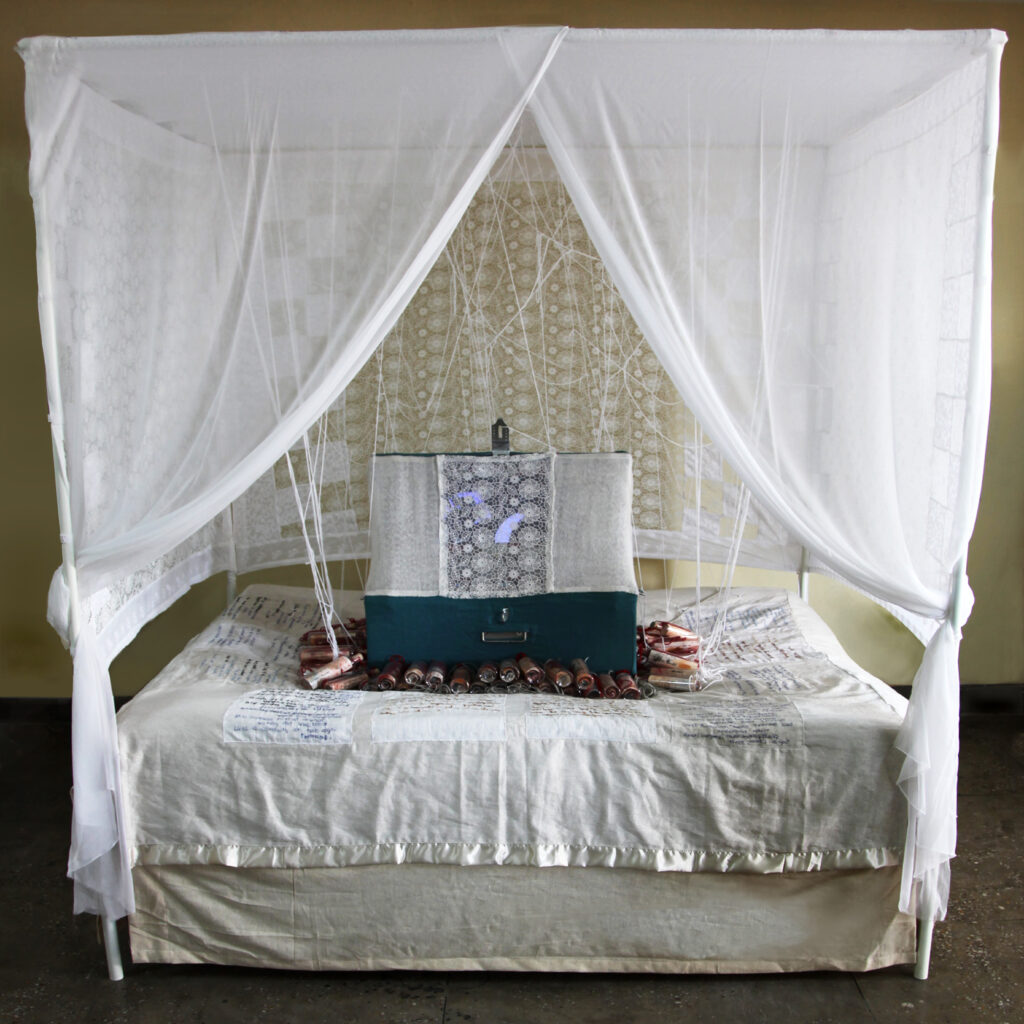
The beds of our mothers, grandmothers, and aunts often became spaces of openness and comfort. They were the people we went to when we needed comfort, and we were part of that intimate world.
But within that comfort zone, there is also another layer. The web surrounding the space represents the structures that women themselves weave and, at the same time, become confined within. So the space is both comforting and restrictive.
That is how I approach intimate or inherited experiences in my work. I’m not simply trying to reproduce a personal memory. I’m interested in taking something very intimate — such as a bed, a domestic space, or a family experience — and looking at the larger structures and relationships embedded within it. The personal becomes a way of thinking about something broader.
Pathak: Could you reflect on how feminist theories shape your work?
Perera: I don’t think you always have to put a label on it. For me, anyone who, at some point, feels the need to go against the grain or liberate themselves from something can identify with feminism in that sense. It is about recognising that you want to move beyond the limitations placed on you.
In Sri Lanka, I am often described as a feminist artist. I think part of that comes from the materials I frequently incorporate as part of my practice, such as lace, needlework, crochet, and other materials that are traditionally associated with femininity and the domestic or decorative arts. These materials were not necessarily considered “fine art” materials, and bringing them into the contemporary art context was, in itself, a kind of intervention.
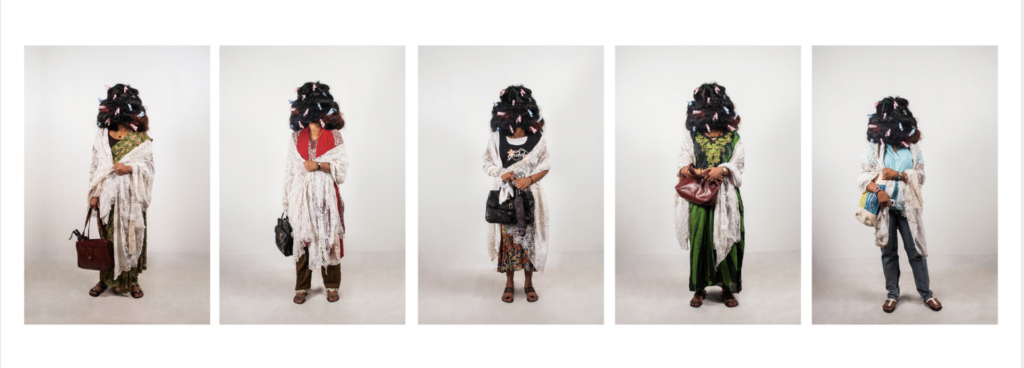
But I don’t use these materials simply because they are feminine. I’m interested in the histories and associations they carry, particularly the ways in which women’s labour and creativity have traditionally been confined to the domestic sphere.
The issues that women encounter inevitably enter my work in some way, but I don’t approach the work with the intention of resolving those issues or providing answers. There is often a certain macabre quality or tension within my work, and I prefer to leave that tension unresolved. That discomfort is important to me. I don’t feel that I need to explicitly tell the viewer what to think. I would rather create a situation where the viewer encounters the discomfort and then reacts to it; begins to think about it.
Pathak: As a founding member of Theertha Artists Collective, can you share your experiences around creating a platform that profoundly shaped the Sri Lankan art scene?
Perera: It was difficult, but I think there was a stronger sense of collectivity at that time. The artists who came together were mostly friends or students of people who were already part of the art community. So, there was an existing sense of trust and familiarity. We initially started Theertha as something quite informal, but as it grew, we realised that we needed a formal structure in order to do certain things and sustain its work.
One of our main motivations was to connect with the outside world. At that time, we felt that we were not really being accepted within our own country, and the situation was quite stifling. We wanted to go beyond that. Throughout the 1990s, many countries in South Asia were experiencing different kinds of crises. Sri Lanka was going through the thirty-year civil war, political violence, and economic difficulties. In that context, the kind of art that had been made previously no longer seemed adequate.
Artists were becoming much more vocal, socially critical, and engaged. The aesthetics changed, the role of the artist changed, the role of art changed, and even the materials artists were using changed. I would describe it almost as an epistemic break in Sri Lankan art history.
We needed new forms of support and new ways of connecting. So we began focusing on international mobility — bringing artists into Sri Lanka and creating opportunities for Sri Lankan artists to travel and work abroad. That was really how our international network began to grow. At the same time, Theertha was very much a community of friends. Our practices developed within that peer group, and there was a lot of critical exchange among us. If someone was working on a series, they would discuss it with the others, and we could say — “This is working”, or “This isn’t working” — because we were friends. That sort of criticism was generally received in a very constructive way. It allowed us to grow, both conceptually and in terms of execution.
Of course, running Theertha was also a huge responsibility. At one point, we had around fifteen artists working with us on a full-time basis, and we were paying them salaries. That meant we had to develop and manage a large number of projects and raise funds to sustain them. At that time, there was also considerably more international funding available for countries considered to be in crisis. Development funding was flowing into the region, and we were able to access some of those resources. At one point, I think we were managing around thirty different budgets for different programmes and projects. Can you imagine? There were almost thirty programmes running throughout the year, one after another.
It was an incredibly vibrant period. The funding landscape has changed considerably since then, but those conditions allowed Theertha to grow into a very active and important artistic community.
Pathak: Speaking about the art scene in Sri Lanka, we can see artists emerging from other regions, not just Colombo, with nuanced practices. How has this impacted the art market ecosystem?
Perera: It is exciting to see practices emerging from regions beyond Colombo. For a long time, especially because of the thirty-year war, the art scene was heavily centred on Colombo. The North and East were severely affected by the conflict, and many artists working in those regions simply did not have the visibility or infrastructure to present their work.
But when the war ended in 2009, and the country began to rebuild, we started seeing some very interesting artists emerging from the North, the East, and other regions. Their experiences gave them very different perspectives, and many articulated those experiences in powerful ways. Some of these artists had actually been working for years, but they were not adequately represented and so their work wasn’t being seen.
Now, there are more galleries, collectors, and more platforms that are interested in Sri Lankan artists. This is important because so many artists struggle after graduating from art school. They end up moving into teaching or other forms of employment. A growing ecosystem means they can continue to work professionally as artists.
However, I also think there are certain issues that emerge when the art market becomes too influential. Artists can fall into formulas because they know what will sell. Certain narratives, including ideas around victimhood, become marketable and get reproduced again and again. For me, taking risks is essential to being productive as an artist. Of course, artists need to sell their work and collectors play an important role in sustaining artistic practices. But you have to be careful; you cannot let the market determine the direction of your work. So I see the art market as both an opportunity and a challenge. It can provide artists with visibility, support, and make their work sustainable, but ultimately, artists have to protect their ability to experiment and stay true to their practice.
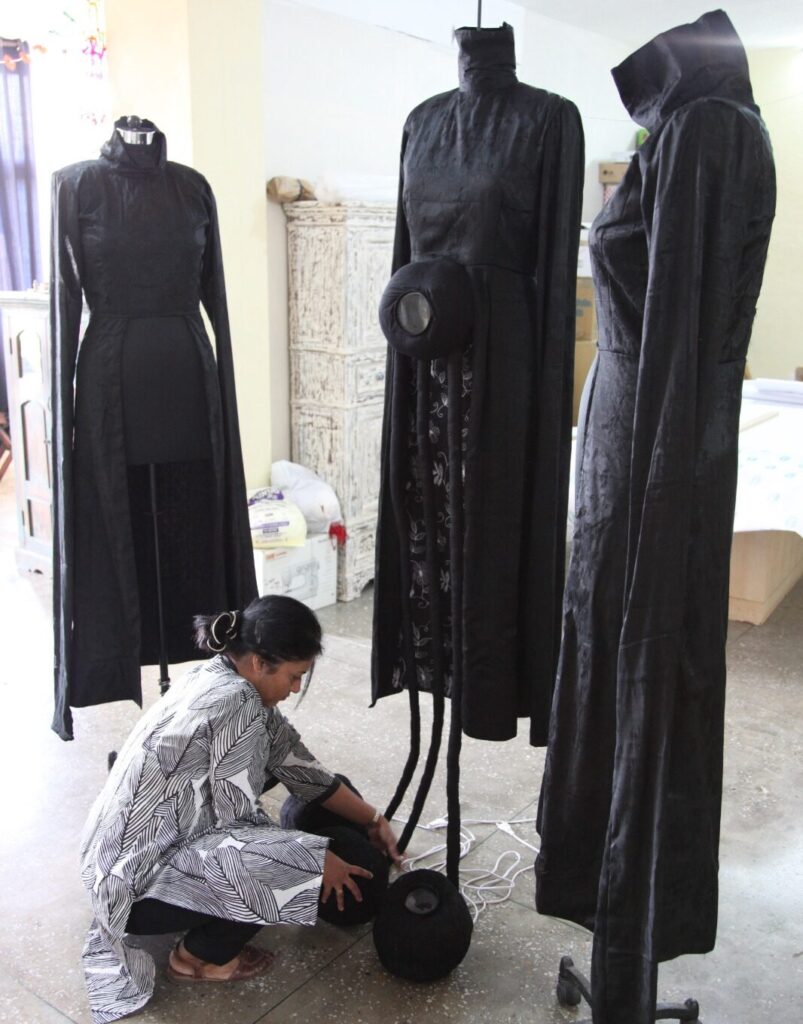
Pathak: How have audiences in Sri Lanka, across South Asia, and in other international art venues responded to your work?
Perera: Most of my collectors are based in India and Sri Lanka, although my works are part of collections outside South Asia as well. A number of museums and private collections have acquired my installations, which is quite unusual because installations are not always easy to collect or exhibit. And I think it is because they are difficult to ignore. When someone encounters the way I use materials or develop an idea, there is often an immediate curiosity about my work, which I like. I feel happy when the work I present is not ignored — when it makes the viewer stop, look, and engage.
But I don’t know if I have a formula that guarantees that attention. In the end, it all depends on the strength of the concept, how the work is presented, and how the materials come together. All of these things matter because collectors have different motivations. But to me, the most important thing is that the work creates enough presence to make people stop and pay attention.
Pathak: Your practice exists between craft and contemporary art. How do you navigate this space, especially within institutional frameworks that may separate the two?
Perera: Personally, I haven’t been questioned or experienced much resistance about whether my work fits into one category or another. I also don’t think of craft and contemporary art as completely separate categories. I often combine craft-based processes with other elements of contemporary art. For example, in my last exhibition, I created a video installation using crocheted curtains. The video was projected through the crochet, so the material became part of the installation rather than simply functioning as a decorative element.
Similarly, I have incorporated needlework and other craft practices into my work alongside elements associated with fine art. For me, it is about bringing these different forms together and allowing them to interact. I think this has also contributed to the gradual breakdown of the distinction between craft and fine art. What may once have been seen as a purely domestic or decorative practice can now become part of a larger conceptual and contemporary art framework. For me, the important thing is not necessarily to decide whether something is craft or fine art, but to think about what the material and the process can achieve.
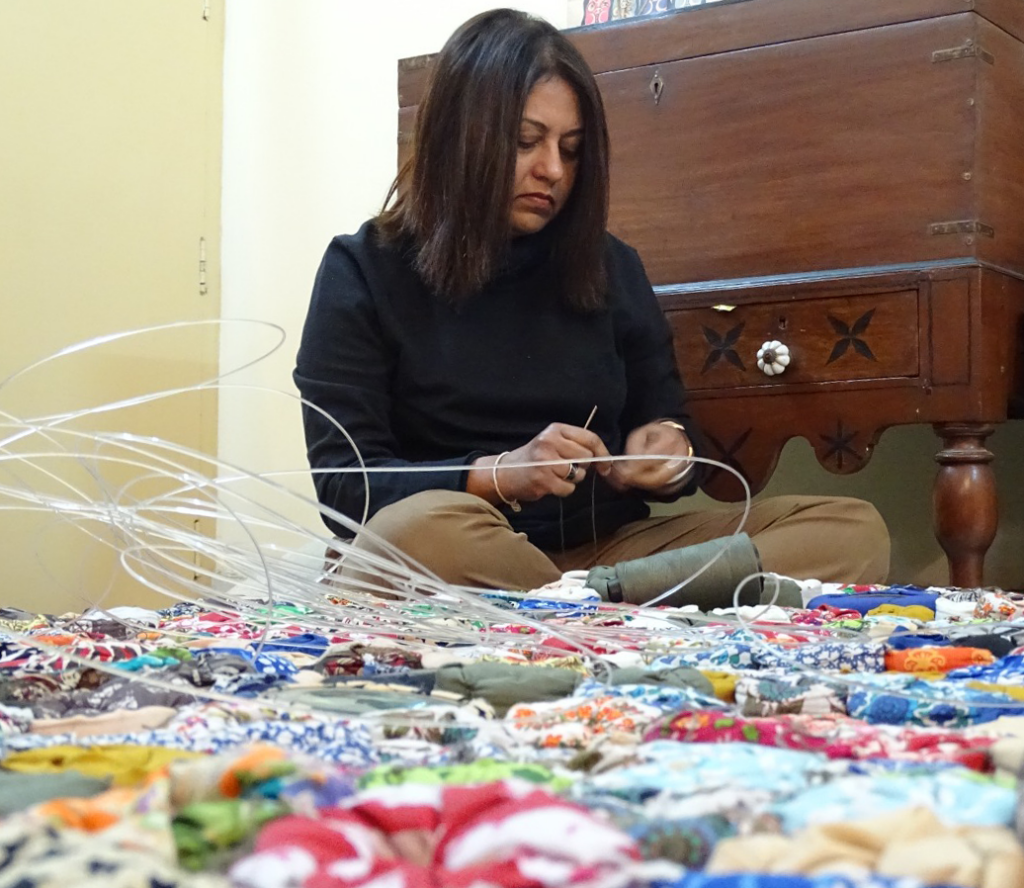
Pathak: Many of your works suggest layered temporalities — moving between the past and the present. How does memory function as both a material and a method in your process?
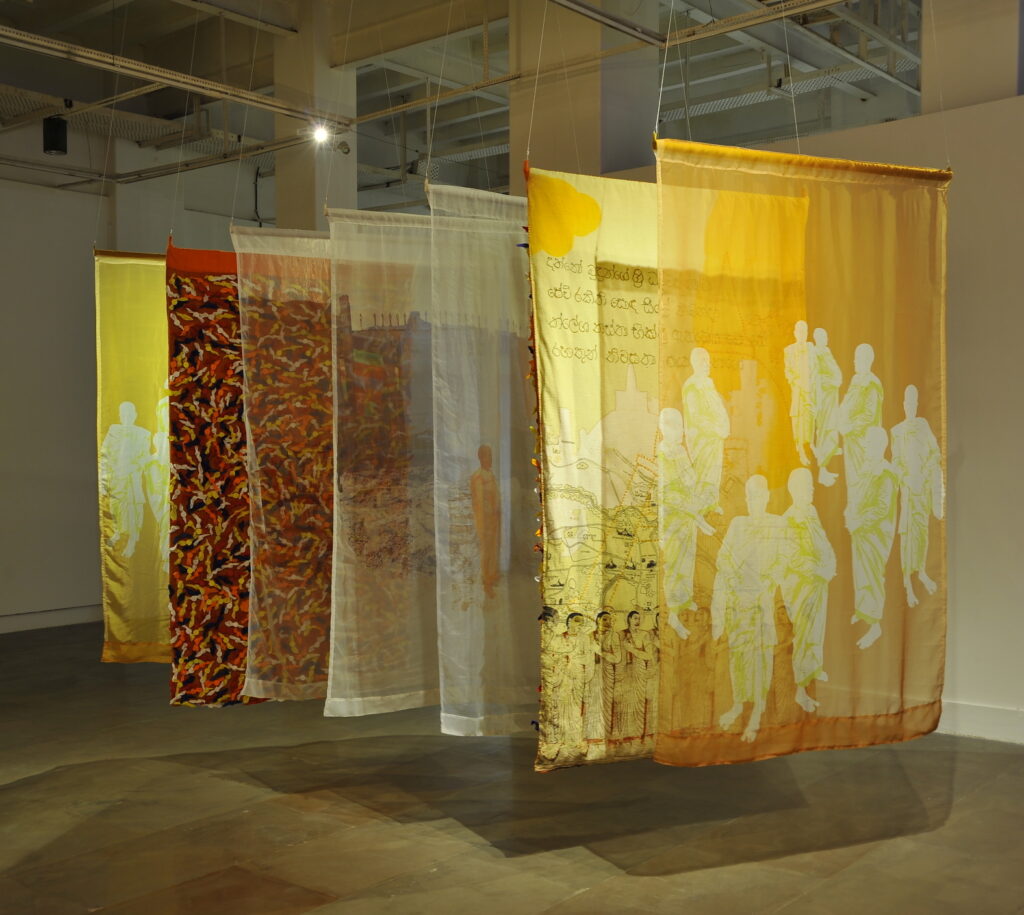
Perera: One particular exhibition, Memory Keeper (2013), came together soon after the war ended in 2009. Around that time, there was a monument in Colombo by the artist Jagath Weerasinghe, commemorating children who had disappeared during the conflict. Soon after the war, the government at the time wanted to remove the monument and replace the site with a leisure space, essentially erasing what it represented.
That really disturbed me. There were many instances, both in the North and the South, where monuments and physical traces connected to the conflict were being removed or destroyed. It made me think about how societies deal with difficult memories and what happens when those memories are deliberately erased.
At the same time, I was experiencing something very personal. My mother was beginning to experience memory loss, and I could see all the anxiety and uncertainty that came with it. So these two experiences — the larger political question of how a society remembers and forgets, and my own experience of watching my mother lose her memories — came together for me.
That was really when I began engaging with memory in my practice. I became interested not just in the act of remembering, but also the anxiety of forgetting. What happens when memories disappear, whether through political erasure, the destruction of physical traces, or the gradual loss of what we remember personally because of old age or illness.
That anxiety runs through much of my work around memory. Memory becomes both a subject and a material through which I think about loss, history, identity, and the fragile relationship between what we remember and what is forgotten.
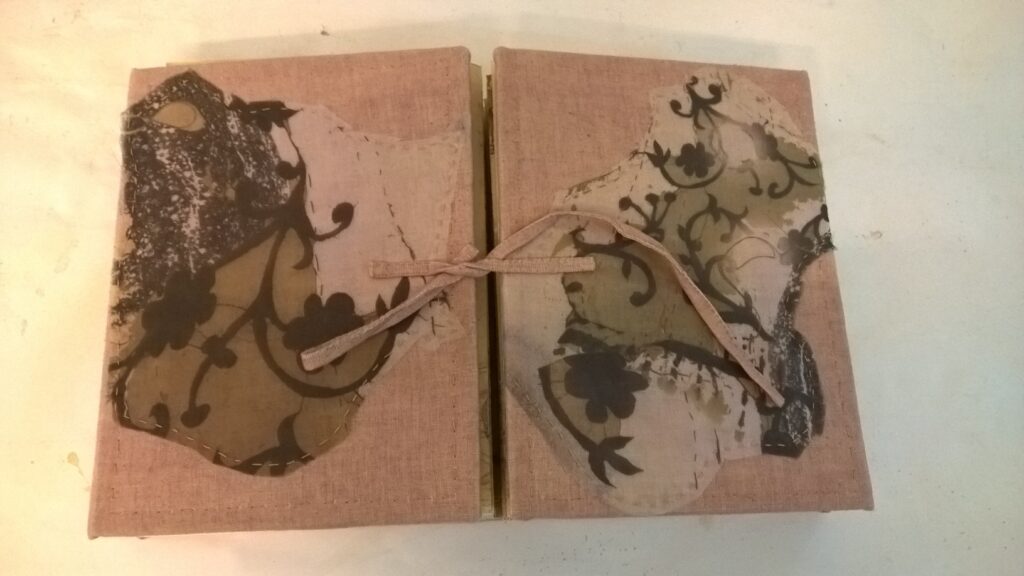
Pathak: Can you elaborate on what triggers you to create art around themes of migration, displacement, and borders?
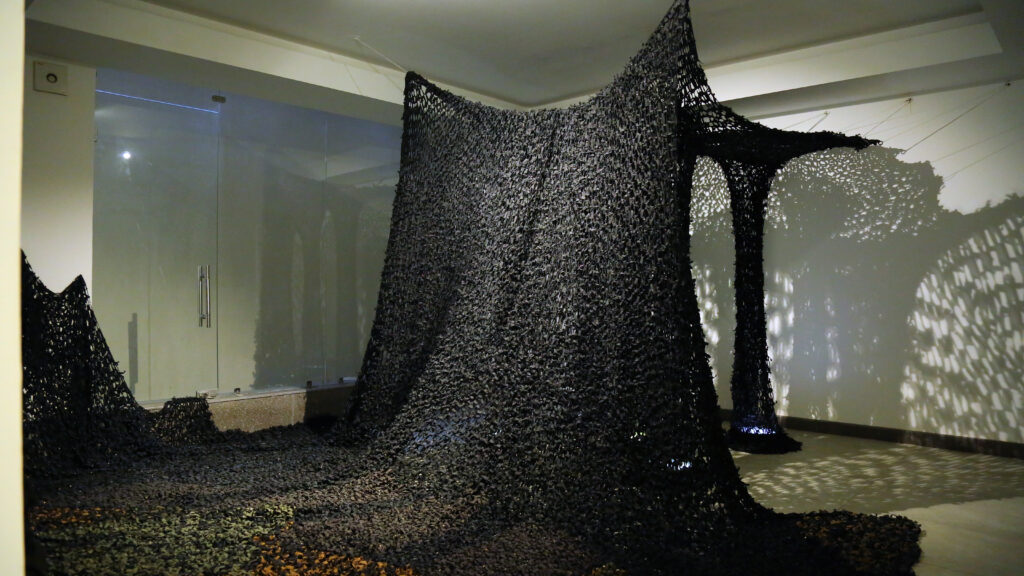
Perera: My engagement with migration and borders is again connected to the experience of war and conflict, both in Sri Lanka and elsewhere. When I began thinking about migration, the Syrian war was starting. A few months before the conflict intensified, I had been invited to Aleppo for an art and photography festival. At that time, it was a vibrant city with a strong cultural life. Then, within five or six months, I watched the city begin to crumble.
That contrast stayed with me — the way a city can be thriving at one moment and then suddenly become a place of destruction and displacement. Much of this happens because of political decisions and the actions of those in power. And once a city is destroyed, you see the resulting exodus of people.
I began thinking about the relationship between cities and migration: how cities are built to attract people, to bring people together, but can also become the reason why people have to leave. That contradiction became an important part of my thinking.
I also began looking at how large cities create enclaves and how communities become concentrated within particular spaces. You can see this even in Delhi. When there is communal violence, for example, particular communities can become confined to specific neighbourhoods, and those divisions are then deliberately intensified. Again, you see questions of displacement and exodus emerging from those situations. So my work around migration is not simply about migration itself. I’m interested in the political and social conditions that produce displacement, and in how cities, borders, and communities respond to those conditions.
I continue to work with these ideas. My upcoming solo exhibition also looks at war, particularly how our conventional understanding of warfare has changed in the present moment. Most of my ideas emerge in this way. Something happens around me, whether politically or socially, and I respond to it through my practice.
Pathak: Your works often carry a quiet yet persistent political voice. How do you approach political expression without becoming overtly didactic?
Perera: There are certain moments when artists need to take a position. In the Indian context, there is a youth uprising happening at the moment, and I think artists have a social responsibility in such situations.
We experienced something similar in Sri Lanka. At one point or the other, many of us have been part of protest movements against the civil war. There are moments when you simply cannot remain detached from what is happening around you. Sometimes you need to speak, and sometimes you need to register a protest, because what artists say can matter.
I believe that is part of the responsibility of being an artist and being part of an artistic community. It doesn’t necessarily mean that every artwork has to become an overtly political statement, but as individuals and as a community, we cannot remain completely aloof from the realities around us. You cannot live in an ivory tower and pretend that these things have nothing to do with you. For me, responding to what is happening around us is part of being an artist.
First published: October 2, 2026