-
ChicagoBaoni, Aadya. "Against Absence: Abir Karmakar and Alok Bal on Navigating Censorship." Impart Perspectives, July 1, 2026. https://imp-art.org/perspectives/interviews/against-absence-abir-karmakar-and-alok-bal-on-navigating-censorship/
-
MLABaoni, Aadya. "Against Absence: Abir Karmakar and Alok Bal on Navigating Censorship." Impart Perspectives, Jul. 1, 2026, https://imp-art.org/perspectives/interviews/against-absence-abir-karmakar-and-alok-bal-on-navigating-censorship/. Accessed 15 Oct 2026.
-
HarvardBaoni, A. (2026) Against Absence: Abir Karmakar and Alok Bal on Navigating Censorship, Impart Perspectives. Available at: https://imp-art.org/perspectives/interviews/against-absence-abir-karmakar-and-alok-bal-on-navigating-censorship/ (Accessed: 15 October 2026).
Against Absence: Abir Karmakar and Alok Bal on Navigating Censorship
Both Karmakar and Bal have spent their careers asking what it means to calibrate their art, not just for meaning, but to evade being censored.
By Aadya Baoni
Link copied!
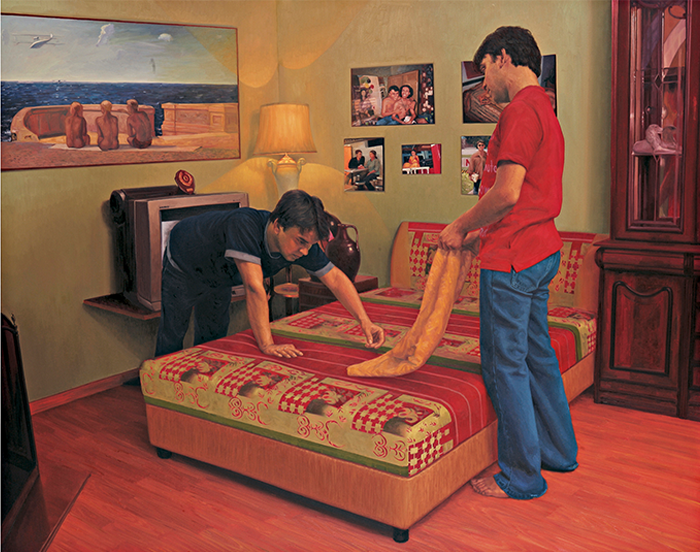
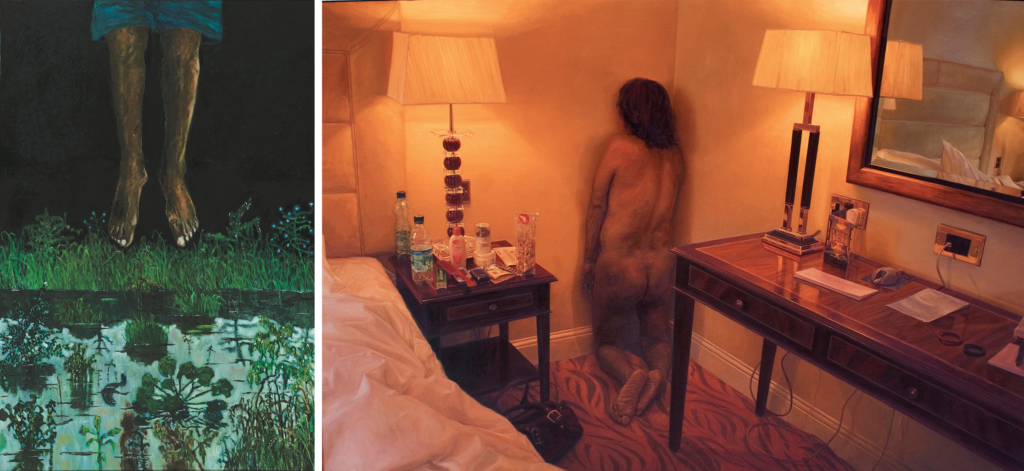
Interiors IV; Abir Karmakar; 2006; oil on canvas. Courtesy the artist
Consider these two images. The first is of a hotel room. A naked man crouches, his face pressed into a corner, his back exposed under the amber light. Every muscle is rigid with tension; the posture, while submissive, is not one of surrender. We are above him, looking down, positioned like an intrusive CCTV that can track his movements — the tell-tale clench of the fingers, the flinch, the twitch. The painting is nearly eight feet tall. The lifelike-scale lends to the painting’s impact of a body bared, vulnerable, bathed in the light emanating from a desk lamp. This is Abir Karmakar, the artist, and the object of surveillance in the oil-on-canvas self-portrait.
The second image is of a figure suspended. Only the feet are visible as it hovers above a pond that reflects the lush, green vegetation that surrounds it. At first, the airborne body seems to embody a weightlessness that reads almost like joy. But then you wonder, is the body hovering above water, poised to touch down or clutching something to avoid falling in? Or is it a quieter, darker image — a portrait of a suicide? The artist of this piece is Alok Bal.
Both artists honed their painting practice at the Faculty of Fine Arts in Baroda, refining their artistic expressions within its cloistered environment. Both have also spent their careers asking what it means to engage with the politics of vulnerable bodies, identities, and communities in their art. Within the span of their careers, censorship has taken on new life in India. Hot takes are blasted across social media and news channels by experts and influencers. Threats are directed at exhibition spaces, and then there is the quieter, institutional pressure that convinces artists to self-censor. Both Karmakar and Bal have dealt with systems of control that have eaten into the innards of their artistic practice.
Karmakar: From Opulence to Absence
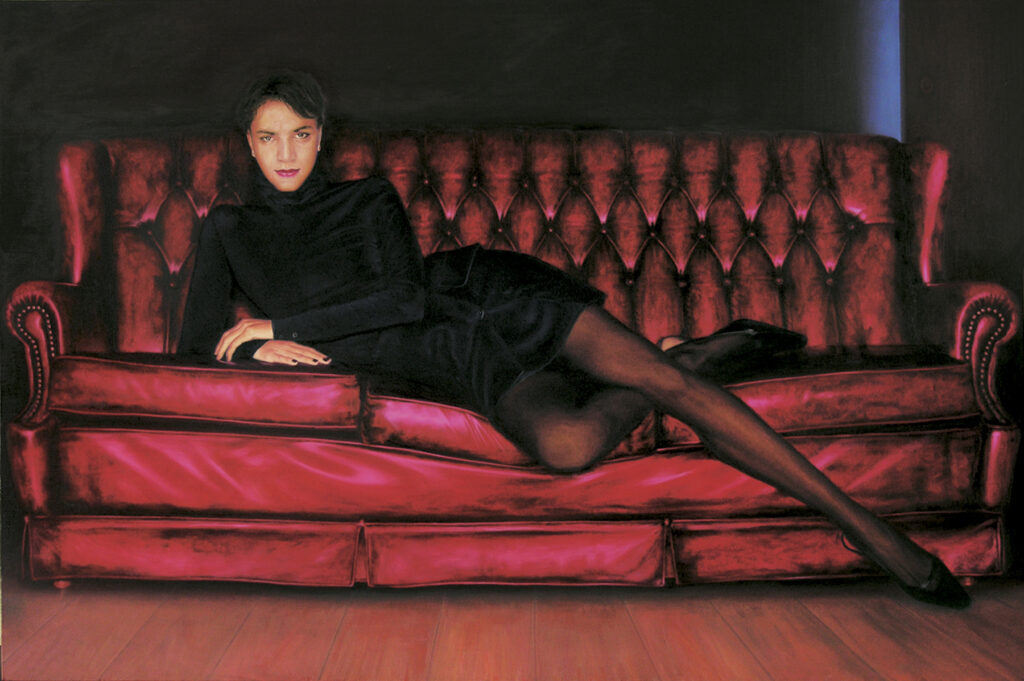
Karmakar grew up middle class in Kolkata. The closest he came to imagining a different existence was when he browsed design and interior magazines with images of glossy furniture and rooms with muted lighting. When he came to Baroda to pursue art, his new friends talked about settling in the West, aspiring to lead more glamorous lives measured in the currency of elsewhere. ‘That became the parameter,’ he tells me. So he painted himself as someone who had already reached foreign shores. He painted himself sprawled on a red tufted couch, inspired by the aesthetics of the aspirational magazines he had once flipped through in his Kolkata home. Sometimes, he painted himself in drag. He was constructing and playing characters who occupied spaces he had not been invited to.
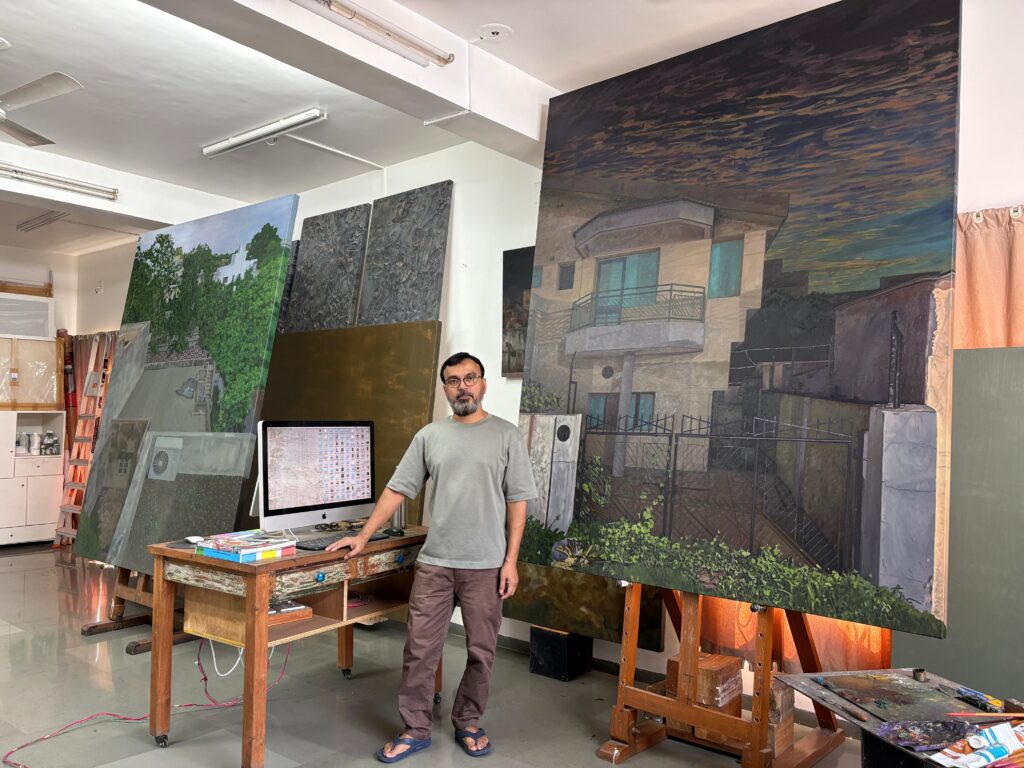
This was also the era when urban Indian men were being granted, cautiously, the permission to explore ‘metrosexuality’, through self-indulgent grooming rituals that had earlier been regarded as ‘too feminine’ or ‘gay’. Shah Rukh Khan soaked in rose petals in a popular soap advertisement and salon procedures became popular among men. Suddenly, the male body was permitted certain vanities and expressions of softness that had previously been frowned upon. Karmakar was watching all of it — and even if he didn’t have the correct terminology for it yet, he understood that identity, for a certain class of people in India, was becoming something that could be constructed and reinvented at will. Identity did not need to be something that was inherited, tied to a surname or gender, but could be created. It was a revolutionary idea for him at the time.
His series, From My Photo Album, began in 2004 and was read almost immediately as queer commentary on gender fluidity, and non-normative desire. This wasn’t entirely misplaced. But Karmakar was doing something more deceptive and mischievous than just that. ‘The whole idea was to mislead the viewer,’ he tells me, with quiet satisfaction. ‘It was a game. Something to disturb the viewer’s notions around sexuality and gender constructs.’ In one painting from the series, two figures make a bed together. Both figures are of Karmakar, but one of them is a stand-in for his wife, who was, at the time, in Kolkata while he was alone in Baroda missing the domesticity of married life. The bed sheet in the painting resembles a banana peel. On the wall hangs Aleksandr Deineka’s Future Pilots (1938), which depicted nude male bodies in heroic proximity, alongside photographs of Karmakar’s hostel friends. The elements of the composition shouldn’t cohere. But they do.
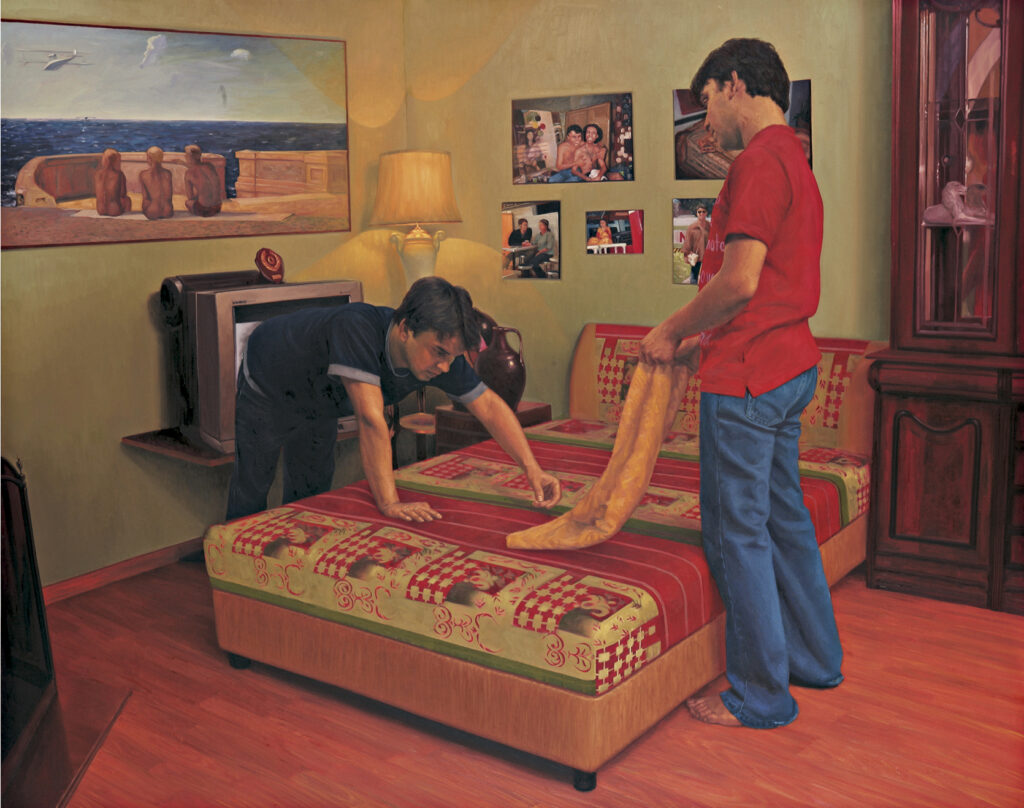
‘All these things from different contexts, put together, starts a different story,’ says Karmakar. He pauses, rubs his stubble. ‘I used to live with eight boys in two rooms in Kolkata. I could roam around naked — that was considered normal. But if you have a different context, the same behaviour can be viewed in a very different light.’ Context, he explains, is not the backdrop in his work. Context is what his work is about.
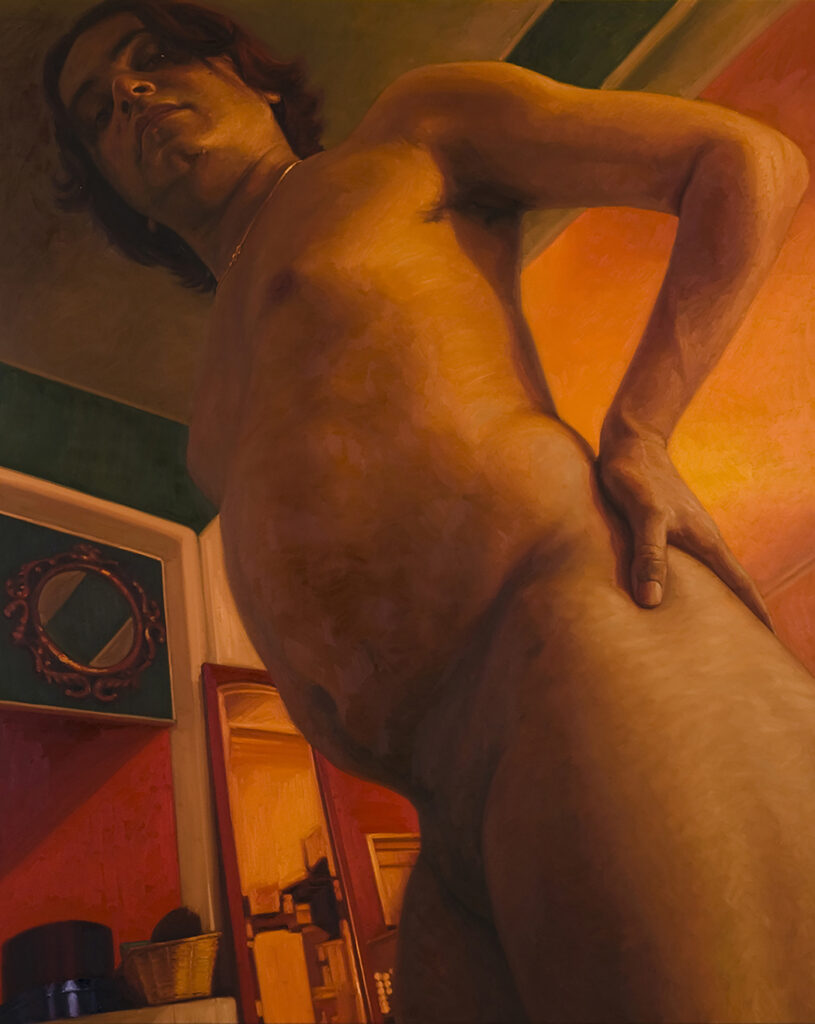
By 2007, Karmakar was preparing for his first major solo show in London, In the Old Fashioned Way, which he wanted to preview in Baroda. His paintings had grown enormous. Male nudes seven, eight, nine feet tall, the figures looking directly at the viewer with an insistence that felt almost confrontational. ‘This is what I am. Look.’
That same year, a 23-year-old Srilamanthula Chandramohan was arrested during the final year masters display at MS University in Baroda. His crime was incorporating Hindu and Christian religious icons into his printmaking work. As a senior student, he had felt relatively protected within the university space. That is until right-wing groups descended on the campus, and the university decided to suspend him. Karmakar, 30 years old at that time, was on the brink of making a niche for himself in the art world. In the aftermath of Chandramohan’s arrest, he reconsidered his plan to preview In the Old Fashioned Way in Baroda before the London show. It was better to be safe than sorry.
‘Misinterpretation is beyond an artist’s control,’ he says, explaining his 2007 decision. He had realised that despite curatorial notes, artist statements and wall texts, an artwork’s meaning is never just about what an artist intends. It is reinvented again and again, in different rooms, and in front of different audiences. Its reception depends on perception, shaped by the political climate, moral and societal codes around the body, and the moment of looking.
In the work that followed, Karmakar moved away from depictions of the body and toward the spaces that contain it. In a fairly recent solo show, Passage (2023), all that is on view are empty rooms. Two adjoining domestic spaces are painted on shaped canvases — one with a green metal wardrobe, the mirrored door ajar, with a Hindu calendar on the mint green wall; the other has a ‘Sacred Heart’ print on faded pink plaster above the water stains creeping up from the floor, and just below an unused air conditioner with a thin layer of dust.
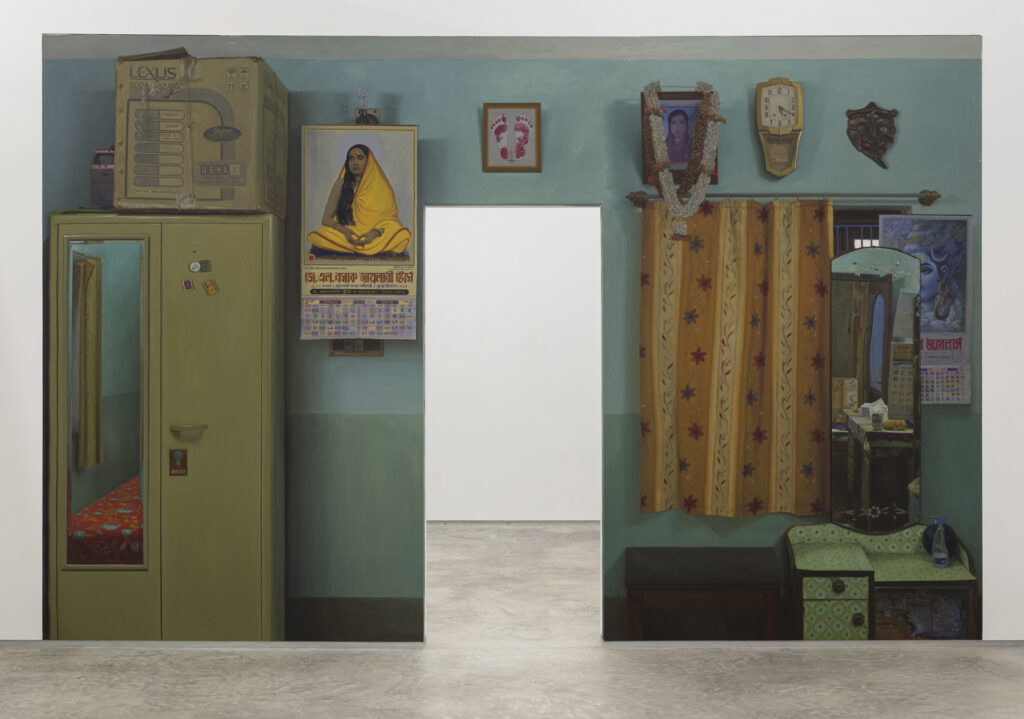
Small details are painted with exquisite care — the threads in the curtain fabric, the faint shadow that frames the sagging electrical wires. The rooms are so precisely observed that you feel like you know its inhabitants — the neighborhood they live in, their habits and domestic rituals, their income and socio-economic class. And yet, no one is home. Clothes hang in the wardrobe. The bed has been slept in. The mirror reflects the empty space where someone stood, recently, before leaving or being made to leave.
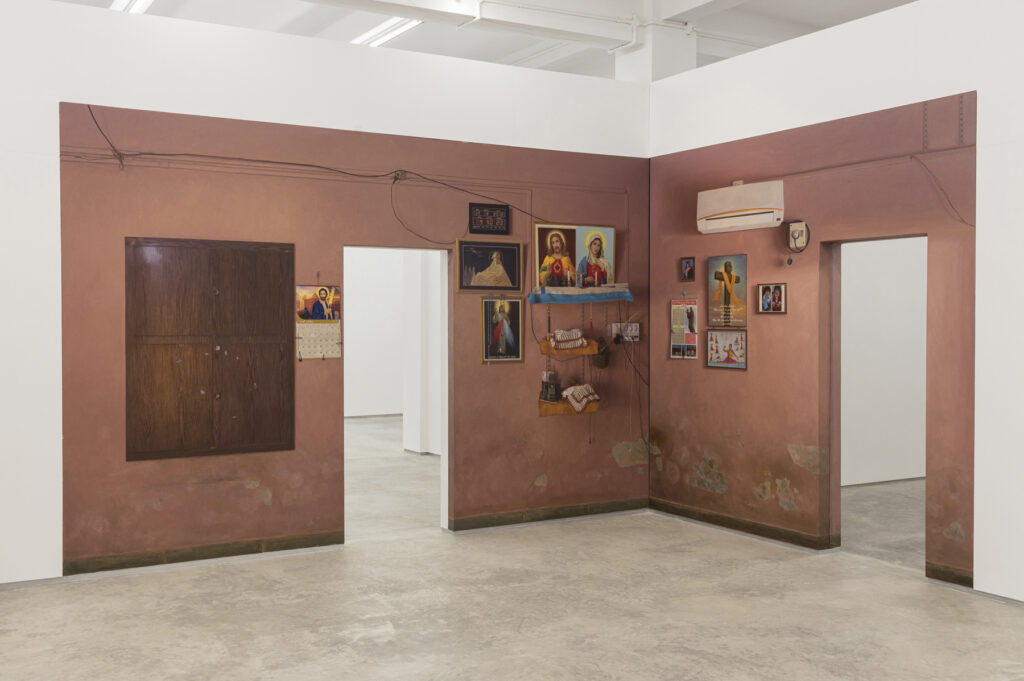
Why, after twenty years of painting the body, would Karmakar choose to remove it entirely from view? ‘Through my paintings, I exaggerate identity, and interrogate the prevalent discomfort around “the Other”,’ Karmakar says. The empty rooms do not resolve that discomfort. They intensify it. Absence becomes symbolic of the body that was pushed out or that chose to hide; the body that found it safer to disappear than to be seen on someone else’s terms. In a country where visibility can be a provocation, the empty room refuses capture. It makes you search for an occupant you will not find. The composition implicates you as the oppressor, the observer within the panopticon that the marginalised body has managed to evade.
Bal: Landscapes Where Ecology Meets Desire
Alok Bal grew up in Rourkela, a steel town in Odisha, industrial but green at the edges — the kind of place where the landscape holds you even as it endures slow ecological degradation. Coming to Baroda was a cultural shock — ‘from green to grey.’ His early work tried to make sense of the city — the concrete, the crowds, the experiences of being a stranger in a strange land. Then, the pandemic swept into town and locked everything down. In the stillness that followed, something shifted. ‘Everything seemed at ease,’ he tells me. ‘Me also. Except for one thing.’ He means the daily death toll that climbed higher and higher and did nothing to interrupt the silence on the streets or the flow of time. Bodies piled up in crematoriums and cemeteries as the days under lockdown turned into weeks, then months. In Bal’s work, the figures started floating.
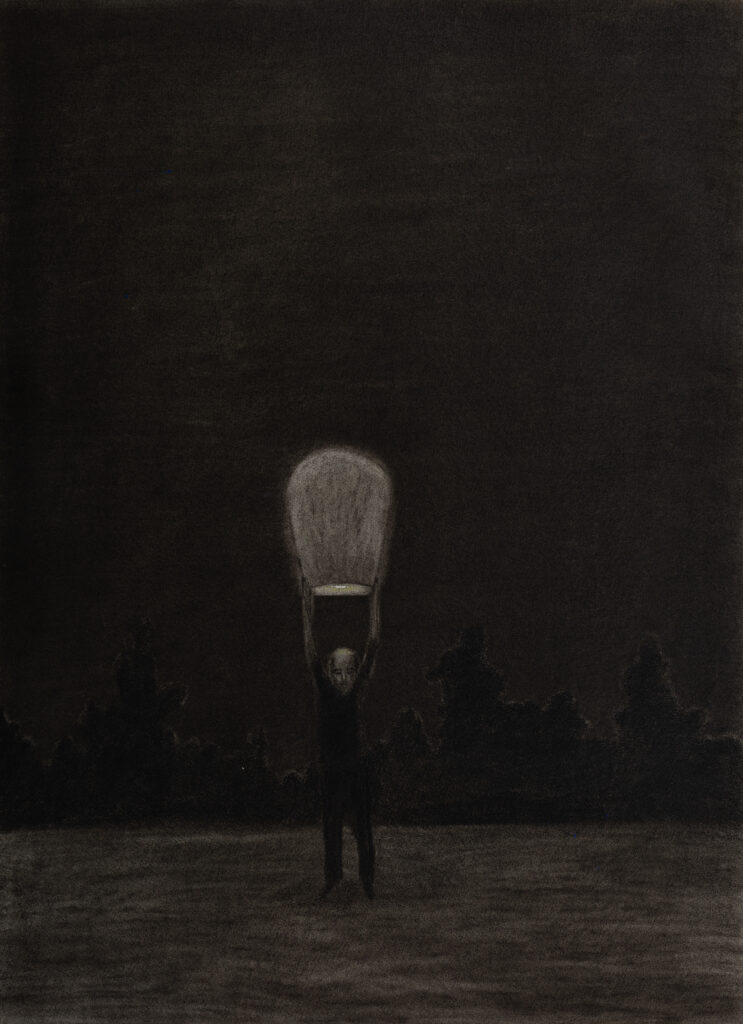
Lantern (2020), one of his charcoal drawings from this period, depicts a figure trying to lift off. He clings to an object, most likely a paper lantern that is now drifting downwards. It may have been useful once but has turned into dead weight. In the sketch, Bal speaks to that moment when liberation and terror intertwine.
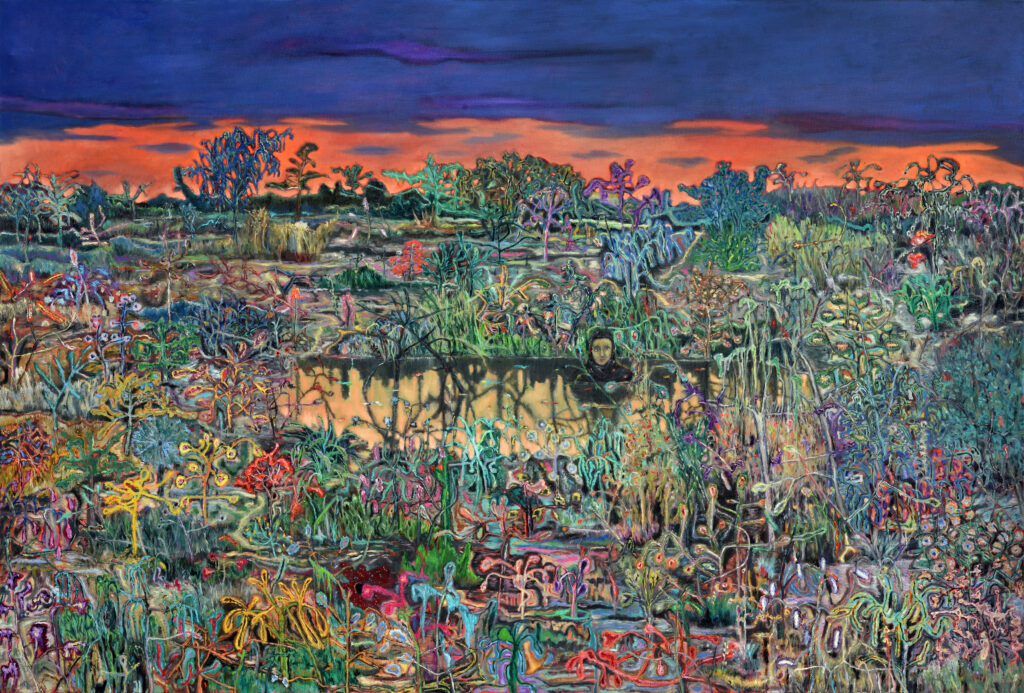
Bal’s paintings are layered — paints and a multiplicity of meanings overlap and drip at the edges. In Daughter (2020-2021), the greens look lush and inviting. But it is only when you look closer that you realise it is, as Bal puts it, ‘a very painful landscape.’ It thrums with a multitude of fears — of losing one’s homeland, of habitats becoming battlefields, of being forced to conform and drowning the Self to do so. The facade of loveliness is not incidental. It is a trap. It is only after you have been pulled in that you confront the hidden ugliness. The utopic dream advertised recedes to reveal the dystopic nightmare that is reality.
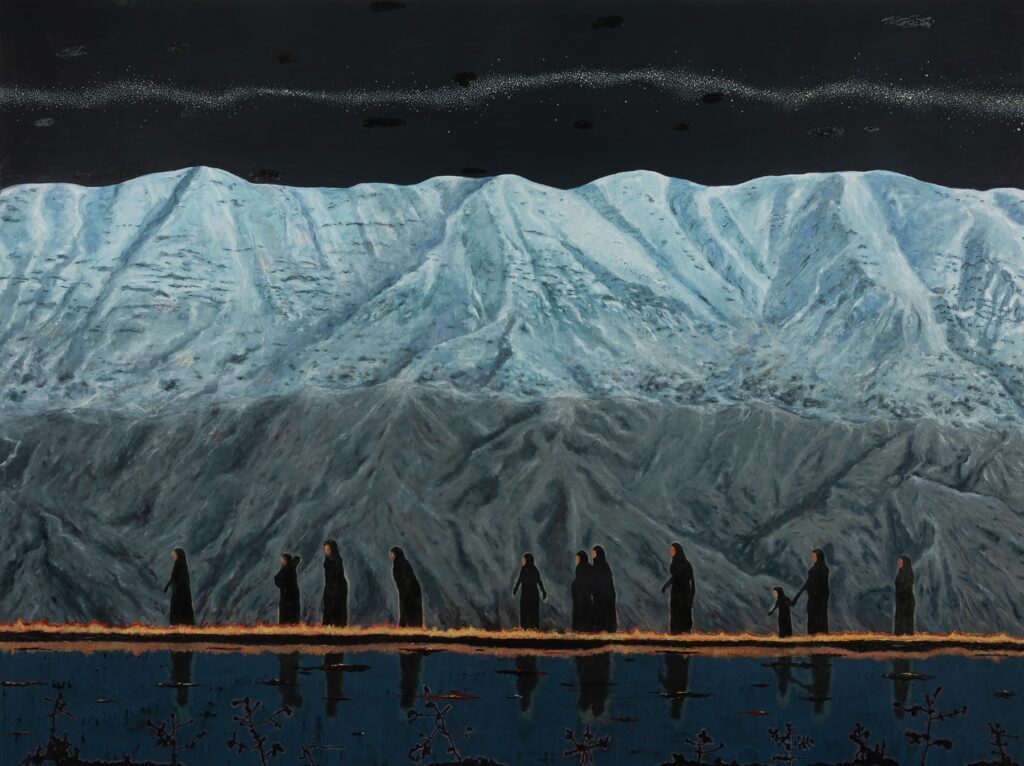
Fire Walkers, completed in 2024, was made after Mahsa Amini was killed in Iranian police custody in 2022. At the time, women had taken to the streets to protest — burning their headscarves and cutting their hair in anger against the state policing their bodies. Bal’s painting shows figures moving through a landscape of fire and earth, their limbs extended, airborne but not free, suspended, as he puts it, ‘between freedom and captivity.’ The colors are extraordinary, warm and almost festive.
What Bal’s landscapes insist on is that ecological collapse or political violence is intrinsically linked to the disruption of what is personal, and intimate to us. The figures in Bal’s paintings seek freedom, but they still float above poisoned fields, or in polluted waters, over contested territories rife with violence, and cities, grey and dreary. So to float is not really an escape, just a desperate attempt to stay afloat.
The Politics of Looking
There is an unwritten disclaimer that hangs in Indian public art galleries against ‘artworks that could hurt religious sentiments.‘ It is never printed on any surface. It is never that explicit. But in a country, home to diverse communities, what is ‘offensive’ is often subjective. The Indian notion of secular ‘tolerance’ rests on self-censorship — on steering clear of what may offend vocal groups who claim to represent their communities. Any artwork that ventures into the territory of the bared body, or transgressive acts, political and personal, runs the risk of triggering moral panic, the consequences of which are rarely abstract.
‘When someone dies,’ Bal says, ‘it becomes just a body. It never thinks, it never talks. So by not thinking, by not speaking, one becomes just like a corpse.’ Artistic rigor mortis sets in the moment the cost of expression becomes too high to bear, when uncomfortable edges get sanded down, flattened, to guarantee safety. He describes the current regime as ‘suffocating’, not dramatically, but plainly, in the way people describe the weather.
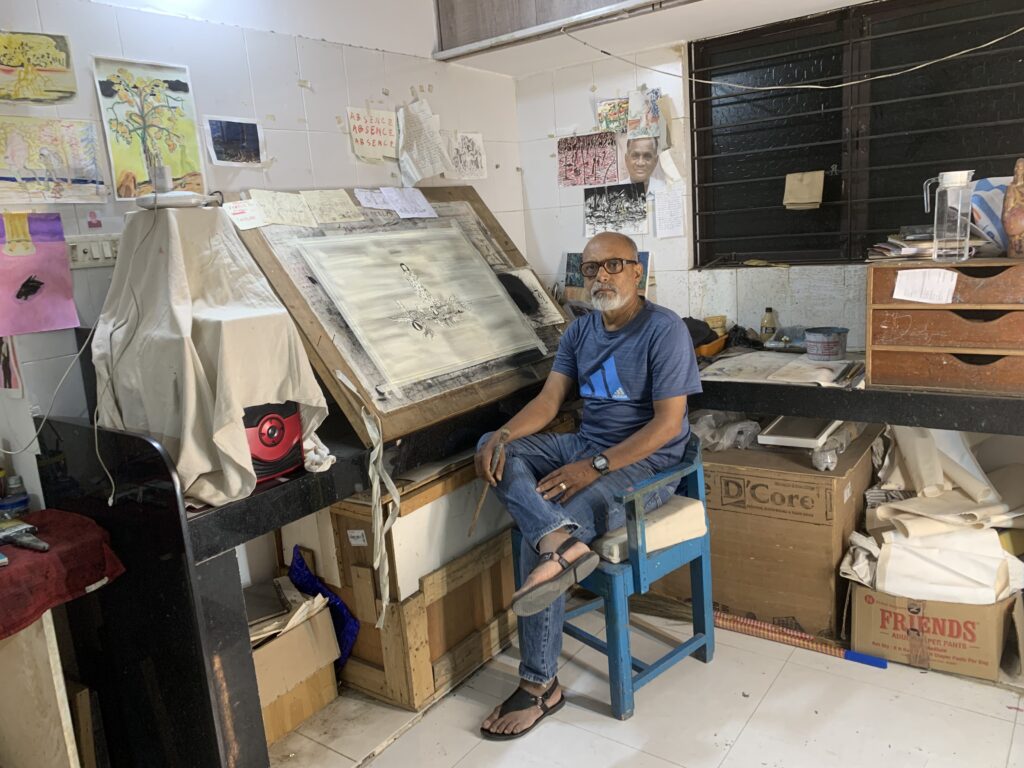
‘The system can easily control a mass of people,’ he continues. ‘Because a mob never has a mind of its own. But an individual thinks. Questions. Rebels.’ This is why, he argues, an independent artist’s practice is inherently disruptive, even if it connects with a very niche audience.
Both painters carry the knowledge that what can be made in a studio is not always what can be safely shown. ‘If you raise certain questions through your art, or display nude images in public galleries in India,’ Bal says, ‘it’s very unsafe.’ He isn’t speaking hypothetically. The record is recent and specific — in December 2023, the Kochi Biennale faced demands to remove nude works. In 2022, Delhi Police pulled a film for ‘obscene’ content. In 2006, MF Husain left the country, never to return, because his portrayal of a nude Bharat Mata made him an easy target. And, just a year later, in 2007, Chandramohan would get suspended from MS University Baroda for using religious iconography in his printmaking.
Suppression in the modern nation-state of India — which has never seriously tried to dismantle the colonial legacies of control — has always been an issue. But, it has taken an even more virulent turn in recent years, with the rollbacks of key legislation protecting LGBTQ+ rights and the unprecedented pushback against all forms of democratic protest and dissent.
And yet, neither Karmakar or Bal will describe their work as a form of resistance. Karmakar is almost firm about it. ‘My work is not about resistance. Rather, my paintings are about the psychological documentation of our society.’ He is skeptical of his art being the catalyst of any real form of activism because it reaches too few people. What it does do, however, is document; record the psychological temperature of moments as they pass into history and create the conditions for asking questions.
Bal puts it differently but arrives at the same place: ‘As an artist, with any creative act, I am asking questions — socially, politically. It finds expression in my paintings too. It’s an intellectual process. Dialogue is necessary.’ Neither man wants to be the artist who tells you what to think. But both want to make work that makes thinking harder to avoid.
Karmakar is unsentimental about the limited role his art can play. He has already learnt how a painting could invite violence in one context but also be perfectly acceptable in another. He understands that context can be a form of protection. His site-specific installations are calibrated, not just for meaning, but for survival — the right space, the right audience, the right moment. But even within these protected circles, the work matters as evidence. Evidence that certain bodies and certain desires exist and have always existed and they refuse to be made ‘unspeakable’.
Bodies That Refuse
‘The whole thing is a construction,’ Karmakar says. He may have painted himself naked and cornered, yes. But, he is also the one holding the brush, deciding the angle, choosing what to reveal and what to withhold. The vulnerability and the control coexist. Both are true at once, and the painting’s power comes from refusing to separate them.
Bal’s Fire Walkers too leaves a visceral impact on the viewer. The figures above the mountain landscape are shown mid-step, neither ascending nor descending, caught in the moment of protest before change.
Taken together, the artistic trajectories of both Karmakar and Bal embody a stand in relation to an impossible situation. Not resistance, exactly, but something akin to a refusal. The refusal to alter their politics, to step away from their self-assigned task of documenting that which causes unease. The refusal to accept terms handed to them by a hostile environment. The refusal to stop looking for loopholes, and perfecting their evasive manoeuvres.
The empty room holds the shape of the body that left it. The suspended figure grips what it cannot put down. The cornered man presses his face to the wall but does not disappear. The beautiful landscape conceals its own grief. None of these are images of defeat. They are images of people deciding, under pressure, what they will and will not give up.
In an India where queer bodies, minority bodies, bodies that desire outside the permitted categories are increasingly subject to surveillance and erasure, this refusal to be made invisible is not a revolutionary act. Rather, it is a record — painted, exhibited, witnessed — that certain bodies existed and refused to be silenced.
‘I witness,’ Bal says. ‘I try to document everything in my capacity — social, political, ecological changes happening around me and in the world.’ He says it without drama, like it is a way of being and living, rather than an artist’s statement. Both he and Karmarkar are adept at opening up lines of inquiry. In doing so, they open up a space where questions are still possible. For other bodies. Other kinds of refusals. Other ways of being.
And that, in the end, is enough.
First published: July 1, 2026