-
ChicagoKhatri, Kratika. "Setting the Table: Dining Rituals of the Mughal ‘Mirza’." Impart Perspectives, September 22, 2026. https://imp-art.org/perspectives/features/setting-the-table-dining-rituals-of-the-mughal-mirza/
-
MLAKhatri, Kratika. "Setting the Table: Dining Rituals of the Mughal ‘Mirza’." Impart Perspectives, Sep. 22, 2026, https://imp-art.org/perspectives/features/setting-the-table-dining-rituals-of-the-mughal-mirza/. Accessed 15 Oct 2026.
-
HarvardKhatri, K. (2026) Setting the Table: Dining Rituals of the Mughal ‘Mirza’, Impart Perspectives. Available at: https://imp-art.org/perspectives/features/setting-the-table-dining-rituals-of-the-mughal-mirza/ (Accessed: 15 October 2026).
Setting the Table: Dining Rituals of the Mughal ‘Mirza’
Food and dining practices played a central role in Mughal courtly culture, providing a way for the 'true' Mughal gentleman to advance socially and distinguish himself from the merely wealthy.
By Kratika Khatri
Link copied!
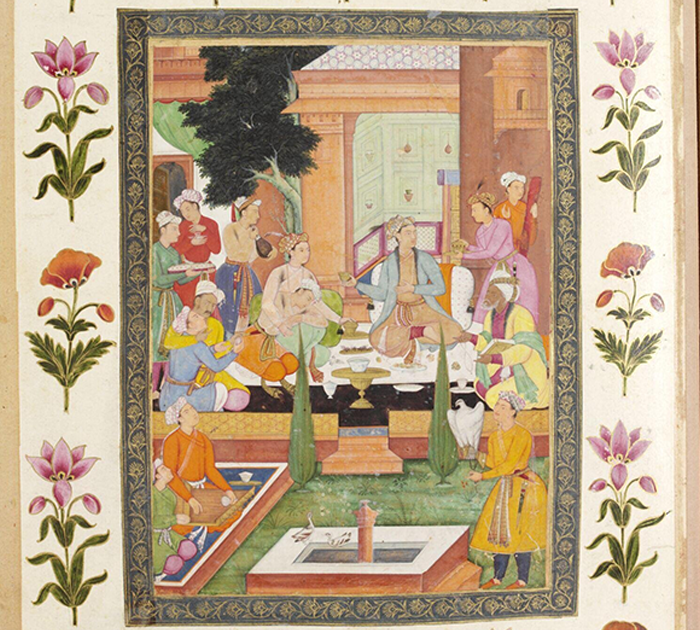
A princely feast at a mehfil; Mughal, India; 1615–1620; Opaque watercolour and gold on paper. Courtesy Victoria and Albert Museum
The Mughal court — established by Babur, consolidated under Humayun and Akbar, and refined by Jahangir and Shah Jahan — was one of the most structured courts of its time. Protocols, codes of conduct, and courtly etiquette defined every aspect of its functioning. The practices and culture of the Mughal court spread across the subcontinent, setting the template for “civilised” behaviour in elite society. But who really counted as a nobleman or a gentleman (mirza) within this system? Part of the answer lies in one word — dimagh. Referring primarily to the brain in Persian, dimagh was also used to speak of one’s palate and nose, the two principal faculties of taste and smell. This did result in some odd practices. In her book, Feasts and Fasts: A History of Food in India (2014), Colleen Taylor Sen states that during Akbar’s reign, palace chickens were fed pellets flavoured with saffron and rosewater, and massaged daily with musk oil and sandalwood — presumably to make them smell as good as they tasted. The anecdote shows just how seriously the Mughal emperor and his courtiers took the pursuit of “being a gentleman” (mizāī).
The use of fragrant substances in food and in dining spaces was regarded as the correct behaviour of a sophisticated and spiritually-refined man, a practice as much for the soul as for the body. Cultural codes around what one ate or drank defined one’s social status and standing at the court. Gluttony was frowned upon and belching was seen as “worse and more unpleasant to the mind than the smell of gunpowder”, according to one Mughal manual about how to be a mirza. In her essay, The Perfumed Palate: Olfactory Practices of Food Consumption at the Mughal Court (2023), historian Neha Vermani observes that “Mughal elite engaged critically with the sensory dimensions of food they consumed, and this skill was posited as the signifier of intellect and refined comportment.” This was how ‘true’ noblemen distinguished themselves from the merely wealthy and claimed cultural superiority over merchants and traders who did not possess their refined tastes and sophisticated palates.
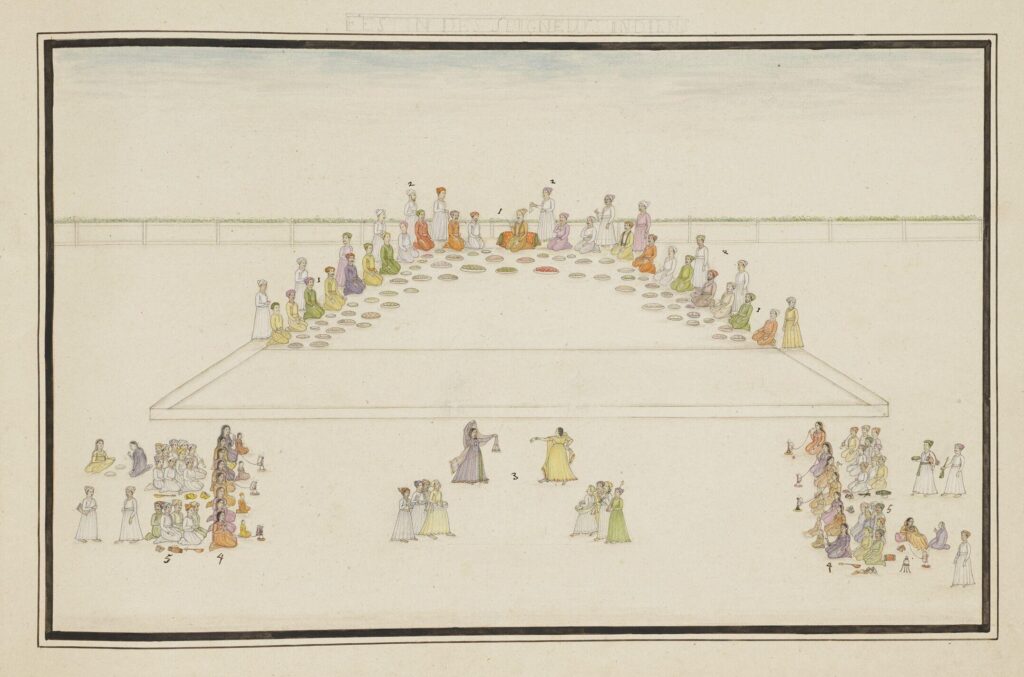
Food, as Roland Barthes put it, is never simply about sustenance. It is, in his words, “a system of communication, a body of images, a protocol of usages, situations and behaviours.” At the Mughal court, the image, protocol, and behaviours drew on three overlapping discourses — of ethics, of the body, and of smell and taste. Dimagh was where they synchronised to help fashion the perfect gentleman. Those aspiring to be a mirza had to be shaped by ‘ilm al-akhlaq (the knowledge and science of ‘virtue ethics’) to become the best version of themselves. To do so, Mughal noblemen would commission, circulate and study manuals called Mirzanamas on codes of conduct along with guides on morality, ethics, medicinal systems, and culinary knowledge. This resulted in a codified lexicon for what it took to be accepted into the elite circles of Mughal society.
The Making of the ‘Empire-Household-Man’
Mughal noblemen drew on the discourse presented by the thirteenth century polymath, Nashir al-Din Tusi, wherein the ‘civilised’ or ‘complete’ man was expected to fit into the “homologous scheme of empire-household-man”, according to Vermani. This demand for ethical self-refining also came with the requirement to follow medical directions about the best diet. To be the ideal man, one had to exercise rationality and cultivate wisdom through the knowledge of the body’s humoral disposition to determine what to eat and how much. A disciplined eater, who could control his appetites through his intellect, was seen as much more likely to be successful in fulfilling his duties to the empire and his household.
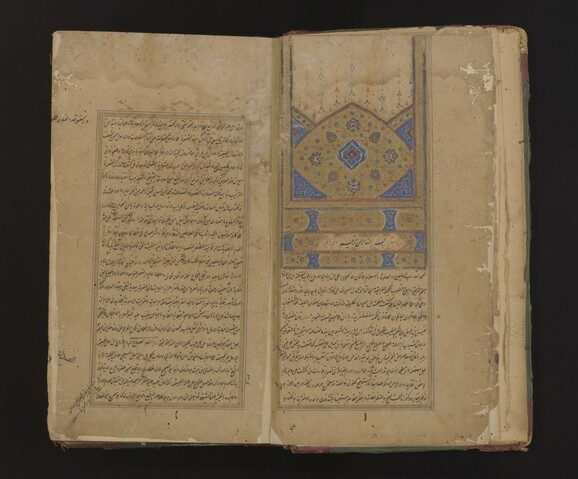
This discourse is referenced by Abul Fazal in his monumental work documenting the reign of Akbar, Ain-i-Akbari. Throughout the text, Fazal deliberately and carefully casts Akbar as the ideal gentleman with self-control around food. Fazal writes, “In the course of twenty-four hours, his Majesty eats but once, and leaves off before he is fully satisfied…” He exalts Akbar’s restraint as an act of disciplined asceticism. Respecting the dietary restrictions around meat in Hindu and Jain communities, Akbar would also shape the rules around ethical consumption of meat by issuing numerous farmans (edicts) banning or restricting animal slaughter on specific days, festivals and at particular religious sites. Jahangir too followed in his father’s footsteps calling for a ban on the slaughter of animals “for a period equal to the years of my life” every year, in addition to the prohibition on killing animals for food on Thursdays and Sundays. He also issued an imperial decree prohibiting the killing of animals during the Jain festival of Paryushana.
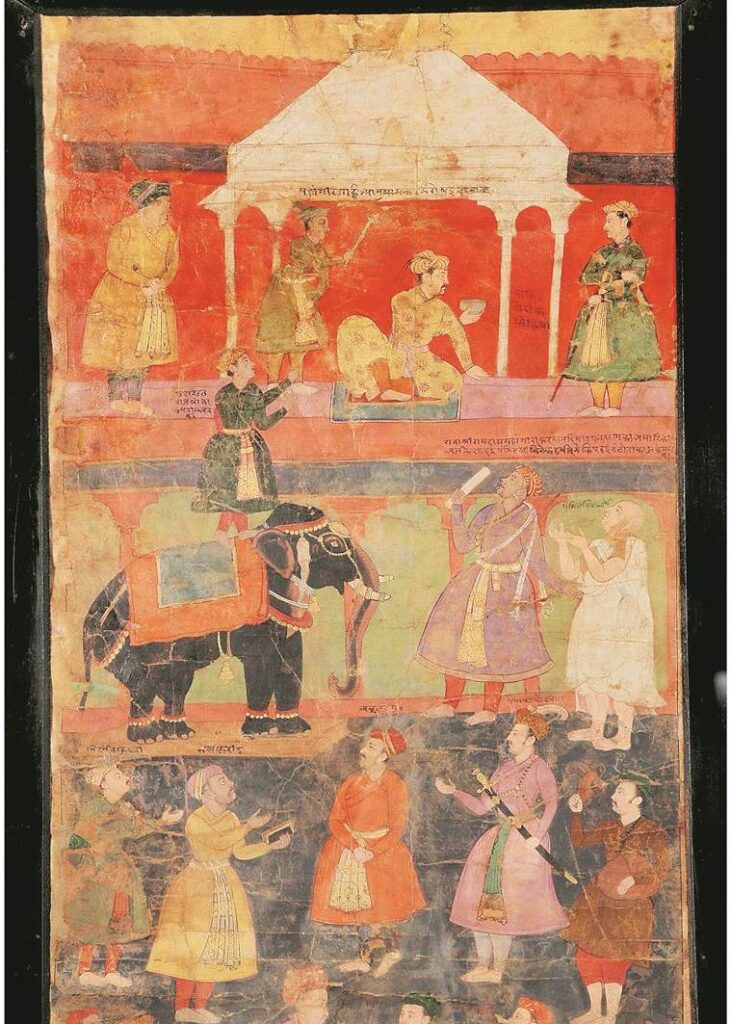
At the Mughal court, the rituals of cooking and serving fragrant dishes continued this discourse of ethical consumption of food. Yunani Tibb, the Greco-Arabic system of medicine and health shared across the Mughal, Safavid, and Ottoman courts, played a prominent part in what a gentleman was supposed to eat. The medical system conceived the body in terms of four “humours”, each tied to a natural element and a temperament. Fire produced a hot, dry, choleric disposition; water, a cold, moist, phlegmatic one; and so on. These elements could be regulated through gustatory and olfactory instruments, and diet was the primary way of creating the ideal balance of humours. The proportion of these temperaments decided one’s state of body and mind; an equitable ratio constituted a balanced and healthy state, whereas any excess led to disease and instability. Hence, formulating accurate recipes adapting to the consumer’s bodily composition was of utmost importance; and so, physicians skilled in the science of the body were often employed as superintendents of the kitchen department. They carefully developed recipes that were perfectly balanced in temperament and flavour. Catalogued manuals and cookbooks perfected by court physicians, such as Fawā’id al insān (1590) and the seventeenth-century Ilājāt -i Dārā Shukūhī, as well as commentaries on renowned Yunani medicine texts like Sharh al-Asbab wa al-‘Alamat (1437), were consulted in elite households while preparing menus.
For knowledge of the body was political too. Fazal notes Akbar’s personal involvement in matters of the imperial kitchen, commending his knowledge of food and the body that his instructions to the staff revealed. As Fazal puts it, it is this knowledge that distinguishes a man from a beast. Such writing cast Akbar as an exemplary example of the empire-household-man.
Food and Feasting in Court Politics
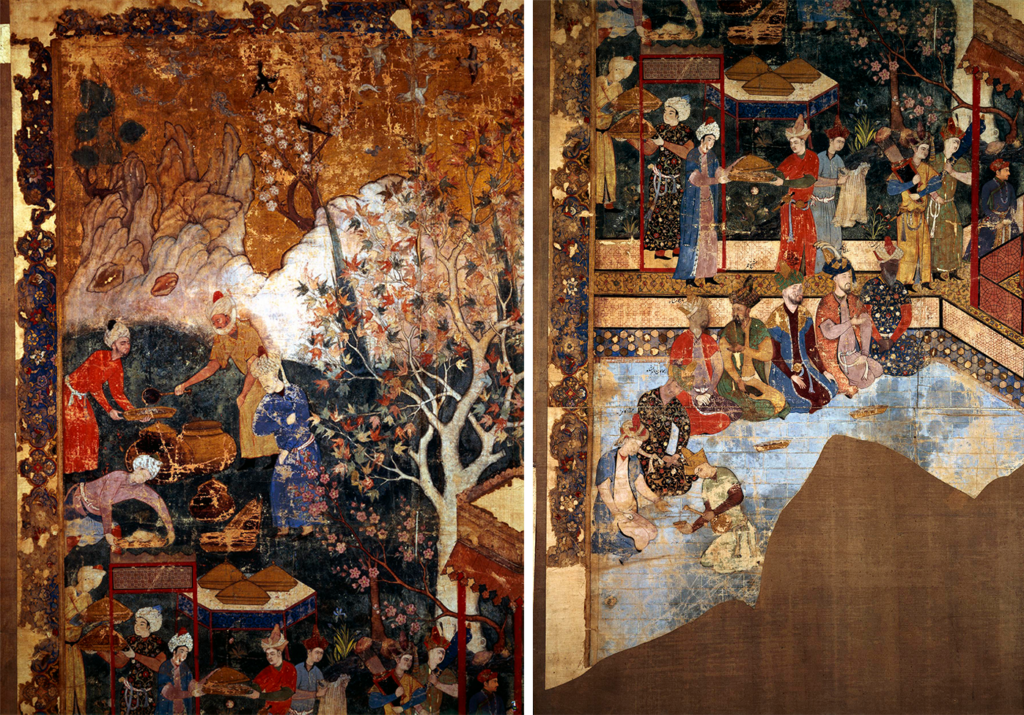
The exchange of gifts, almsgiving, public or diplomatic feasts, and proper etiquette around donating or gifting food also held weight as practices of self-refinement within the empire-household-man model. A painting in the Akbarnama documenting the 1562 visit of the Iranian ambassador, Sayyid Beg, illustrates how the exchange of food items and dining practices in the presence of honoured guests were complex and political rituals. Fazal reports in his written account, the list of gifts sent by Shah Tahmasp I, “fiery Arab coursers…swift steeds…delicate cloths…and wonderful curiosities”, but the painting reveals much more. Spread across two folios, it depicts a diplomatic dialogue and mediation of power facilitated through the gifts received by Akbar and the feast presented to the ambassador as a gesture of goodwill and friendship.
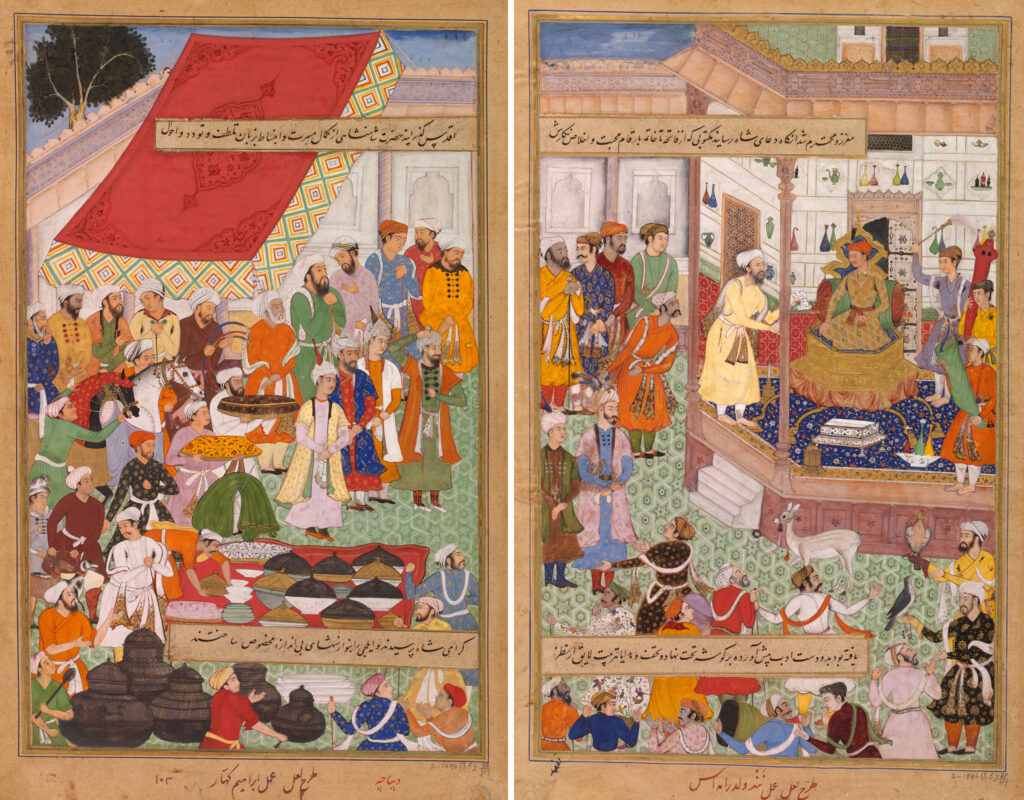
Inclusion of sweet-tasting food such as exotic fruits and sugar were important in both Timurid and Mughal Indian traditions. Especially as parting gifts, they were representative of goodwill, friendship, and sometimes apology for any real or perceived shortcomings. In contrast, an elaborately stuffed betel leaf could have a medley of meanings — it could be offered as a royal favour or to hasten the departure of an unwelcome guest. But because it was seen as a ‘gift of honour’, like the khil’at (robe of honour), the host risked the recipient’s refusal — a clear sign of insubordination or rejection. Therefore, paan and its accoutrements were only offered if and when the hierarchies of power at play were already known and the chance of refusal was next to none.
Taste, too, was political as it marked real social distinction. Under Humayun and Akbar, exhibiting good taste became a way to distinguish oneself at court and advance socially. By Jahangir’s reign, the discourse had become fully self-aware; here the emperor himself was the grandmaster of taste and the ultimate gourmand. In his autobiography, the Tuzuk-e-Jahangiri (Jahangirnama), Jahangir dissects the sensory aspects of what he ate. Detecting the faintest variations, he writes with great sensuality about his food and drink, especially Kabul grapes, mangoes, and wine. However, this too was not void of intellect. The pursuit of true, ethical pleasure at the Mughal court meant a measured and mindful engagement with the senses. In the elaborate discourses around food, ethics provided grounds for civility and self-refinement; the body was the site where the precise science of cultivating the self could be applied; and finally, good taste was the outcome — the evidence and visible social register of what had been achieved.
The rituals and discourse around ethical consumption of food and court writings cemented the Mughal emperor’s reputation as the supreme mirza. Therefore, he and, by extension, the imperial household set the bar on what constituted good taste, and courtiers and their households sought to reproduce these standards on the scale available to them. A seat at the imperial table was treasured not only because it gave courtiers legitimacy, signalling their closeness to the royal household, but also because they had front row seats to observe the ideal empire-household-man in action. Food, therefore, was an important component of Mughal kingship practices.
From the Kitchen to the Table
But who were the ones who crafted the Mughal dining experience?
A painting now housed at the British Museum presents the Princes of the House of Timur feasting in a garden pavilion. Painted by Mir Sayyid Ali, it essentially reaffirms the Timurid-Mongol genealogical legacy of the Mughals by placing figures who lived across generations together in one composition. However, when we shift our focus to the edges, we see the many kitchen attendants and cooks toiling away in the background as they prepare the banquet’s dishes, while food servers and cupbearers swarm the dining space, carrying dishes and drinks from the kitchen to the guests.
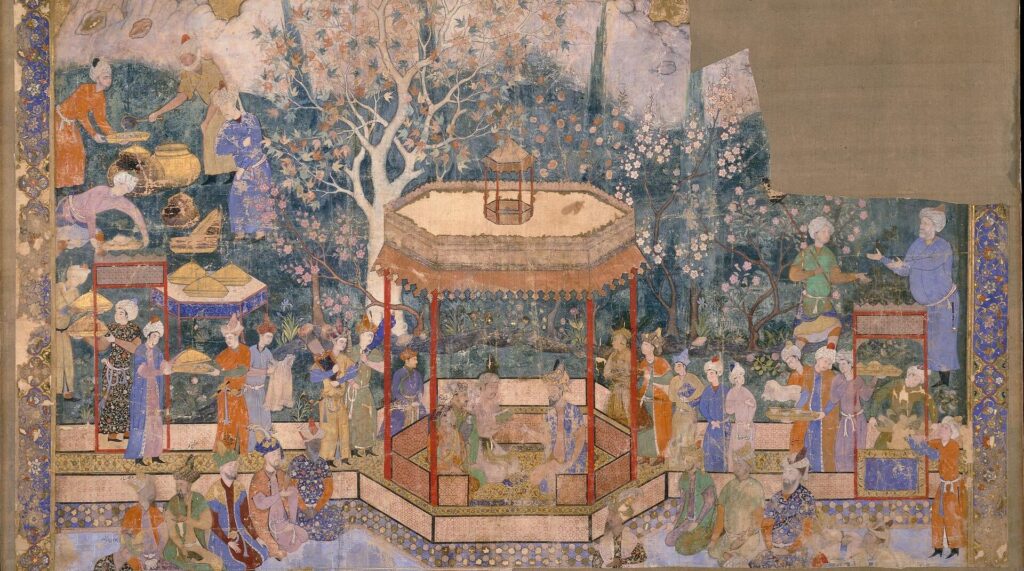
The imperial kitchens had a strict hierarchy — starting with the superintendent, titled “Mir Bakawal” (Master of the Kitchen), who was charged with the executive role of supervising the food department of the royal household, which included the harem where the emperor’s wives, concubines, and his women relatives lived with their servants and slaves. The Mir Bakawal was a mansabdar (high-ranking official) and part of the imperial bureaucracy. They were entitled to temporary land assignments (jagir) and salaries comparable to serving military officers. They also received a khil’at and a ceremonial knife on appointment.
As one of the most elite members of the royal household, they worked directly under the emperor-appointed prime minister. What qualified a man for the post was less skill than proven loyalty and a deep understanding of the science of the body. Given the ever-present anxiety about poisoning, the preference for inherited trust over open recruitment was the entire point of the system. He supervised the food preparation, perfected recipes, and even compiled cookbooks. An assistant to the superintendent was responsible for keeping a check of inventory and requirements for fresh produce, utensils, fuel, and estimating funds required for the department. The funding was formally processed by the treasurer, his assistant, and the superintendent.
A chief meal decker or sufrachi was responsible for setting up the dining space and supervising the serving process. He made sure the space, whether indoors or outdoors, was laid out perfectly, which included the use of fragrances. It was also the sufrachi’s job to make sure the emperor was served correctly and to note his responses so that subsequent adjustments could be made to the dishes or menus, depending on his tastes. Led by the sufrachi and superintendent, was an entourage of men who carried the food from the kitchen to the emperor’s dining area.
An elaborate process for tasting (and poison checks) was instituted to ensure that the food the emperor ate was wholesome, delectable and balanced. Once a dish was ready, it was checked by the cooks themselves, then the junior Bakawal, and finally the Mir Bakawal. The food then left the kitchen, but only after it had been sealed and coded using cloths in specific colours and counted to ensure no tampering was possible. The dishes were once again tabulated at the dining hall and the seals were opened by the superintendent. This elaborate system was formulated out of the ever-present fear of contamination and threat to the emperor. Inside the kitchen, cleanliness and security were non-negotiable.
In her essay on domestic labour in precolonial India, historian Shireen Moosvi states that according to her calculations based on data from the A’in-i Akbari and other textual sources, over 22 per cent of the funds set aside for use by the royal household was spent on “personal services” in 1595 during the reign of Akbar. The nobility, following their emperor’s lead, spent over 20 per cent of their income paying domestic staff. Even the common cavalrymen, who had to maintain and keep their horses healthy and well-fed from their own salaries, would keep aside about 14 per cent of their earnings to pay the house help. Moosvi concludes that, unsurprisingly, domestic servants constituted a large part of the population of the Mughal court.
Within the emperor’s ‘ideal’ household, the imperial kitchen employed the biggest retinue of servants and imperial officers for smooth operations, and spent the most on ingredients. Next on the rung were elite courtiers who enacted a medieval version of ‘keeping up with the Joneses’ among themselves as they tried to emulate the emperor. Thus, being a mirza also meant having the funds to bankroll the lifestyle of one, while domestic labour was the necessary, albeit rarely acknowledged, metaphorical spine of the empire-household-man.
First published: September 22, 2026