-
ChicagoSihag, Yashvardhan S. "How Mughal Fashion Blended Statecraft and Style." Impart Perspectives, May 8, 2026. https://imp-art.org/perspectives/features/how-mughal-fashion-blended-statecraft-and-style/
-
MLASihag, Yashvardhan S. "How Mughal Fashion Blended Statecraft and Style." Impart Perspectives, May 8, 2026, https://imp-art.org/perspectives/features/how-mughal-fashion-blended-statecraft-and-style/. Accessed 15 Oct 2026.
-
HarvardSihag, Y.S. (2026) How Mughal Fashion Blended Statecraft and Style, Impart Perspectives. Available at: https://imp-art.org/perspectives/features/how-mughal-fashion-blended-statecraft-and-style/ (Accessed: 15 October 2026).
How Mughal Fashion Blended Statecraft and Style
The silhouettes and embellishments on garments, such as the 'anarkali' and 'angarkha', carry the imprint of pluralistic Mughal courtly styles from a time when politics in the Indian subcontinent favoured syncretism over division.
By Yashvardhan S Sihag
Link copied!
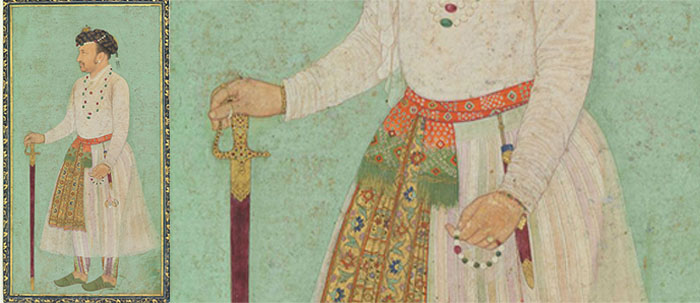
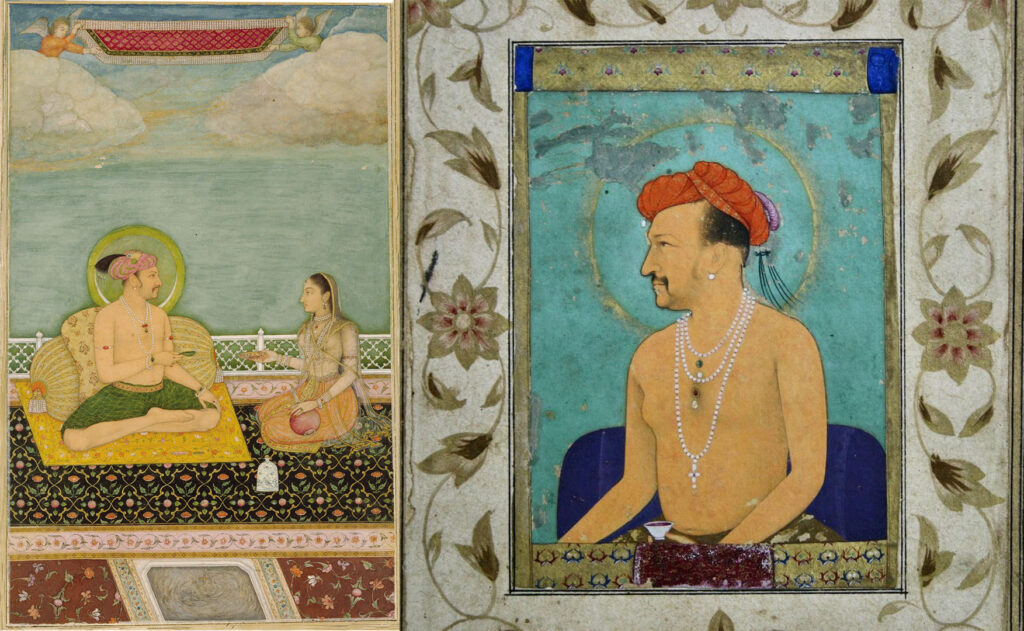
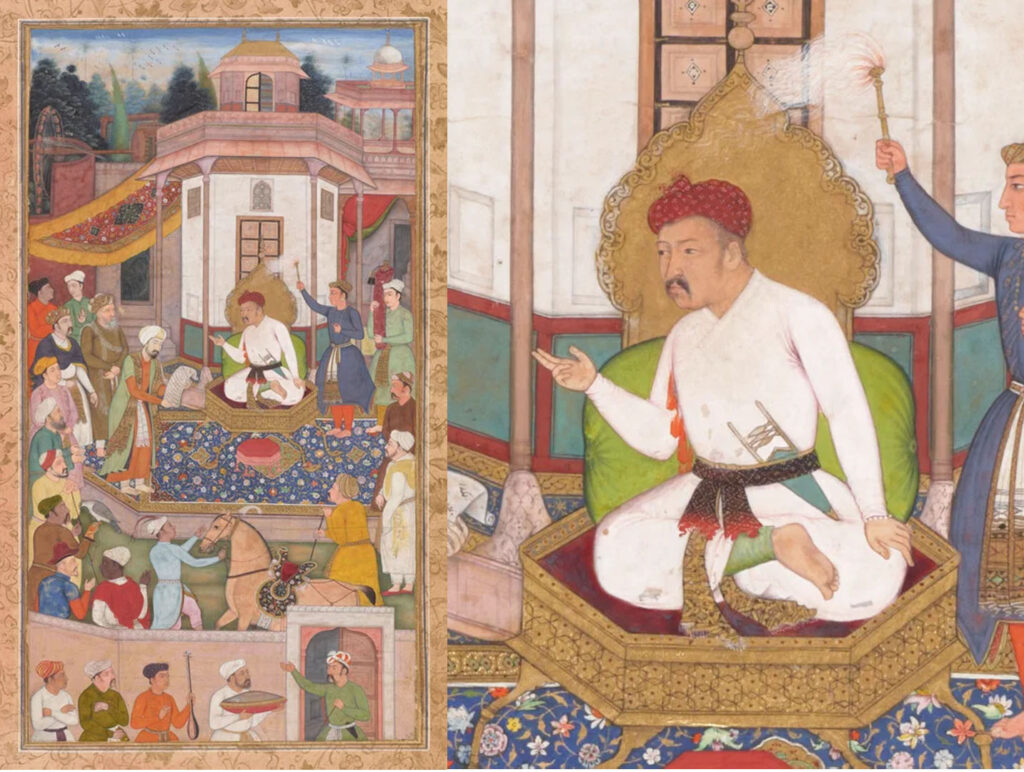
From L-R: Portrait of Jahangir in a white jama and detail of the two overlapping patkas; Balchand; Mughal; Agra, India; 1620; Pigment, ink, gold and ivory on paper; 19.1 x 10.4 cm. Chester Beatty, Dublin
In his memoirs, the Tuzuk-i Jahangiri, Jahangir is represented as the quintessential aesthete. This is exemplified in his miniature portraits, often featuring a host of luxurious objects, such as jade wine cups, jewel-encrusted daggers, and finely woven textiles. In one such painting, where he is depicted in his typical resplendent regalia, two overlapping textile sashes or patkas gracefully wind around his torso — one bearing a distinctive bandhani tie-dye design, emblematic of Rajputana culture, and the other displaying intricate Islamicate geometric designs. These twin sashes depict a carefully crafted visual manifesto of the emperor’s filial identity — as the son of both his Muslim father, the Mughal emperor Akbar, and Hindu mother, Rajput princess Harkha Bai.
This kind of multicultural sartorial sensibility reached refined heights during the reign of Akbar and his successors but did not originate in Mughal courts. Art historian Finbarr Barry Flood in his book Objects of Translation argues that between the tenth and twelfth centuries, medieval elites engaged in “cultural cross-dressing” at cosmopolitan zones of contact around mercantile hubs in northern India. Muslim elites adopted luxury items of ornamentation and dress favoured by rich Hindu and Buddhist rulers while Buddhist and Hindu elites reciprocally took to ‘fashionable’ Turko-Persian wear as a sign of their sophisticated, worldly tastes. Such exchanges revealed a “complex interplay between sameness and difference, self and other,” according to Flood. Ultimately, such syncretic dressing practices was a way for cosmopolitan medieval elites, across both cultures, to best position themselves vis a vis the dominant social and class structures at play.
With the ascent of the Delhi Sultanate (r. 1206–1526) and later the Bahmani Kingdom (r. 1347 to 1518), Indic centres of power began participating more visibly in cultural “code-switching”. For instance, by the 14th and 15th centuries, Hindu Vijayanagara rulers, started wearing the Islamicate kabayi (tunics) and kullayi (caps) to assert their equality with neighbouring Muslim rulers, presenting themselves as the “Hindu Raya Suratrana” i.e. “Sultans among Hindu kings”. However, this type of dressing was restricted to public events as a deliberate political strategy. There was never any actual shift away from Indic dress codes, especially in more private settings.
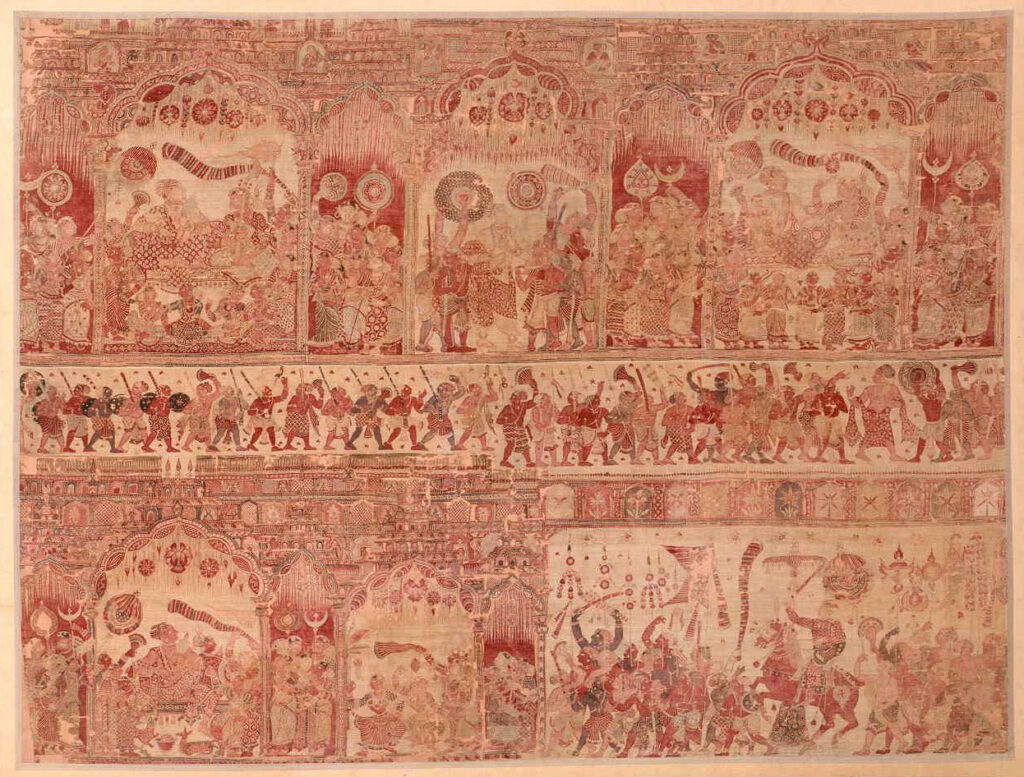
In contrast, the Mughals’ engagement with Indic dress codes and textiles was not limited to strategic diplomatic posturing, according to art researcher Simran Agarwal in her essay The Emperor’s New Clothes. Rather, the Indic permeated their most intimate vocabularies of self-expression through clothing.
From Culture Shock to Assimilation
Agarwal in her essay points to a remarkable painting of Jahangir that depicts him bare-chested, sitting in the padmasana — the lotus position — drinking wine with a female member of the royal household in a domestic setting. Just a few decades before that, Jahangir’s great-grandfather Babur had sneered at how the general populace of Hindustan “go about naked,” referring to how the people in the newly conquered territory dealt with the scorching tropical heat by leaving their upper bodies bare. Islamic culture saw the unclothed body as an affront to God and upheld dressing modestly. Babur was therefore, unsurprisingly, shocked by Indic cultural values that celebrated bodily beauty as proof of inner virtue, and the use of draped textiles as a way to accentuate and display a person’s physical attributes. According to cultural historian Phillip Wagoner, the Mughals were faced by “sharply opposing attitudes to the body” in their new empire.
But, by the time Jahangir ascended the throne, hybridity and syncretism of form and expression was firmly embedded in Mughal fashion, according to Agarwal. She references not only the Mughal emperor posing bare-chested in a private setting but also during a very public jharokha darshan — a kingship practice involving the public appearance of the king before his subjects from a palace balcony at sunrise. Jahangir is shown wearing layers of pearl necklaces, earrings, a turban, and a dhoti, giving his subjects a glimpse of his body — much like the holy darshan of the deity in Hindu temples.
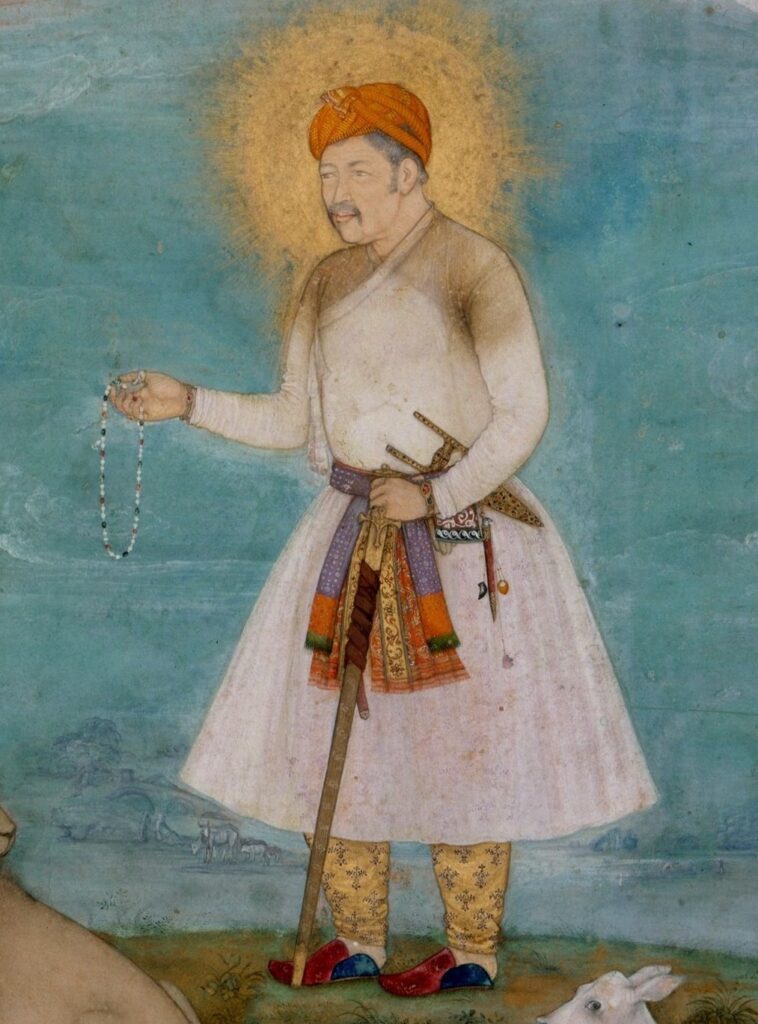
Jahangir’s sartorial choices did not emerge in a vacuum — they were preceded by his father’s experiments. According to art history scholar Sylvia Houghteling in the The Art of Cloth in Mughal India, Akbar was the first Mughal emperor to wrestle with the question of how not to alienate his predominantly non-Muslim subjects while also not losing his identity as a Muslim emperor. His solution was embracing a modified, cotton version of heavy Persian robes, drawing on the design of the jhaggā — a garment indigenous to the Rajput kingdom of Mewar. Colloquially referred to as jama, Akbar would officially name this new design “sarabgati,” literally meaning “that which covers the whole body” — bridging Hindu and Islamic ways of dressing.
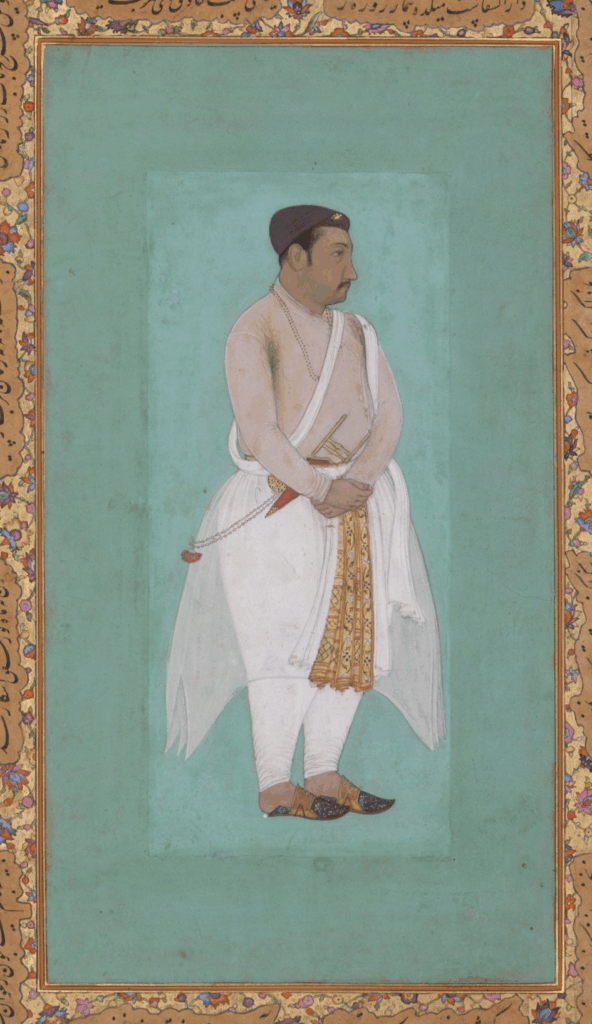
The typical Mughal jama — a side-fastening coat-frock with a nipped waist — soon became a staple durbar (court) style. The near-transparency of cotton muslin was combined with the jama’s tight, body-hugging bodice and flared skirt falling to below the knee or to the ankle, and worn with a tailored lower garment — either loose fitting ‘paijamas’ or more tapered ‘churidaars’. Houghteling has highlighted how the final look was an ideal balance of Islamic modesty and Indic aesthetics around showcasing the body.
As Agarwal points out in her piece, Akbar’s court historians wrote of how the emperor’s body ‘glowed’ in simple, white jamas, ascribing his radiance to the ‘nur’ (Divine Light) he had inherited from the Mongolian matriarch Alan Gua, the mythical ancestor of Akbar’s forebear Genghis Khan. Such testimonies strengthened Akbar’s position as the rightful ruler of ‘Hindustan’, not just within his own empire, but also the larger Islamicate world.
As a daily wear item, the cotton jama also achieved two more objectives, according to Houghteling in her essay The Emperor’s Humbler Clothes. One, it was infinitely better suited to the warm tropical weather than natural fabrics like silk and wool used in traditional Persian robes. Two, it became a form of virtue-signalling as popular Sufi texts often mentioned cotton as a fabric that embodied Islamic piety and humility,
Even the Rajputs were not immune to the updated jama’s charms. But, while Muslim nobles had the side fastenings of their jamas on the right, Hindu Rajputs would tie them on the left side — a small but significant detail that revealed the wearer’s religion. Changes in Rajput dressing styles — from the use of turban ornaments (sarpech), jewelled daggers, embroidered jamas with paijamas, instead of dhotis — all became synonymous with their proximity to Mughal power. They also, in turn, inspired variations to standard Mughal designs, such as the chakdar jama with four to six pointed edges at the hem. The signature silhouette, favoured by Mughal courtiers because it allowed agile movements, may have been inspired by Rajput’s courts’ takauchiah garment with slits (chaks) at the hem.
The Politics of Style
Surpassing the jama as a codified instrument of politics was the khil’at (Robe of Honour). The Arabic origin of the word means “cast off garment” — pointing to the practice of a sovereign handing his expensive robe to a subordinate as a mark of appreciation. Such a ‘gift’ emphasised the superior status of the sovereign but also symbolised the imperial goodwill bestowed on a loyal vassal or courtier. The khil’at, typically decorated with jewels and other precious ornamentation, also held monetary value. But a “robe of honour” could take other forms and deliver other messages. For instance, Jahangir would personally invent the Nadiri hunting coat drawing on Persian, Chinese, and European design elements, reflecting Mughal cosmopolitan culture. The exclusive design was meant primarily for his own personal use and to create khil’ats for a select few. So when Prince Khurram (Shah Jahan) emerged victorious in the Deccan, Jahangir sent him an astoundingly elaborate Nadiri to express his happiness, an acknowledgement that the young prince was entering the exclusive club of elites who the emperor held in high esteem. The episode is recorded in the Jahangirnama.
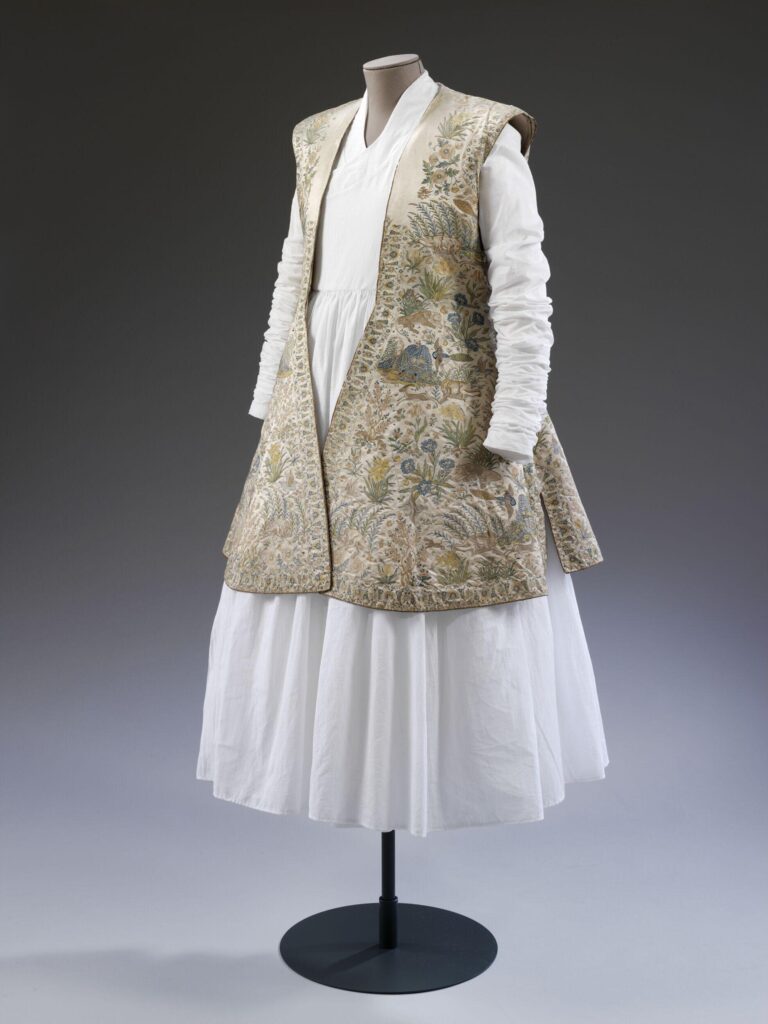
Similarly, Jahangir was known to hand soft pashmina shawls to Rajput rulers to communicate volumes about the warmth of their partnerships. But at the same time, such shawls, previously rebranded as ‘Paramnarm’ by Akbar, alluded to a lingual play on the Persian phrase “Ragi gardan narm kardan,” which meant renouncing pride and learning to obey, according to Houghteling. The gift of the shawls, therefore, was Jahangir’s way of sending the hard message to his vassals to stay loyal but couched in the softest of materials.
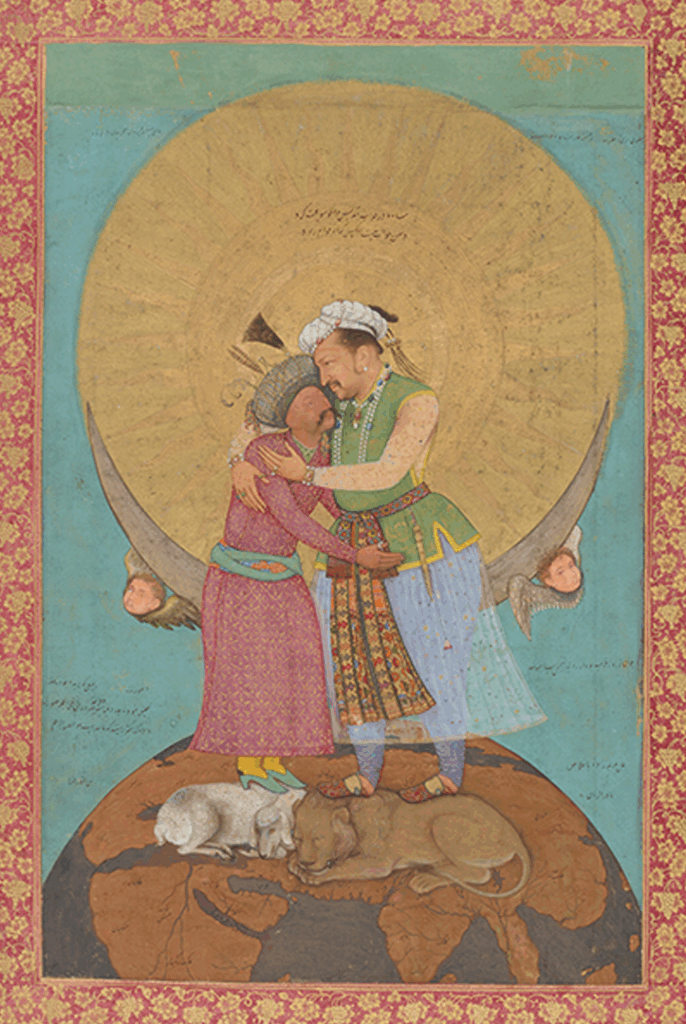
The concept of the khil’at was used by Jahangir in another unusual context to define his relationship with another powerful Persianate kingdom — Safavid Iran. Undoubtedly, the Mughal dynasty owed a debt of gratitude to them for supporting Humayun and helping him reclaim his kingdom. But, at the same time, the Mughal empire had, in the succeeding decades, become a competing and important centre of Persianate political and cultural power. This paradoxical situation was depicted in Abu’l-Hasan’s painting, Emperor Jahangir embraces Shah Abbas. In reality, the Safavid shah, known as “Abbas the Great,” had never visited the subcontinent or met Jahangir in person. In the painting though, based on a dream that Jahangir supposedly had, the two rulers are shown embracing each other while standing on the globe. While Abbas wears a Persianate-style robe of brocaded silk consistent with the Safavid style, Jahangir is shown wearing a simple cotton jama beneath a green Nadiri vest. Houghteling argues that Jahangir in all probability gave instructions to the painter about what clothing Abbas and he should be depicted wearing in the painting. Jahangir’s attire is so specific to his identity, specifically the Nadiri, that no one would mistake it as a robe of honor gifted to him by Abbas. In this painting and others, Jahangir would visually assert that he wore no one’s robes but his own, and owed no form of political submission to the Safavids.
One of the reasons why Mughal statecraft was so intertwined with clothing was the subcontinent’s booming textile economy. CA Bayly’s essay points out that often, in lieu of cash tributes, the imperial bureaucracy would accept payments made in cloth, such as Bengali cotton muslin or Kashmiri shawls. Bayly states that in regions within the Mughal empire where gold and silver were scarce, it was cloth transactions that supported commerce. Akbar’s court historian, Abu’l Fazl, documented Akbar’s keen interest in regional textiles and their production, given that they were a significant source of revenue. The A’in-i-Akbari lists around 30 types of cotton fabric, 39 varieties of silk, and 26 kinds of wool. Among them, mashru, a cotton-silk blend, was promoted by Akbar at court because the cotton-silk blend gave Muslim elite the chance to enjoy the regality of silk while adhering to Islamic strictures against ostentatious dressing.
Regional textiles would often be incorporated into patka sashes — a regional garment with roots in Western India. Typically measuring about 11 feet in length and 1.5 feet in width, these fabric strips were cinched around the waist. They were the easiest ‘vehicle’ for imperial messages to be presented in courtly settings, conveying the emperor’s alliances, patronage, and dominance, all at once. Houghteling’s scholarship points to several paintings of Akbar showing him wearing signature textiles from conquered regions. One example is the painting that depicts Akbar receiving the news of victory at Gogunda in Rajasthan. Agarwal, in her analysis of the painting, points out how he is shown wearing a red and black bandhani patka over a gold-brocaded silk one. She argues that this choice of patkas symbolised both Akbar’s power over the defeated Sisodias of Mewar, and his friendship with the Kachchhwahas at Amber.
Under Jahangir and then Shah Jahan, cosmopolitan craft hubs continued to flourish in Lahore, Kashmir, Dilli/Shahjahanabad (now Delhi), Agra, Ahmadabad (now Ahmedabad), Fatehpur and Burhanpur. The finest silks — satin, kimkhah, katan, and tassar sourced from Banaras, Bengal, Orissa, Assam, Persia, and China; delicate cottons, including the famed muslins of Bengal; and rich velvets from Gujarat flowed through these nodal cities where royal karkhanas (workshops) were located.
Decline and Dispersal
However, imperial patronage of the arts steadily declined during Aurangzeb’s reign, beginning with the royal atelier being disbanded. The Mughal karkhana system, which had underpinned the state-led economy of textile crafts in the subcontinent for decades, saw a rapid decline in the late 17th century, coinciding with the gradual weakening of the Mughal empire following Aurangzeb’s death in 1707.
Artisans working at imperial karkhanas began migrating to smaller regional hubs, seeking protection and patronage under smaller courts of Rajput kings, the Nawabs of Awadh and the Nizams of Hyderabad. Others set up smaller, independent workshops in areas where European trade was expanding. The resultant dispersal of artisans spread the craft techniques perfected in the workshops under the Mughals far and wide, across geographies, but with localised variations. The artisans of Kinari Bazar (Chandni Chowk) relocated to Awadh, leading to the emergence of zardozi embroidery while the intricacy of the kinkhwab brocade continued to thrive in Varanasi. Shisha embroidery, where small mirrors are stitched into a fabric’s weave, became prevalent in northwestern India and Balochistan (in present-day Pakistan). What was once the exclusive design language of the imperial ‘centre’ diversified into various ‘regional’ dialects.
Even today, the silhouettes and embellishments on garments such as the anarkali, angarkha, pyjama and churidaar carry the imprint of pluralistic Mughal courtly styles from a time when politics in the Indian subcontinent favoured syncretism over division.
First published: May 8, 2026