-
ChicagoSastry, Devi, and Shrey Maurya. "How Mughal Gemstones Became Cartier’s ‘Hindou Jewels’." Impart Perspectives, May 26, 2026. https://imp-art.org/perspectives/dispatches/how-mughal-gemstones-became-cartiers-hindou-jewels/
-
MLASastry, Devi, and Shrey Maurya. "How Mughal Gemstones Became Cartier’s ‘Hindou Jewels’." Impart Perspectives, May 26, 2026, https://imp-art.org/perspectives/dispatches/how-mughal-gemstones-became-cartiers-hindou-jewels/. Accessed 20 Oct 2026.
-
HarvardSastry, D. and Maurya, S. (2026) How Mughal Gemstones Became Cartier’s ‘Hindou Jewels’, Impart Perspectives. Available at: https://imp-art.org/perspectives/dispatches/how-mughal-gemstones-became-cartiers-hindou-jewels/ (Accessed: 20 October 2026).
How Mughal Gemstones Became Cartier’s ‘Hindou Jewels’
While contemporary debates around cultural appropriation in fashion concern erasure of South Asian influences, Cartier’s "Indian-inspired" jewellery brings up a different set of questions.
By Devi Sastry & Shrey Maurya
Link copied!
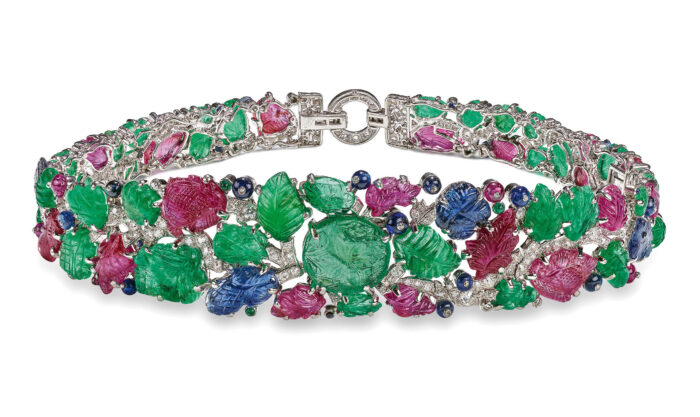
Mountbatten Bandeau; Cartier London; 1928. Courtesy Victoria & Albert Museum
South Asian design and craft traditions have been at the centre of several recent controversies — from the Prada chappals to the bandhini-print Ralph Lauren skirt. Outrage typically crests across our social media feeds within 24 hours with each case serving up fresh ammunition in ongoing cultural identity wars. While most conversations revolve around cultural appropriation, they point to deeper fault lines in the current copyright regime that favours trademarked ‘innovations’ over existing design methodologies and heritage practices. Distinct aesthetics rooted in specific craft traditions — even ones that have acquired Geographical Indication (GI) tags — therefore become difficult to protect.
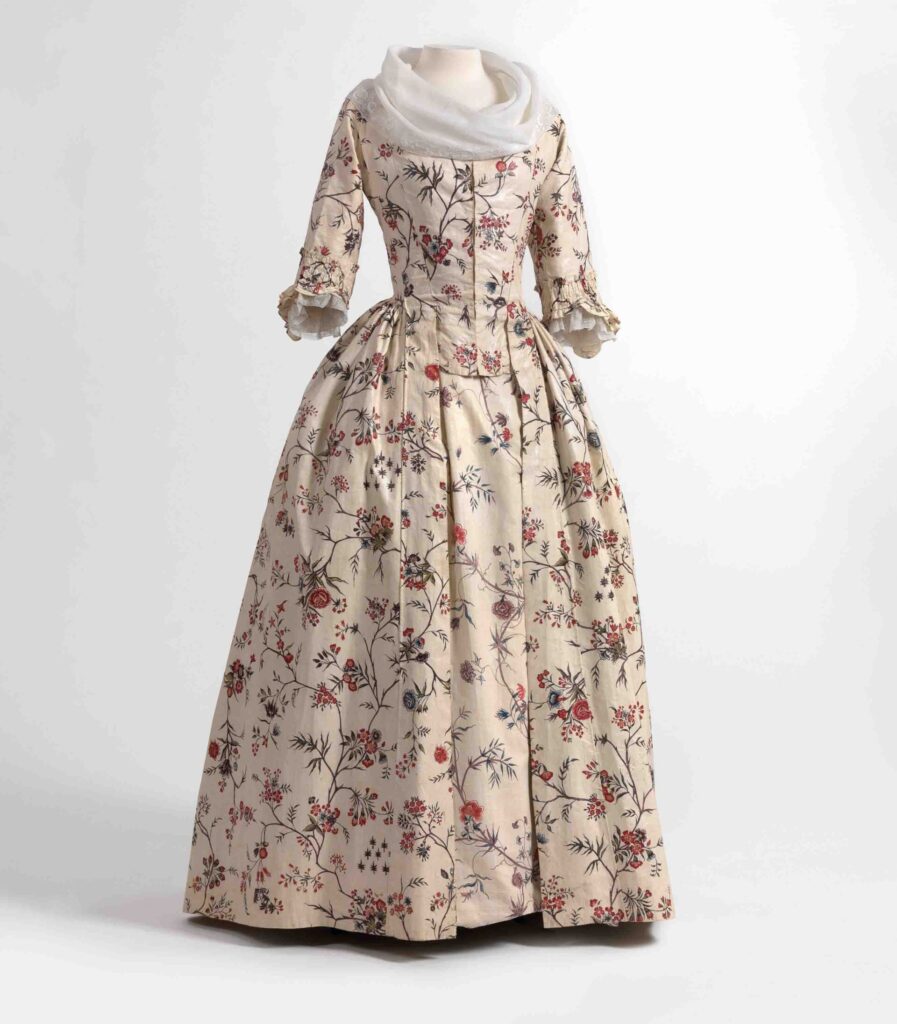
Imitation, however, is not a new phenomenon. The practice has been well documented since European merchants began devising cheaper alternatives to South Asian craft products for their own domestic mass markets. As the centre of trade shifted with colonial control, Indian craftspeople became suppliers of raw materials and labour rather than producers of finished goods. It became the norm to appropriate existing design traditions and mechanise production of signature styles native to the region under new, generic names, such as cashmere, calico, and chintz.
Fantasies of the Orient
By the turn of the 20th century, ‘The Orient’ — broadly referring to regions spanning Northeastern Africa, Southwest Asia and the rest of the Asian continent became a constant source of design inspiration for Western luxury goods. European brands that had started out as boutique artisan workshops in the 19th century had become large maisons — prestigious design houses catering to the growing European middle class and elite. Part of the job was making ‘oriental’ designs available in forms that the European market found appealing.
One of the most famous historical examples of how South Asian aesthetics travelled to the West is the story of Cartier’s Tutti Frutti creations. Praised for combining colourful Indian stones with Art Deco designs, signature jewellery pieces from the 1920s collection are widely recognised and coveted even a century later, surfacing briefly at auctions before disappearing into private collections. One such piece, a 1925 bracelet, showcases carved rubies, sapphires, and emeralds in the shape of berries and leaves set in platinum on a diamond-studded branch. But what inspired the French luxury house to create such a delectable design?

The story begins in 1911 when Jacques Cartier — the youngest of the three Cartier brothers — travelled to India to attend the Delhi Durbar. The emergent jewellery house saw this as an important step in their plans to cement an association between Cartier and the East in the minds of their European clientele. This was especially advantageous at a time when everything ‘oriental’ was both fascinating to Western elites and greatly desired in high society circles. South Asia was already a vital nexus in the international jewel trade, and ‘jewels of the Orient’ held a special allure in the early twentieth century, fuelled by the stories of large-sized gems found on the subcontinent. Upon his return to Europe, Jacques organised an exhibition titled Oriental Jewels and Objets d’Art Recently Collected in India at Cartier’s London branch in the spring of 1912. A resounding success, the exhibition not only whetted the European public’s appetite for Indian designs but also firmly established Cartier’s connection to India.
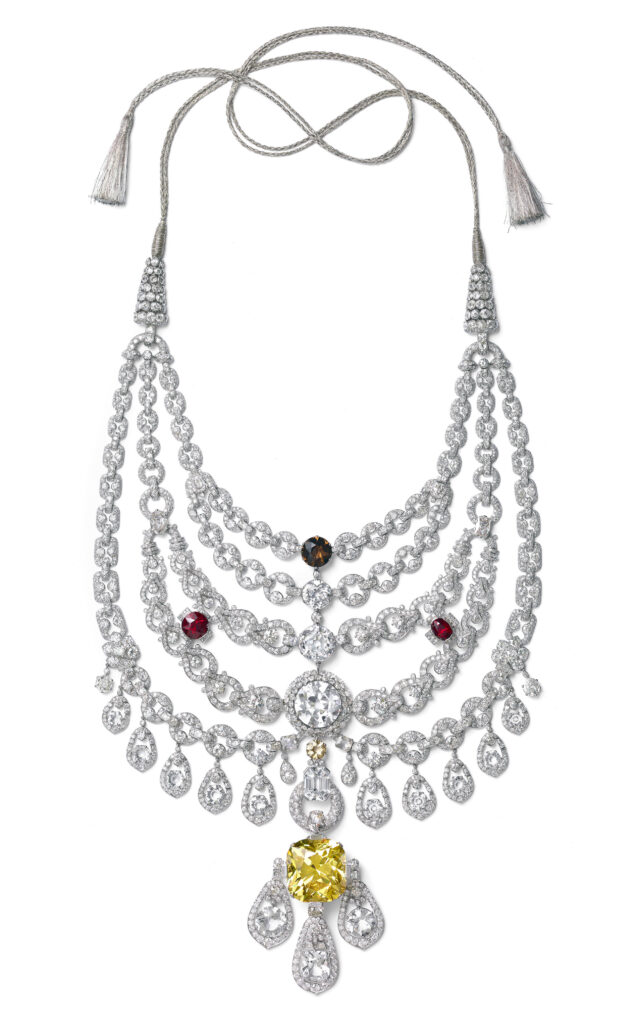
The strategically-timed visit also helped Jacques on a side quest — to woo Indian maharajas, notorious for their extravagant lifestyles, as Cartier’s clients. He met with many ruling princes at the Durbar who would go on to invite him to visit their palaces. Over the course of several trips, Jacques would strengthen his connection to Indian royalty by befriending the maharajas of Baroda, Patiala, and Nawanagar, among others. Impressed by Cartier designs, the maharajas would often have their gemstones re-set in ‘modern’ settings to better fit in with European royalty and Western tastes, which was the case with the famed Patiala necklace. They would eventually become some of Cartier’s most valuable clients through the 1920s, post World War I, and the 1930s Depression Era years, unaffected by downturns in the West.
A ‘Tutti Frutti’ Twist
With every successive trip, Jacques’ engagement with the Indian aesthetic deepened. He not only met with gem merchants in Bombay (now Mumbai), Delhi and Calcutta (now Kolkata), but also immersed himself in the decorative arts and architecture of the subcontinent during his travels. In one diary entry he described the ten centuries that preceded his era as ‘one of the most wonderful periods in the history of the world’ before declaring that ‘India’s share in the intellectual discoveries of these times was paramount.’
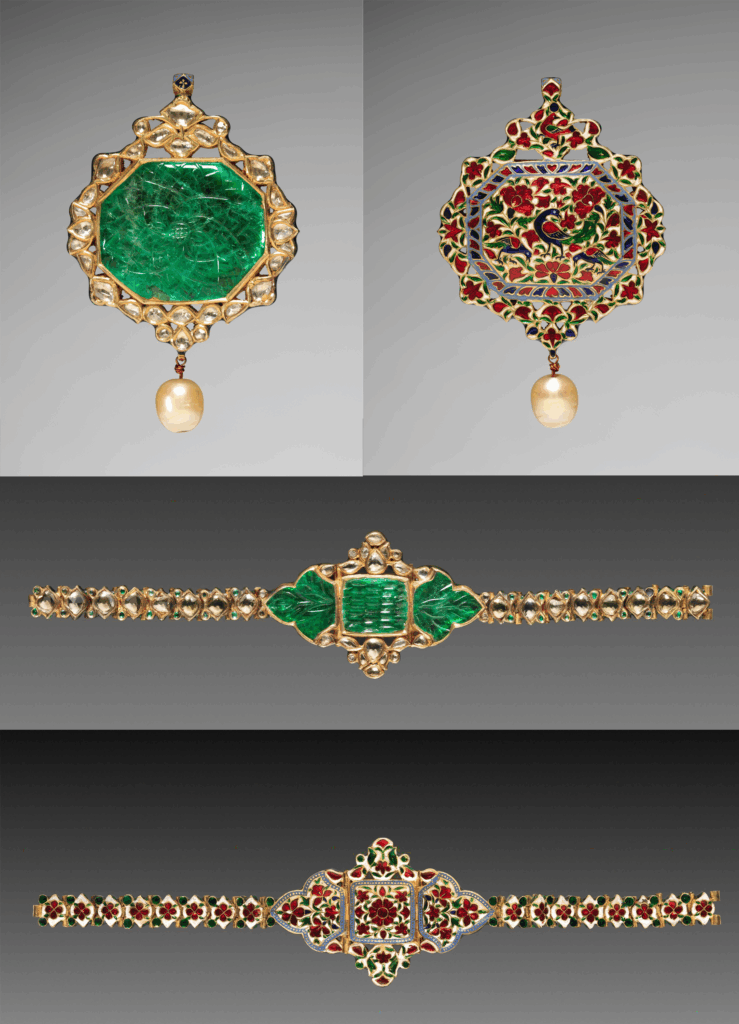
As the family’s gemstone expert, he took a keen interest, specifically, in coloured and carved gemstones whose provenance could be traced to Mughal-era imperial karkhanas (workshops). These were markedly different from the gemstones used for European jewellery of the period, which were typically cut and faceted to enhance their brilliance and clarity. In the Mughal lapidary craft, however, precious stones were carved with foliate motifs or shaped to resemble leaves, flowers, and fruits. Rather than clear, faceted gems, these designs were built around sculptural, organic forms. Jacques was especially drawn to the colours and varieties of the gemstones he saw on his trip. He returned to Paris with many such carved gemstones in his luggage, along with the inspiration to create what he would initially call the ‘Hindou Jewels’, later renamed ‘Tutti Frutti’.
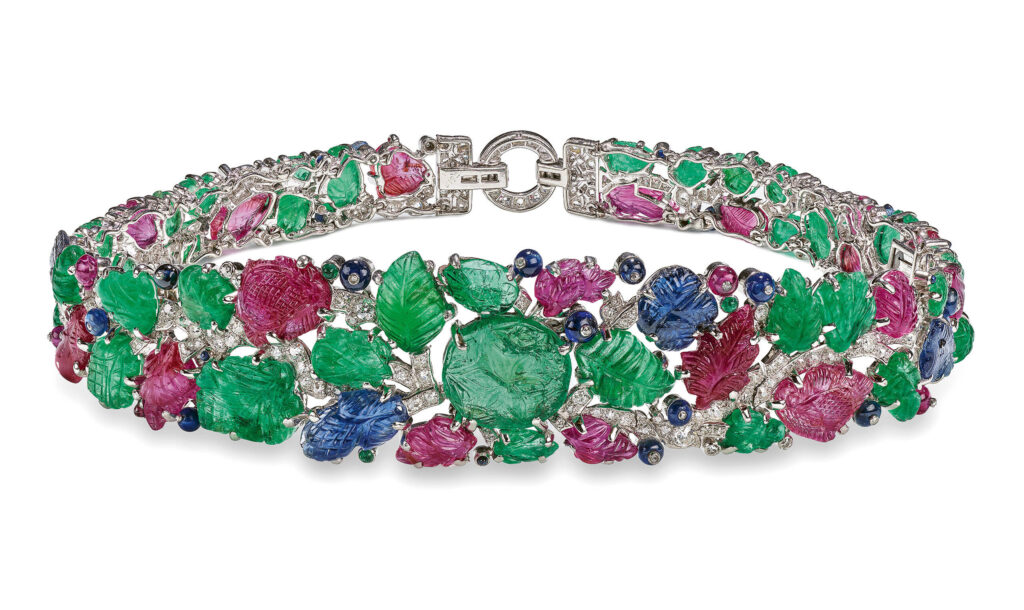
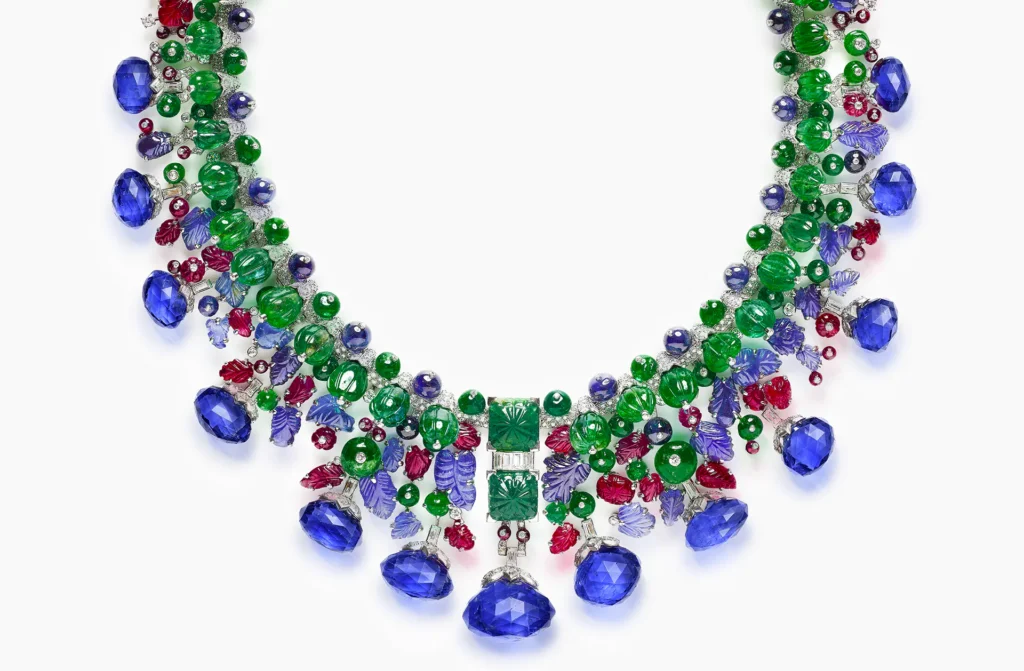
The Tutti Frutti style is composed of three colours — red, green and blue, an entirely new combination in Europe at the time. The finest pieces include large emeralds, often carved for and once belonging to Mughal emperors; polished sapphire cabochons from Sri Lanka and Kashmir; and deep, berry-red rubies and spinels surrounded by icy diamonds. The coloured stones and jewellery bought in India were remounted on platinum settings at Cartier’s atelier in Paris. In addition to the existing stones, Jacques would also commission Mughal-style gems to be carved at lapidary workshops in India for specific designs.
From bracelets to brooches, these colourful creations did not simply gesture to the vibrancy of South Asian jewellery traditions — they materially adopted Mughal artefacts and craftsmanship, reimagining their use within Cartier’s design sensibility. Historic pieces include a 1928 bandeau sold to Edwina Mountbatten (who would become the last Vicereine of India), and the 1936 ‘Collier Hindou’ commissioned by Daisy Fellowes, an American heiress and celebrated fashion icon in Parisian high society. Notably, the collier was originally fastened with a black silk cord instead of a clasp as an explicit homage to traditional Indian-style bib necklaces.
In the 1970s, this ‘Hindou’ style of jewellery was formally renamed ‘Tutti Frutti’ and, in 1989, patented by Cartier. Although other prominent jewellery houses such as Van Cleef & Arpels, Mauboussin, and Boucheron also produced pieces inspired by the same Mughal Indian aesthetic, Cartier’s version of the style is the most widely recognised.
The Maison continues to produce opulent Tutti Frutti high jewellery necklaces, with recent examples including the 2020 Maharajah Necklace, the 2021 Udyana Necklace, and the 2016 Rajasthan Necklace, whose central emerald was likely carved in a Jaipur workshop. The most recent one is the 2026 Tutti Kanya with a signature beaded ruby tassel. Instead of a rigid mounting, it uses a stringing technique similar to traditional Indian jewellery where finished sections or beads and gemstones are strung together on gold wires or silk threads. In spite of the rebrand, the Indian influence is ‘more alive than ever for the Maison’, and remains a core element of Tutti Frutti’s identity and Cartier’s marketing even today.
Repurposing South Asian motifs
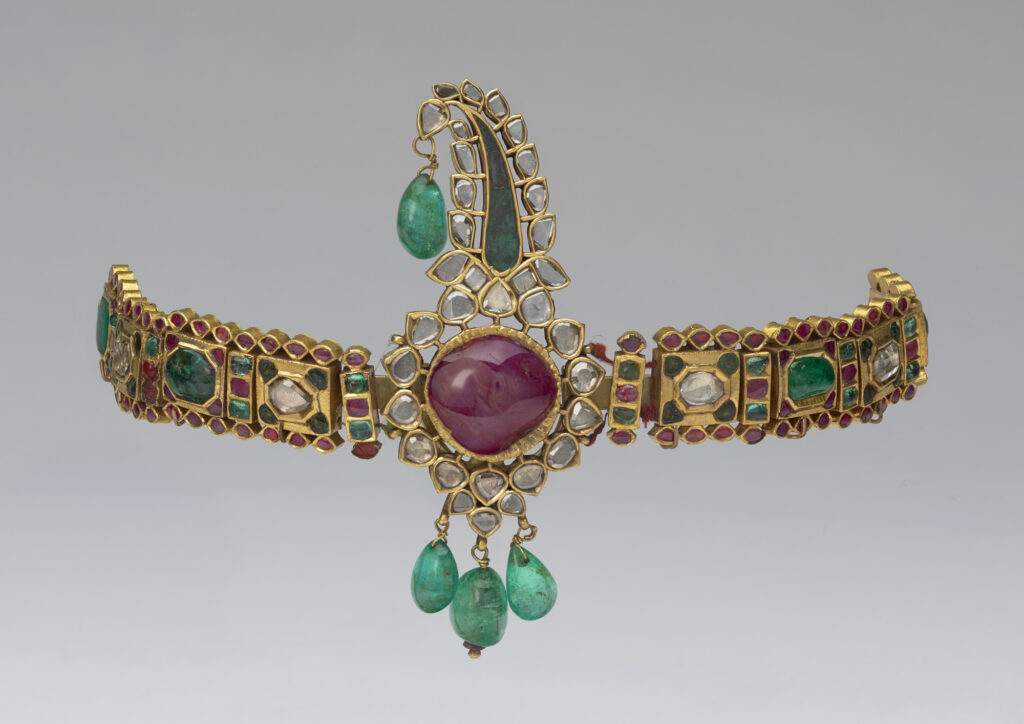
Encounters with South Asian decorative arts and jewellery traditions informed other Cartier pieces of the era as well. These include necklaces that borrowed from the bib-style, tasselled shoulder brooches inspired by turras (dangling ornaments worn on the side of turbans) and jabot pins that adopted the paisley motif, a popular shape for sarpechs (turban ornaments worn front-center).
Jacques Cartier’s sketches from his many visits to the subcontinent would prove particularly useful in this regard. In her book The Cartiers, Francesca Cartier Brickell writes of her great-grandfather:
‘All the way through Ceylon and India, he had been sketching his surroundings: The scroll shapes on temple walls in Kandy […] would find their way onto tiaras; the interlocking ovals decorating an old ceremonial cannon would become the basis for an Art Deco bracelet; and the red-and-green paisley motif on a rug would be reborn as a brooch, vibrant in rubies, emeralds, and diamonds.’
This meticulous recording and intentional repurposing of South Asian motifs was thus at the heart of Cartier’s experiments with cultural ‘fusion’ hailed as design innovation. The Mughal carved gemstones, aka the ‘Hindou jewels’, are described as ‘the raw material for Cartier’s Tutti Frutti style’, mirroring the logic and language of imperial extraction that redefined global trade networks in the colonial era. An anecdote from Jacques’ first visit to Baroda observes this shift in real time — when Jacques attempted to secure a commission from Sayajirao Gaekwad III, the court jewellers expressed great anxiety at the prospect of losing their business to a European house. Cartier presented a threat to their status as producers of finished goods — much like the threat that imperial economics posed to craftspeople across the subcontinent.

While contemporary debates around cultural appropriation often have to do with the erasure of South Asian influence, Cartier’s Indian-inspired jewellery brings up a different set of questions: What do we make of cultural and material ‘borrowing’ under inherently unequal conditions of exchange — even if the roots are acknowledged? Louis Cartier, Jacques’ eldest brother, famously coined the motto ‘never copy, only create’ — but Cartier’s designs weren’t created in a vacuum and often dallied with Eastern influences, incorporating Chinese, Japanese, and even Egyptian iconography into their jewellery and objets d’art (art objects). What lines can then be drawn between creating, co-opting, and combining different styles, shorn of craft lineages, under a generic name?
A ‘Savage’ Appeal
Beyond the issue of acknowledgement, these jewels provide insight into the reductive lens through which ‘oriental’ aesthetics were viewed in Europe. Despite their popularity, Tutti Frutti creations were referred to as ‘savage’ and ‘barbaric’ in a Vogue article from the 1930s, as their rounded cuts differed from the polished, sharp-edged gems favoured in the West. This reveals the period’s prevailing orientalist discourse, whereby Eastern aesthetics could be extolled for their exotic nature and simultaneously denigrated for their ‘uncivilised’ origins. In this context, what Cartier achieves with Tutti Frutti jewels is not necessarily a harmonious conjunction of East and West, but a way to cherry-pick and contain aspects of the subcontinent’s artistic traditions within the Western framework of the Art Deco style, which was also, in turn, inspired by the arts of Africa, Asia, and Mesoamerica. Much like the berry-shaped gemstones themselves, South Asian motifs cultivated over centuries were plucked and integrated into European tastes and trends — a tendency that remains all too recognisable in the world of fashion today.
First published: May 26, 2026