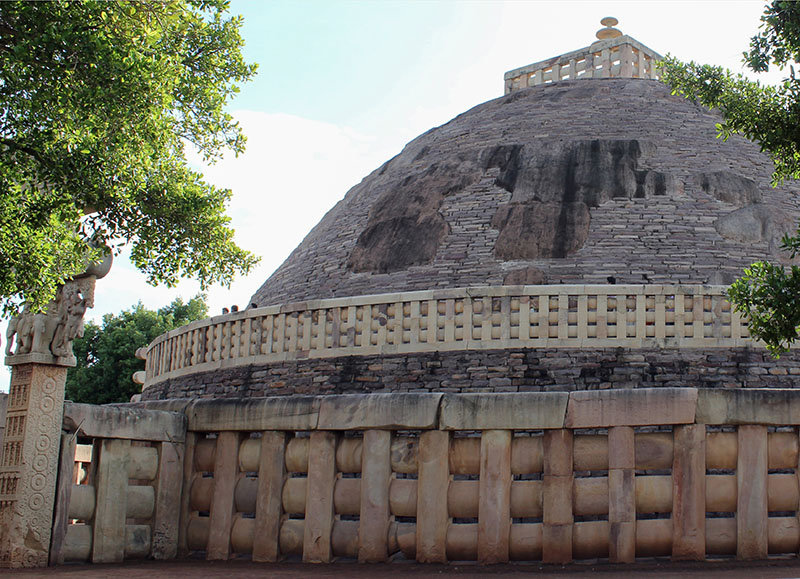
Meaning ‘railing’ or ‘raised platform or altar’ in Sanskrit and Pali, vedika refers to the outer railing around a sacred monument or object in Buddhist and Hindu architecture. Constructed around sacred trees, mounds or stupas, it usually bears low-relief inscriptions depicting protective deities, mythological events and other religious iconography. It often encloses a space for circumambulation around the central shrine.
More Definitions
Vesara Architecture
A term for an architectural style primarily associated with medieval-era temples in the Deccan region, especially north Karnataka. Derived from…
Kalahasti
A temple dedicated to the Hindu deity Shiva, located in the town of Kalahasti in Andhra Pradesh, India. It is…
Mahamandapa
A pillared pavilion or hall found in Dravida temples. Typically the largest mandapa (pavilion) of the temple, the mahamandapa serves…
Cushion Capital
In architecture, it is a type of crown, which is the top-most part of a column, pillar or pilaster. It…
Groyne
A long, rigid hydraulic structure constructed perpendicular to the seashore or riverbank to interrupt flow of water. They are usually…
Abacus
In architecture, a wide slab at the top of a load-bearing column, forming the uppermost section of the capital and…
Ardhamandapa
A half-open pillared hall in Hindu temples. The ardhamandapa serves as an open porch at the entrance of the temple…
Sukhanasa
An ornamental feature in Hindu temple architecture which lies over the entrance to the garbhagriha (the inner shrine). It literally…