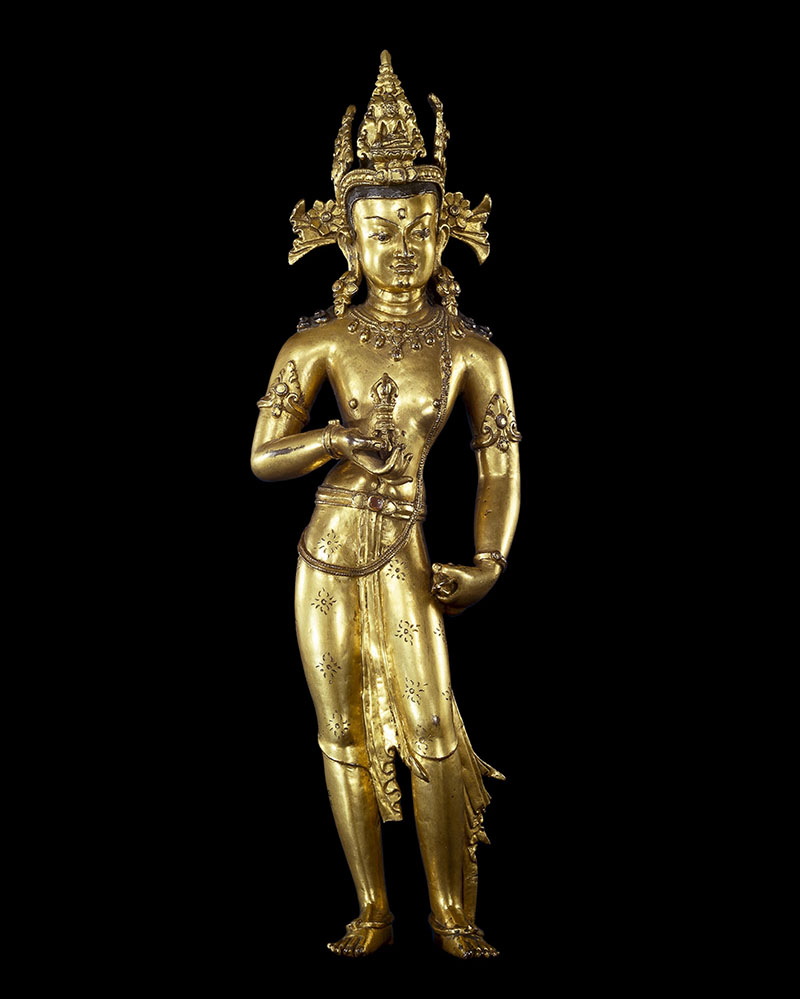
A bodhisattva in the Mahayana and Vajrayana traditions of Buddhism, he is primarily associated with the Akshobhya Buddha. Iconographically, he is white in color with a vajra or thunderbolt in his right hand and an upturned bell or ghanta in his left. Some sub-traditions of Buddhism regard him as the second patriarch of Buddhism after Vairochana Buddha. Within Tibetan Buddhism, rituals related to him are believed to purify the mind and soul.
More Definitions
Rama
The seventh of the ten incarnations of the Hindu deity Vishnu, Rama was the son of King Dasharatha and Queen…
Khadgapurusha
The anthropomorphic representation of Vishnu's sword as a male figure, following the Ayudhapurusha tradition.
Shatananda
In Hindu epic and Puranic literature, a sage who is the son of the sage Gautama and Ahilya. In the…
Kankaladhara
A form of the Hindu deity, Shiva, in which he is shown with a kankala-danda (a staff bearing the bones…
Mahabharata
The longest Indian epic poem, traditionally attributed to the legendary sage Vyasa and compiled into its extant recension sometime between…
Anantashayana
A representation of the Hindu god Vishnu, which shows him reclining atop a coiled form of the serpent Ananta, on…
Bhuvaraha
The name of the anthropomorphic form of Varaha, an avatar (manifestation) of the Hindu deity, Vishnu. As Varaha, Vishnu assumes…
Hadith
An important religious text within Islam, it is a record of the traditions or sayings of the Prophet Muhammad. Its…