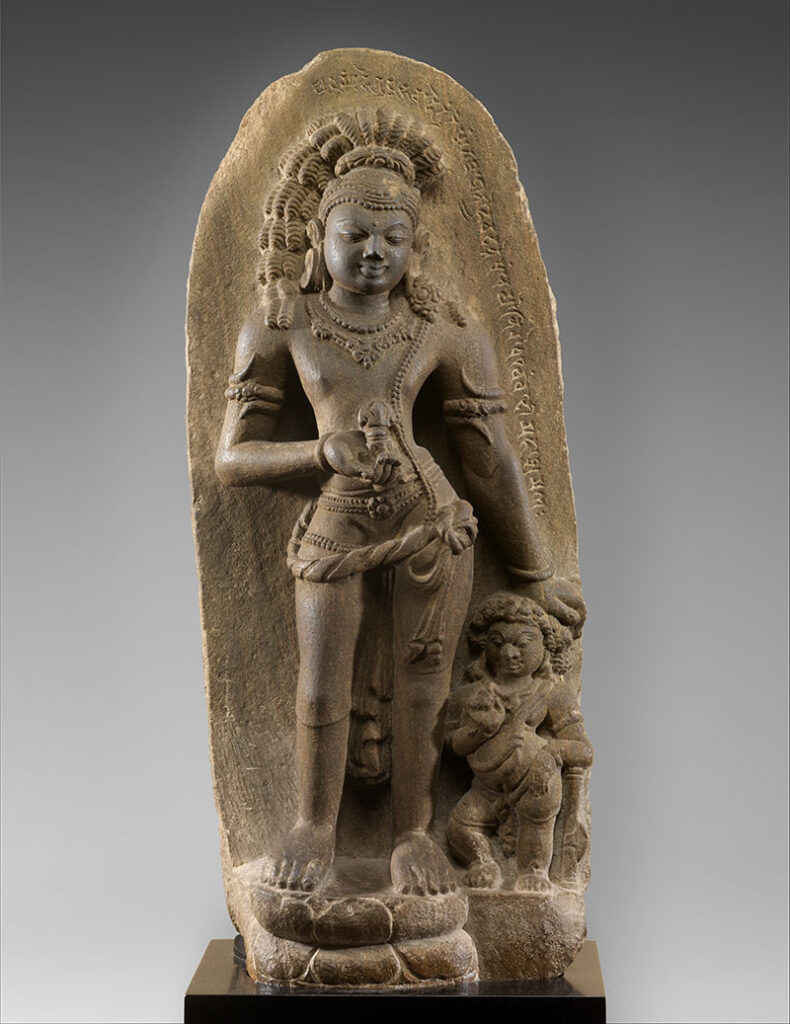
A bodhisattva from Mahayana Buddhism and the protector and guide of the Gautama Buddha as well as a manifestation of his power. He is considered one of the earliest of the three protective deities surrounding the Buddha and one of the major dharmapalas (protectors of dharma) in Mahayana Buddhism. The deity is manifested in two distinct ways — his human form, which is depicted with a vajra (weapon) in his right hand, and his dharmapala form, Acarya-Vajrapani, depicted with four heads, arms, legs and a third eye, and shown holding a bell and a lasso. He is depicted as a yidam (a manifested deity representing Buddhahood) in Vajrayana Buddhism, with multiple limbs, treading on demons or lying on snakes. He is also depicted in the yab-yum (primordial union) position with his consort. From the Sanskrit words vajra, meaning “thunderbolt” and pani, meaning “in hand.”
More Definitions
Vairochana
One of the five Tathagatas or the five transcendental Buddhas in Vajrayana Buddhism, Vairochana is a celestial buddha who is…
Mahavidyas
A group of ten goddesses from the Tantric Hindu pantheon, consisting of Kali, Tara, Shodashi, Bhuvaneshvari, Chhinnamasta, Bhairavi, Dhumavati, Bagalamukhi,…
Kaushalya
The seniormost queen of King Dasaratha, she appears in the Hindu epic Ramayana epic as the mother of Rama.
Parashurama
The sixth avatar or incarnation of the Hindu deity Vishnu, he is known for his aggression, bravery, patience and serenity.…
qadamgah
Persian for ‘footstep site’, referring to a place rendered holy by the visit of a saint or a sacred object,…
Upanishad
A body of texts written in Sanskrit and considered to be the latter part of the Vedas. They cover issues…
Adimurti
Also known as Para Vasudeva, it is a manifestation of the Hindu deity Vishnu. The conventional iconography of the form…
Pushtimarg
A Vaishnavite devotional cult that revolves around the worship of the Hindu deity Krishna as a child, in the form…