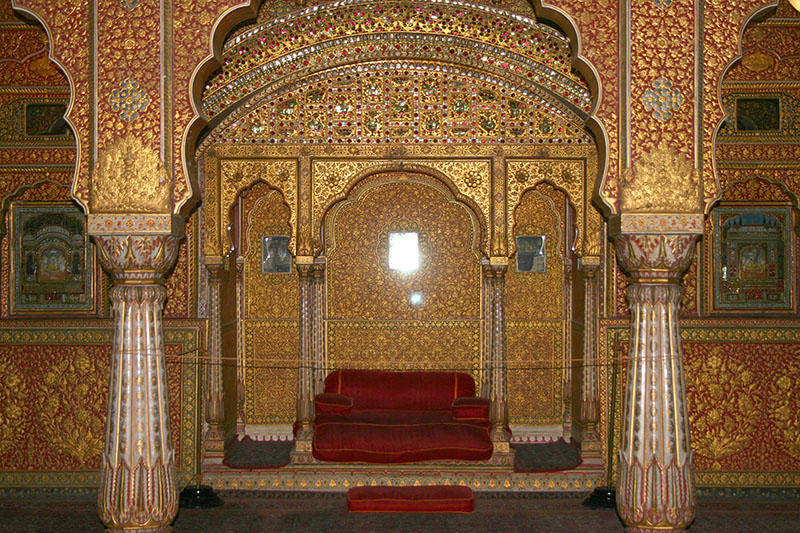
A traditional form of decorative gesso painting practised primarily in Bikaner, Rajasthan. It derives its name from the Usta community of artisans who specialise in the technique. The community migrated from Multan in present-day Pakistan to the Mughal court in Delhi and, later, to Bikaner. The technique was used to decorate interior surfaces, such as the walls and pillars of structures like the Junagadh Palace and Anup Mahal in Bikaner. Since the colonial era, it has also been used to decorate objects made from camel hide. It typically consists of two processes: manoti or munabhati, the embossing on a flat surface, and nakashi or naqqashi, the painting of the manoti.
More Definitions
Kolam
An art form practised in Tamil Nadu that consists of lines, loops and curves around a grid of dots, traditionally…
Kajli Siyahi
A technique associated with the Patna School, where paintings are rendered directly by paintbrush on the surface, without using pencilled…
Secco
Also called fresco secco or fresco finto, this is a technique of wall or mural painting wherein casein, tempera or…
En Plein Air
Meaning “in open air” in French, it is the style of creating a finished landscape painting outdoors. Before the practice…
Bagta
A painter who worked in eighteenth century Rajasthan in the court of Devgarh under the ruler Rawat Jaswant Singh. He…
Chitrashala
A painted room in the form of a gallery commissioned by kings, nobles and merchants. The chitrashala in Bundi Palace,…
Fresco
A mural painting technique where water-based pigments are applied over wet lime plaster. As the paint and plaster dry together,…
Formalism
An approach to art which emphasises aspects of form, such as line, shape and colour. Formalism engages with the visual…