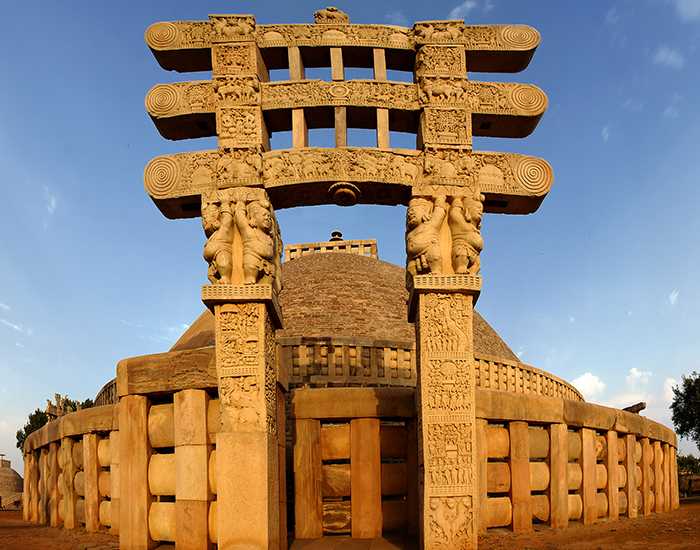
Meaning ‘gateway’ or ‘arched entrance’ in Sanskrit and Pali, torana refers to a free-standing gateway marking the entrance to a Buddhist shrine or stupa, or a Hindu temple. Usually made of stone, it comprises two pillars supporting two or three transverse beams extending beyond the pillars on both sides, or an ornamented arch forming a single structure. The oldest surviving Buddhist torana is at the Bharhut Stupa, dated to c. 250 BCE.
More Definitions
Stucco
A type of fine plaster or coating material used to cover walls and ceilings with decorative patterns, it is also…
Mihrab
A niche in the wall of a mosque which indicates the qibla (direction of the Kaaba in Mecca) and is…
Sakha
In Indian temple architecture, it refers to the vertical sidepieces of a door frame or an entrance frame, or the…
Groyne
A long, rigid hydraulic structure constructed perpendicular to the seashore or riverbank to interrupt flow of water. They are usually…
Garbhagriha
Translating to 'womb chamber' from Sanskrit, it is the innermost sanctuary in Jain, Buddhist and Hindu temples, within which the…
Zenana
A Persian term for private quarters in a house reserved exclusively for women. Originally an extension of the Islamic concept…
Blind Bays
In architecture, a recess or space between two vertical supports that is set on a wall without doors or windows.
mezzanine
Platform or balcony projecting as a partial, intermediate storey between the floor and ceiling of a full-heighted space. The mezzanine…