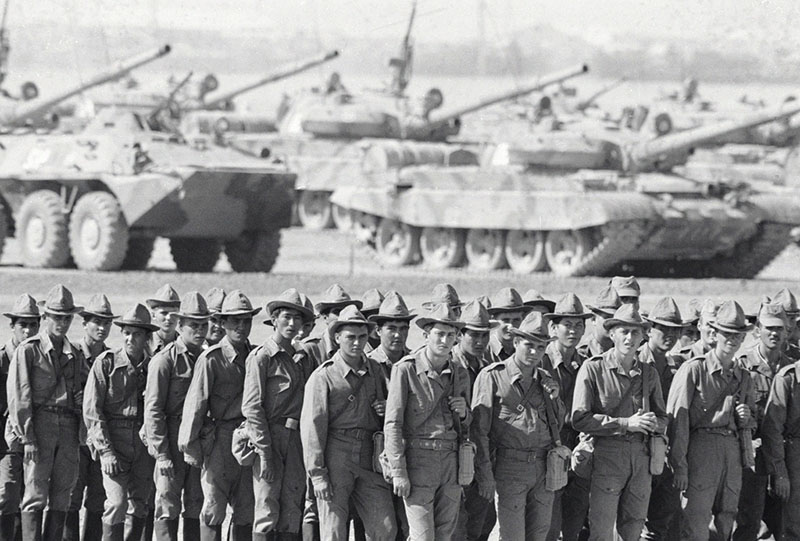
After the emergence of an unstable communist government in Afghanistan in 1978, which soon faced coups and insurgency from various local Islamic groups, the neighbouring Soviet Union invaded Afghanistan on December 24, 1979, with the intention of protecting communist influence and interests. The Soviets also aimed to preempt American intervention in the fragile political situation of the country, and installed a loyalist of theirs as the Afghan president. The Afghan War over the next decade saw continued internal conflict between the Soviet-backed Afghan government and US-supported Islamic guerrilla fighters (mujahideen); over 4 million Afghans fled to Pakistan and Iran. The Taliban emerged in the wake of Soviet withdrawal in the early 1990s. The war also eventually contributed to the collapse of the Soviet Union.
More Definitions
Champa
Group of political territories of Cham people that encompassed modern-day central and south Vietnam between the second century CE and…
Maharaja Jai Singh III
Maharaja Jai Singh III (b. 1819; d. 1835) was the ruler of the Jaipur princely state from 1819 to 1835,…
1970 UNESCO Convention
International treaty on combating the international trafficking of assets of national cultural significance, formulated and adopted during the 16th Paris…
Kaurvaki
Kaurvaki (b. 288 BCE; d. n.d.) was the second queen of the Mauryan king Ashoka and the only queen to…
Dutch East India Company
Founded in 1602, the United East India Company or Vereenigde Oost Indische Compagnie was a commercial organisation comprising several trading…
Bahmani Sultanate
Muslim kingdom of the northern Deccan in India, founded in 1347 by Zafar Shah, a soldier in the service of…
Narasimhavarman II
Also called Rajasimha, he was a ruler of the Pallava Dynasty and ruled parts of present-day Tamil Nadu and Andhra…
Chera
A dynasty that ruled over areas of present-day Kerala and Tamil Nadu from c. second century BCE. There were multiple…