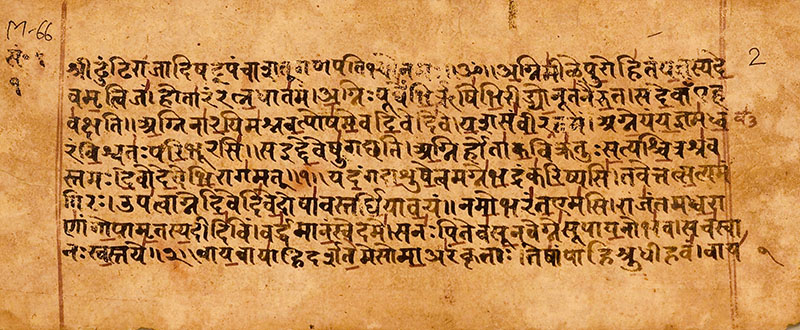
Earliest extant text from the Vedic corpus, dated roughly between 1700 and 1200 BCE. Like the other Vedas, the Rigveda was orally transmitted in archaic Sanskrit for generations and considered to be the direct word or sound of God rather than authored by man. The text comprises ten books of 1,028 mantras in praise of various devas, or deities, the most prominent of which are Indra, the king of the gods, associated with thunder or lightning; Agni, the fire god, who especially represents the sacred fire of the Vedic yajna or ritual sacrifice; and Prajapati, the creator or father of the universe, known as Brahma in later texts. The Rigveda also contains the earliest textual reference to the four varnas of Brahmanical society, which later develop into what is now known as the caste system.
More Definitions
Alvar
A group of twelve Vaishnavite Tamil poet-saints who advocated for personal devotion (bhakti). Their poetry and devotional songs were based…
Newar (language)
Language of the Newar people, indigenous inhabitants of Nepal Mandala. Newar is a Tibeto-Burman language from the Sino-Tibetan family. It…
Kufic Script
The earliest extant Islamic script, historically preferred for use in the Quran. The calligraphic script is angular and slow-moving, with…
Sahitya Akademi
Established in 1952 and inaugurated in 1954, it is India’s National Academy of Letters, created for the promotion and preservation…
Domingo Paes
Domingo Paes (b. n.d.; d. n.d.) was a Portuguese horse trader who visited Vijayanagara, the capital of the Vijayanagara empire,…
Heer-Ranjha
An epic love story popular in the Punjab region across present-day Pakistan and India, it narrates the story of lovers…
Quran
The primary religious scripture of Islam, containing the word of God as revealed by the archangel Jibrail (Gabriel) to the…
Ramayana
One of the two major ancient Indian epics written in Sanskrit, it is believed to have been composed by Valmiki…