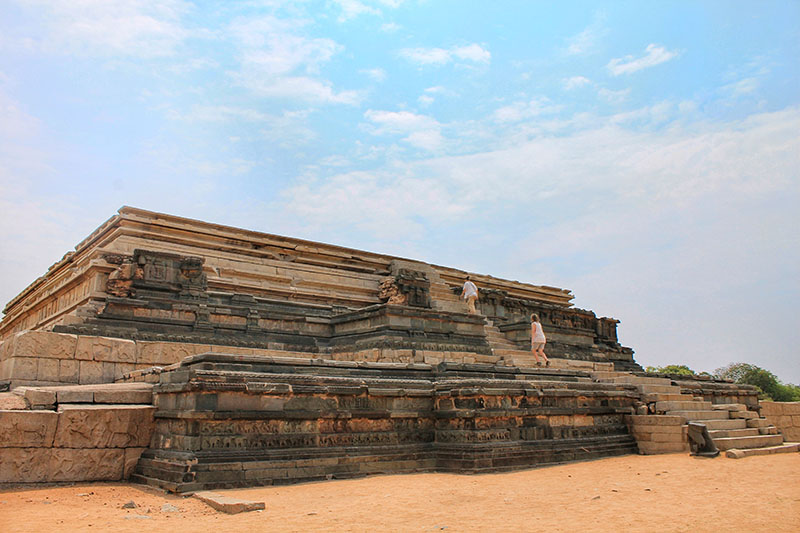
A ten-day public celebration of the Hindu festival of Navaratri, which was observed in Vijayanagara — the capital of the Vijayanagara empire — during the fifteenth and sixteenth centuries. It was held in the lunar month of Asvina, corresponding to the months of September and October in the Gregorian calendar. These celebrations included ritual and devotional practices, entertainment programmes, displays of the empire’s power and prestige and other events, which took place over nine days. In the Vijayanagara kingdom, the festival also marked the beginning of a new financial year. The royal platform, known as the Mahanavami Dibba, was an important site for these celebrations, which were were chronicled by foreign travellers, such as Domingo Paes and Fernao Nuniz, in their accounts of the empire.
More Definitions
Karva Chauth
A Hindu festival, it is primarily celebrated by women in northern India during the Hindu month of Kartika. On this…
Pradakshina
A ritual act in Hinduism, Buddhism, Jainism and Sikhism, it is a clockwise circumambulation in which a devotee takes a…
Agamas
A collection of Hindu literary and scriptural texts that establishes systems of ritual and worship, among other things such as…
Agamic Texts
Meaning “tradition” or “received knowledge” in Sanskrit, the term refers to a set of scriptures within Hinduism, Jainism and Buddhism.…
Vanamala
An important motif in Vaishnavite Hinduism, it is offered as a garland to Krishna and Vishnu. It is usually identified…
Utsavamurti
Processional idol in Indian temples, usually made of metal. During temple festivals, a representation of the temple’s central deity/deities is…
Janeu
The sacred thread worn Brahmin men after initiation rites of upanayana, which marks the advent into adulthood.
Yagnopavita
A sacred thread worn over the left shoulder and crosswise over the torso, which symbolises a Hindu rite of initiation…