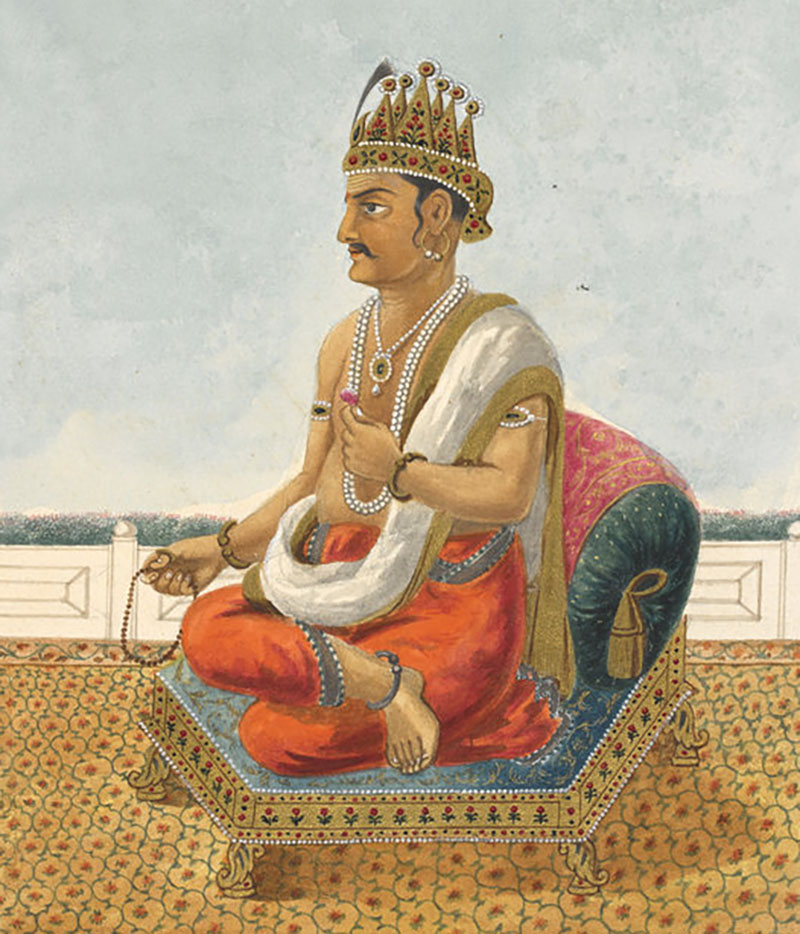
In the Indian epic Ramayana, the father of Sita and father-in-law of Rama. In later Vedic texts, Janaka is stated to be a ruler of Videha, a region corresponding to parts of present-day Bihar and Nepal, and historians suggest a possibility of him having been a historical figure who may have lived and ruled between the ninth and seventh centuries BCE.
More Definitions
Apasmara Purusha
Also known as Muyalaka or Muyalakan, he is a dwarf within Hindu mythology who represents spiritual ignorance and has the…
Shakyamuni Buddha
An epithet used for the Buddha, the founder of Buddhism, who lived sometime between the fourth to sixth century BCE.…
Ushnisha
One of the thirty-two lakshanas within Buddhist iconography, the ushnisha is an oval arrangement of hair on top of the…
Vajrasattva
A bodhisattva in the Mahayana and Vajrayana traditions of Buddhism, he is primarily associated with the Akshobhya Buddha. Iconographically, he…
Devadushya
Meaning “divine cloth” in Sanskrit, it is an upper body garment. In Jainism, it is believed that the deity Indra…
Jyotirlinga
An aniconic representation of the Hindu deity Shiva in the form of a lingam (phallus), representing Shiva as a stambha…
Sangha
A monastic order comprising bhikkhus (monks) and bhikkhunis (nuns), it is one of the Three Jewels of Buddhism. From the…
Aruna
The charioteer of Surya, the sun god in Hindu mythology. In iconographic conventions, he is shown driving a chariot pulled…