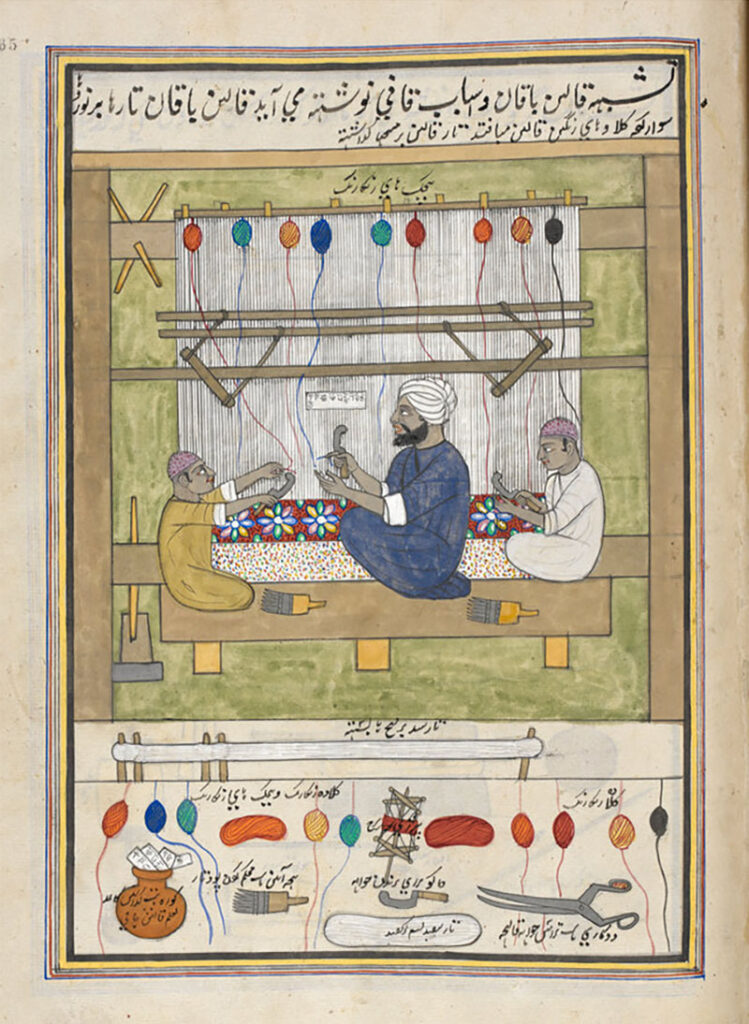
Upright handloom traditionally used for tapestry and carpet weaving, in which the warp threads are stretched vertically between roller-beams at the top and bottom, or, in early versions, suspended from a cross-beam at the top and weighted at the bottom. The shed or gap for the weft threads to pass through is opened by a hand-operated mechanism, making the weaving process slower than the treadle-operated low-warp loom. Facing the loom, the weaver works weft patterns into the back of the warp, ensuring consistency with the reference image by going around the loom or using mirrors. The high-warp loom is speculated to have originated in Syria or Mesopotamia.
More Definitions
Enlarger
A transparency projector used to produce photographic prints from negatives and transparencies. Enlarging became popular in the mid to late…
Lease Rod
A tool used to separate warp yarn threads and keep them in their place in a hand loom. It is…
Paper Negative
A photographic negative created on paper, rather than on modern cellulose film or a glass plate. William Henry Fox Talbot's…
Naksha
Also known as a jala, it is an arrangement of threads that maps the desired design and is attached to…
ground glass
Glass that has been given a coarse surface finish, usually with a fine abrasive, to be used as the viewfinder…
Tanari
A wooden implement, it comprises vertical rods fixed on a plank around which the warp thread is wound.
Single-Lens Reflex Camera
A camera that allows the photographer to view the subject through the lens while simultaneously seeing the image that will…
Tube Drill
A technology for drilling developed during the Mature Phase (c. 2600–1900 BCE) of the Indus Valley Civilisation. It was made…