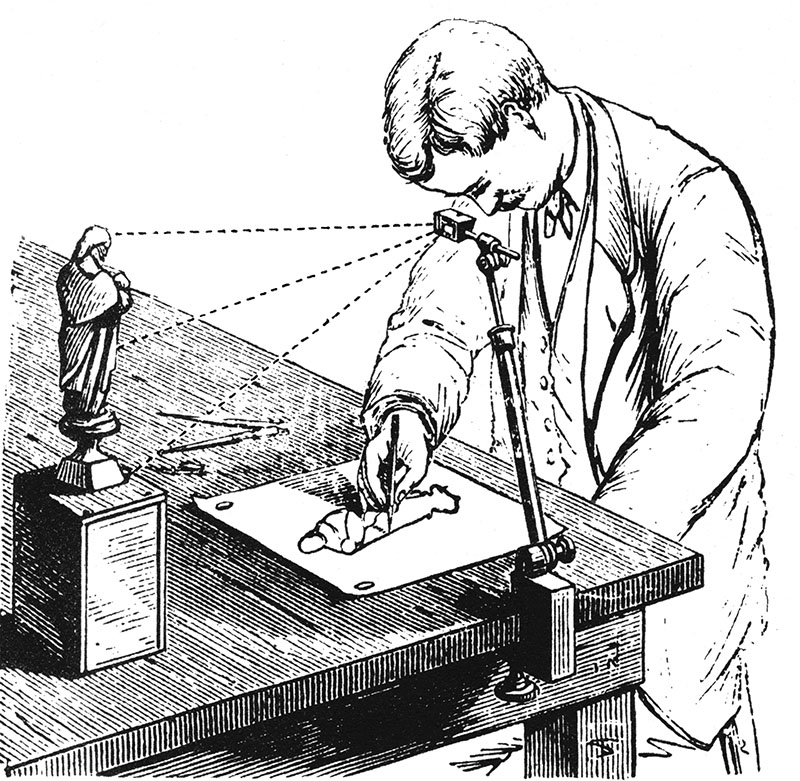
An optical device and precedent to the camera, which was used as an aid for drawing and sketching. Developed in 1806 by William Hyde Wollaston, it featured a prism with four faces set on a stand above a sheet of paper, which superimposed the reflection of the subject in front of the artist onto the drawing surface. From the Latin, meaning “light chamber.”
More Definitions
Hollowed Bone
A tool made from shaping human or animal bone and used by prehistoric people as tools as well as to…
Four-Shaft Pit Loom
A pit loom with four shafts or harnesses that support the healds through which the warp threads are passed. The…
Lease Rod
A tool used to separate warp yarn threads and keep them in their place in a hand loom. It is…
Enlarger
A transparency projector used to produce photographic prints from negatives and transparencies. Enlarging became popular in the mid to late…
High-Warp Loom
Upright handloom traditionally used for tapestry and carpet weaving, in which the warp threads are stretched vertically between roller-beams at…
Ari
An embroidery tool resembling a crochet needle, it comprises an elongated wooden handle and a long, fine needle tipped with…
Pinhole
A small circular hole used in optics and photography as an aperture for a light beam to pass through and…
stop bath
An acidic solution that is used to stop the development of photographic film once it is sufficiently developed. It acts…