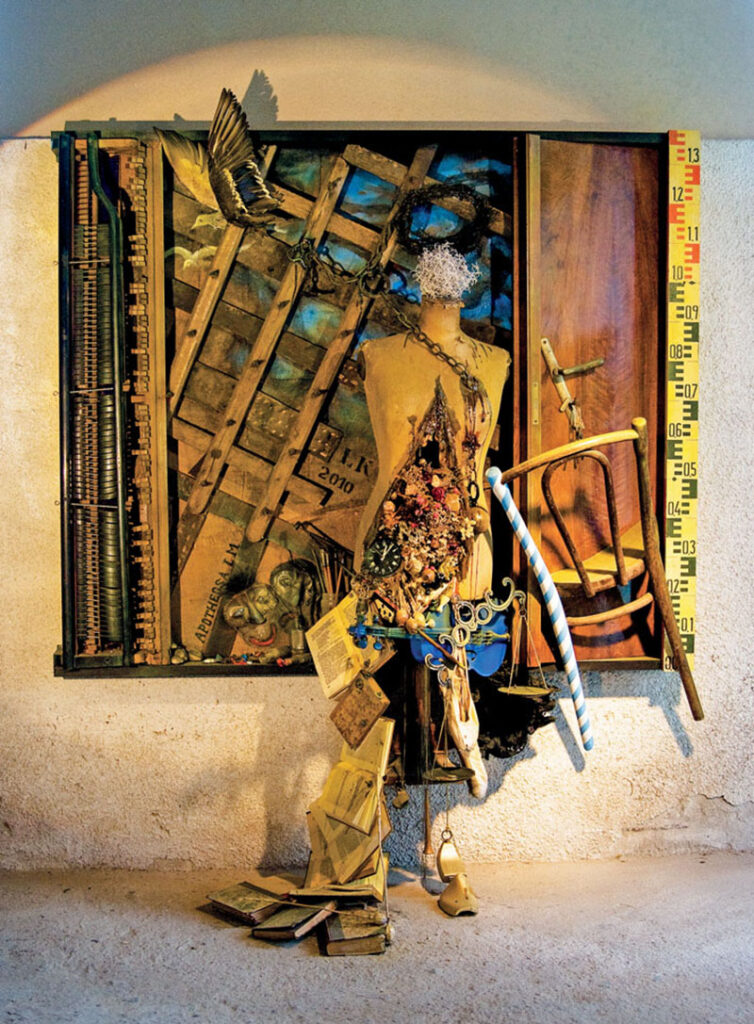
Art made by assembling disparate elements from everyday or found objects. Assemblages are often associated with movements such as Dadaism, Neo-Dadaism, Arte Povera and Young British Artists. The term was coined by the artist Jean Dubuffet in the 1950s and notable artists include Marcel Duchamp, Robert Rauschenberg, Kurt Schwitters, Joseph Cornell, Louise Nevelson and Jean Tinguely.
More Definitions
Ginning
The process of removing debris and dirt from raw cotton fibre, either manually or by running it through a mechanical…
Weft-Interlocked Technique
A form of tapestry weaving wherein weft threads of opposing colours are looped onto the same two warp threads to…
Mukaish
A variant of badla embroidery in which metallic wires are sewn onto the fabric with the help of a needle…
Illusionism
A technique in painting, sculpture and architecture where the artwork simulates the optical reality of the viewer by employing techniques…
Chandrakali Sari
A type of sari made in Ilkal in Karnataka, India, woven in dyed silk and decorated with embroidery. Traditionally considered…
Back Stitch
A variety of the stem or split stitch, wherein individual stitches are made in the opposite direction of the embroidery.…
Pietra Dura
A form of mosaic work wherein hard semi-precious stones are inlaid onto stone to form images. The decorative technique flourished…
Satin Stitch
Also known as damask stitch, it is a technique in embroidery that uses flat stitches to cover sections on a…