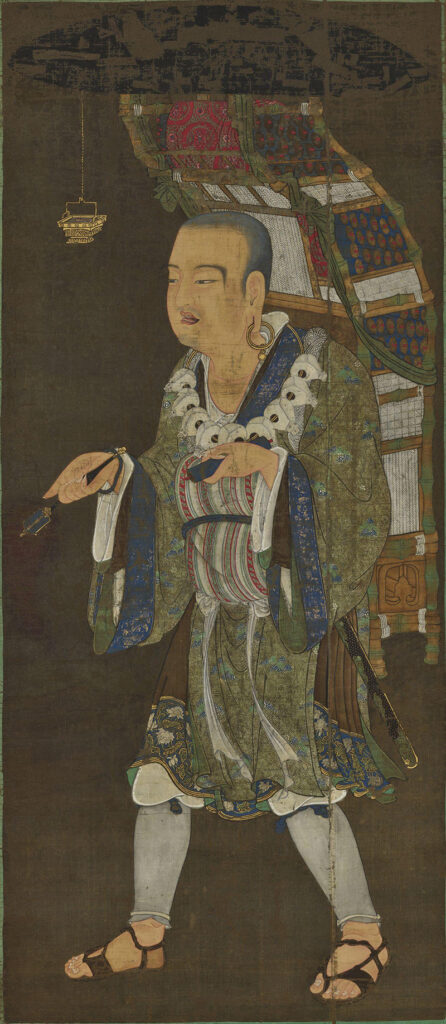
Xuanzang (602–664 CE) was a Buddhist monk, pilgrim, and scholar from present-day Yanshi in the Henan province of China. In 629, he travelled to the Indian subcontinent seeking to deepen his knowledge of Buddhism beyond the texts available in China at the time. His record of the sixteen-year journey, Datang xiyu ji (‘Records of the Western Regions of the Great Tang Dynasty’), is a key historical source for the study of seventh-century South and Central Asia, along with those of other Chinese pilgrim-travellers such as Faxian and Yijing. It contains descriptions of everyday life, political and religious observances, and Buddhist monuments and images that no longer survive intact, and has provided crucial clues and context to modern archaeologists.
Xuanzang spent several years at the Nalanda monastic university, studying Sanskrit and Buddhist philosophy. He returned to China in 645 with over six hundred Buddhist texts in Sanskrit. His translations of about seventy-five of these comprised the largest collection of Buddhist texts translated into Chinese at the time, and a major development in the Chinese Buddhist canon, designated the New Translations. Among these are some of the most important scriptures of Mahayana Buddhism. Based on his studies in the Yogachara (Vijnanavada) tradition of Mahayana Buddhism, Xuanzang wrote the Cheng weishi lun (‘Treatise on the Establishment of the Doctrine of Consciousness Only’), which became the basis of the Weishi (Consciousness Only) school in China, and is responsible for the spread of Yogachara thought to Japan and Korea. Also: Hiuen Tsang; Hsüan-tsang.