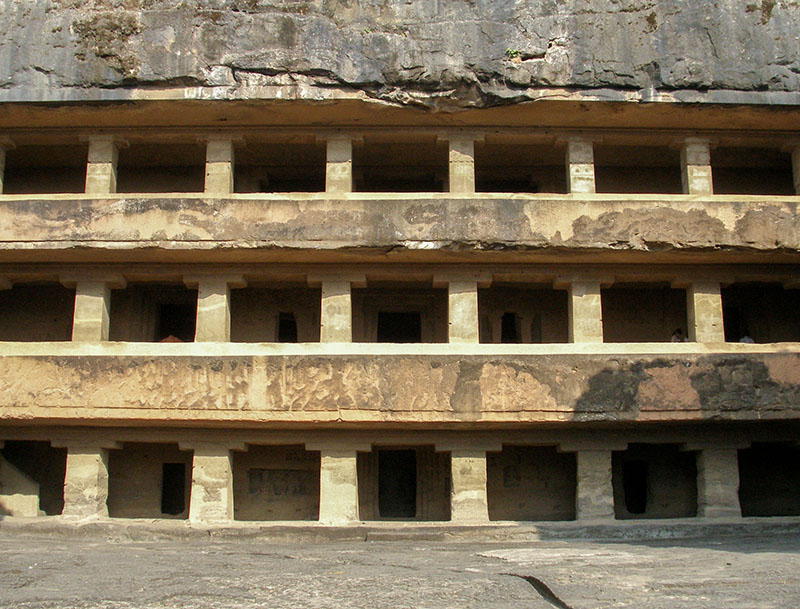
Referring to the act of leisurely strolling as well as a garden or dwelling place in Pali and Sanskrit, vihara is a Buddhist monastery and place of religious education. It typically comprises multiple residential cells for monks, connected to an open central court and an entrance porch. Initially serving as places of rest for wandering monks, the earliest surviving viharas are rock-cut structures accompanying early Buddhist cave temples in India dating to the second century BCE. These evolved into large centres of learning known as mahaviharas, such as Nalanda in India and the Shalban Vihara in Bangladesh.
More Definitions
Shala
Derived from the Sanskrit word broadly meaning "house" or "shelter", shala may refer to a covered pavilion, often oblong; a…
Palisade
A fence or defensive wall made of closely packed wooden or iron stakes or tree trunks and typically serves as…
Zenana
A Persian term for private quarters in a house reserved exclusively for women. Originally an extension of the Islamic concept…
Collonade
A row of columns, typically equidistant from each other and joined by an entablature. A colonnade may be freestanding or…
Blind Bays
In architecture, a recess or space between two vertical supports that is set on a wall without doors or windows.
stringcourse
Horizontal band running along the exterior surface of a building or a boundary wall, serving aesthetic and sometimes functional purposes.…
Apsidal
A term referring to the shape of an apse, an architectural element that serves as a semi-circular end for a…
Shikhara
A superstructure, tower or spire characteristic of North Indian temple architecture, it usually rises above the innermost sanctuary or the…