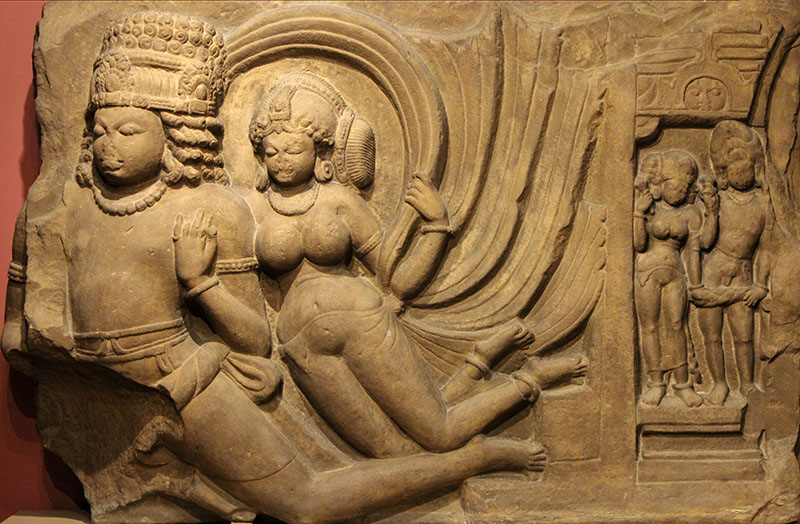
A group of demi-gods and semi-divine beings in Hindu, Jain and Buddhist mythology, they possess magical powers, with some sources describing them as possessing the ability to fly. From the Sanskrit, meaning “wisdom-holders.”
More Definitions
Mahakala
A deity common to Buddhism, Hinduism and Sikhism, whose name is composed of the Sanskrit maha, meaning "great," and kala…
Mahayogi
An epithet for the Hindu god Shiva where he is represented as an ascetic, sitting with his legs crossed and…
Gadadevi
The anthropomorphic representation of Vishnu’s gada or mace, held in one of his four hands, she is worshipped in some…
Kurma
Literally meaning "tortoise" in Sanskrit, it is second of the dashavatara or ten incarnations the Hindu deity Vishnu, wherein he…
Airavata
Meaning 'belonging to Iravati' or 'produced from water', Airavata is a celestial white elephant, usually depicted with three or five…
Atisha
Atisa Dipankara Srijnana (b. 982; d. 1054) was a religious leader and master who is considered a major figure in…
Agamic Texts
Meaning “tradition” or “received knowledge” in Sanskrit, the term refers to a set of scriptures within Hinduism, Jainism and Buddhism.…
Prakriti
In the Hindu religious tradition, it is a theological concept that describes the primary principle, or source, of matter. In…