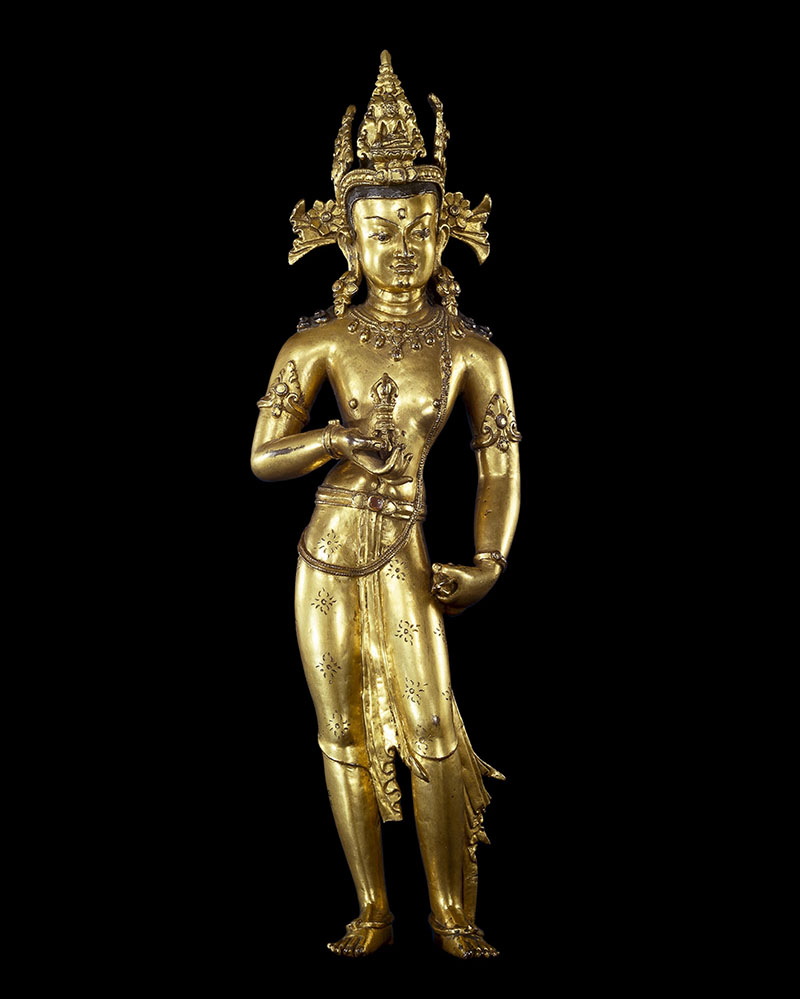
A bodhisattva in the Mahayana and Vajrayana traditions of Buddhism, he is primarily associated with the Akshobhya Buddha. Iconographically, he is white in color with a vajra or thunderbolt in his right hand and an upturned bell or ghanta in his left. Some sub-traditions of Buddhism regard him as the second patriarch of Buddhism after Vairochana Buddha. Within Tibetan Buddhism, rituals related to him are believed to purify the mind and soul.
More Definitions
Aiyanar Sasta
The guardian deity of several folk and Hindu traditions in south India. Temples to Aiyanar Sasta are usually built at…
Madrassa
An institution of higher learning in the Islamic thought. In its earliest form, it was an extension of mosques and…
Vidyadhara
A group of demi-gods and semi-divine beings in Hindu, Jain and Buddhist mythology, they possess magical powers, with some sources…
Jataka
A large collection of approximately 550 stories about the Buddha’s former lives in both human and animal form. The stories…
Hinayana
A term coined by the Mahayana Buddhist tradition to denote followers of the contrasting, more orthodox school of Buddhism. Literally…
Neelakantha
From the Sanskrit word nilakanta, meaning "blue throat," this is an epithet used for the Hindu deity Shiva. According to…
Amar Chitra Katha
A series of Indian comics begun in 1967 by Anant Pai, based on religious mythology, legends, folktales and biographies of…
Parshvanatha
Parshvanatha (b. c. 872 BCE; d. c. 772 BCE) was the twenty-third Tirthankara (propagator of dharma) of Jainism. He is…