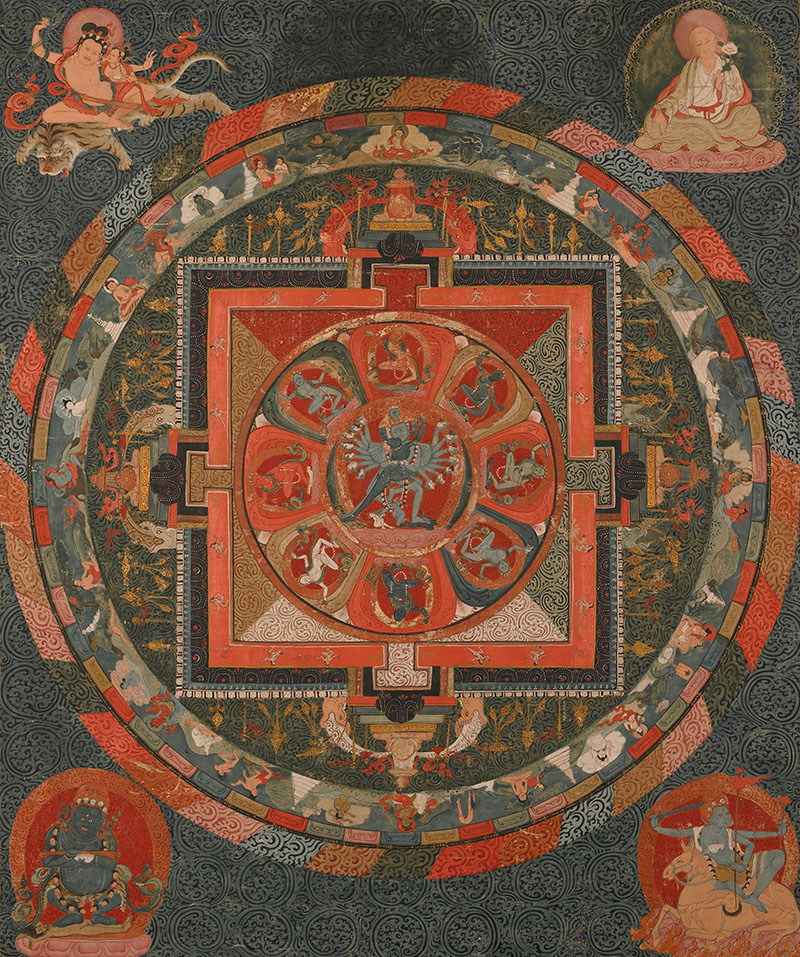
Heterodox spiritual doctrine and body of knowledge that originated around the sixth and seventh centuries CE in the Indian subcontinent, largely in Kashmir and Nepal, but also in Bengal and Assam, later spreading further south. The basic premise of Tantra is the body’s divinity and the senses as means to spiritual bliss. Some key features of Tantric ritual include the use of mantras (sacred chants), mandalas (symbolic geometrical drawings), and mudras (hand gestures). Tantra developed out of non-Vedic cultures, drawing much of its material from earlier Shaivism, though Tantric sects emerged in Vaishnavism, Buddhism and Jainism too. Important Tantric deities include Bhairava and Kali. There is huge variation in belief and practice across Tantric sects. Despite many of these sects being historically at odds with elite forms of Brahmanism, Tantrism has been enormously influential in mainstream Hinduism as it is practised today; its followers are known as Tantrikas. The term tantra is Sanskrit for loom or warp.
More Definitions
Tirobhava
Meaning “concealment” or “veiling” in Sanskrit, it is one of the cosmic acts of deities in the Hindu religious tradition.…
Chakravartin
A title referring to an ideal ruler in Buddhist, Jain and Hindu traditions and often used for the Mauryan emperor…
qadamgah
Persian for ‘footstep site’, referring to a place rendered holy by the visit of a saint or a sacred object,…
Prajnaparamita
A central concept in Mahayana Buddhism that refers to the perfect way of seeing reality. It also refers to a…
Bharata (Jainism)
In Jain mythology, he is the first chakravartin ("universal emperor") and the oldest son of Rishabha Deva, the first Tirthankara.…
Nrittamurti
The term used for a deity’s dancing form in Hindu religious iconography. It is most commonly associated with the Shiva,…
Drupada
In the epic Mahabharata, the ruler of Southern Panchala and the father of Draupadi, Shikhandi, Satyajit, Dhrishtadyumna, Uttamaujas and Yudhamanyu.…
Janaka
In the Indian epic Ramayana, the father of Sita and father-in-law of Rama. In later Vedic texts, Janaka is stated…