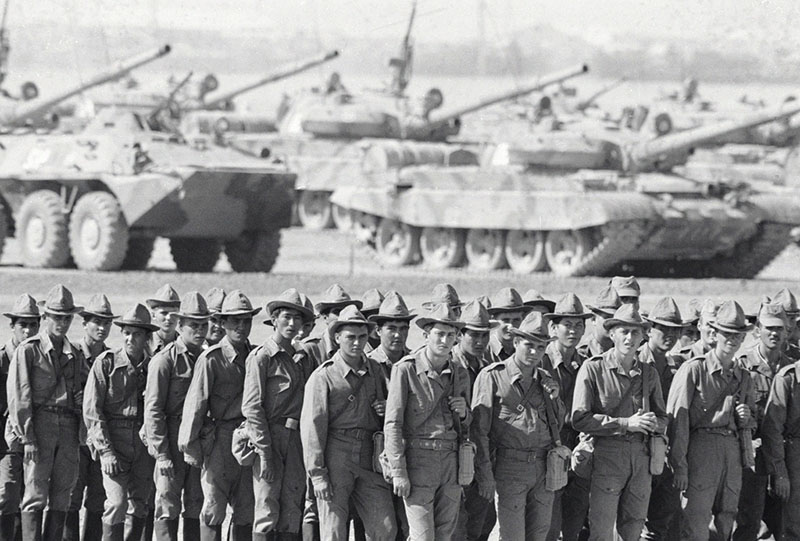
After the emergence of an unstable communist government in Afghanistan in 1978, which soon faced coups and insurgency from various local Islamic groups, the neighbouring Soviet Union invaded Afghanistan on December 24, 1979, with the intention of protecting communist influence and interests. The Soviets also aimed to preempt American intervention in the fragile political situation of the country, and installed a loyalist of theirs as the Afghan president. The Afghan War over the next decade saw continued internal conflict between the Soviet-backed Afghan government and US-supported Islamic guerrilla fighters (mujahideen); over 4 million Afghans fled to Pakistan and Iran. The Taliban emerged in the wake of Soviet withdrawal in the early 1990s. The war also eventually contributed to the collapse of the Soviet Union.
More Definitions
Peshwa
The head of the advisory council of the Maratha kingdom. While it was originally an appointed role, the office of…
Timur
Timur (1336–1405; r. 1370–1405), also known as Tamerlane, was a Turkic conqueror of Mongol descent. He rose from among the…
Kalinga War
A war fought between the independent kingdom of Kalinga and the Mauryan empire under Ashoka, which ended in 261 BCE,…
Deva Raya II
Deva Raya II (b. n.d.; d. 1446) was a ruler of the Sangama dynasty, which founded and governed the Vijayanagara…
India House, London
The premises of the High Commission of India in London, UK. The proposal for the building was put forward by…
Calico Acts
Passed by the British Parliament in 1700 and 1721, these acts banned the sale and use of imported calico cloth…
Karnat dynasty
Dynasty that ruled Mithila (parts of India and Nepal) between 1097 and 1324 CE, preceded by the Palas and followed…
Portuguese Estado Da India
A Portuguese term literally meaning the State of India, it is used to refer to the regions of India that…