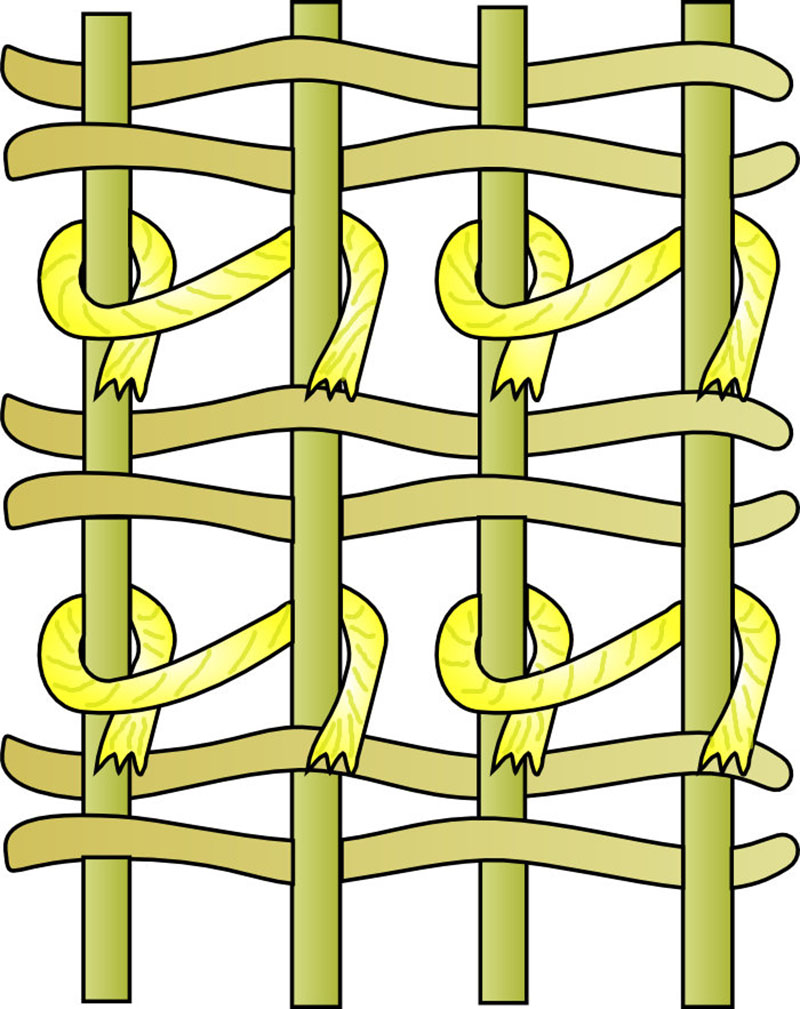
Also known as a Senneh knot, it is a technique of hand-knotting found in rugs from eastern Iran, India and Pakistan. Half of the weft thread is knotted tightly with the warp with the other end is left loose, resulting in an asymmetric knot, which can be manipulated further to create more complex designs. The technique is typically used to create rugs with high knot counts and detailed designs.
More Definitions
Dorukha
A textile with double-sided design, typically seen in Kani weaving and kantha embroidery. The embroidery is executed in a way…
Engine Oil Painting
Paintings made using engine oil as the pigment binder, instead of typically used oils such as linseed or safflower oil.…
Tintype
A photograph made by creating a positive directly on a thin sheet of black-enamelled metal coated with collodion. They were…
Hand Stencil
The technique of imprinting human hands on rock surfaces, found in Prehistoric cave paintings. The process involves placing one hand,…
Cable-Edging
A motif with a raised surface, it is often found in textiles. Cables are created by knitting out of order,…
Tapestry Weave
A weft-facing technique of weaving, wherein coloured weft yarns are interlaced with plain-coloured warp. The design is created using the…
Secco
Also called fresco secco or fresco finto, this is a technique of wall or mural painting wherein casein, tempera or…
Carding
The process of untangling and cleaning raw plant or animal fibre to produce a continuous fibre suitable for spinning into…