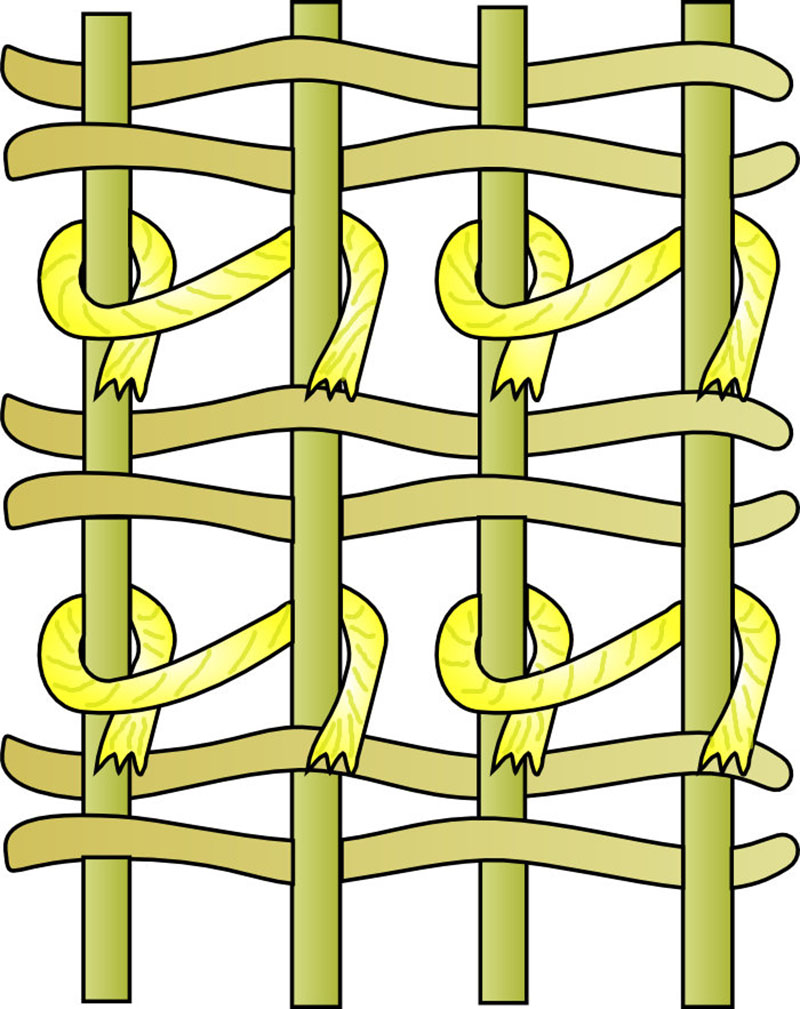
Also known as a Senneh knot, it is a technique of hand-knotting found in rugs from eastern Iran, India and Pakistan. Half of the weft thread is knotted tightly with the warp with the other end is left loose, resulting in an asymmetric knot, which can be manipulated further to create more complex designs. The technique is typically used to create rugs with high knot counts and detailed designs.
More Definitions
Gelatin Dry Plate
A method of producing photographic negatives that emerged in the 1880s, using a glass plate coated with silver salts in…
Madras terrace
A technique of brick-and-lime flat roof construction, named after the erstwhile Madras Presidency of colonial South India where it emerged.…
Overdye
In textile production, it is the practice of dyeing a fabric or yarn that has already been dyed.
Serigraphy
A stencil-based printing process which involves forcing ink through a fine screen, usually made of silk, polyester or nylon, onto…
Linocut
A printmaking process in which a design is carved in relief on a sheet of linoleum, then inked. The sheet…
Gilt
An object that is covered with a thin layer of gold, often used in jewellery, ornamentation and textile. From the…
Radiocarbon Dating
A method of determining the objective age of carbon-based materials by measuring the amount of carbon-14, formed when the nitrogen…
Patthakati
Skilled artisan involved in the process of making Benarasi brocade textiles, who punch holes in a card corresponding to a…