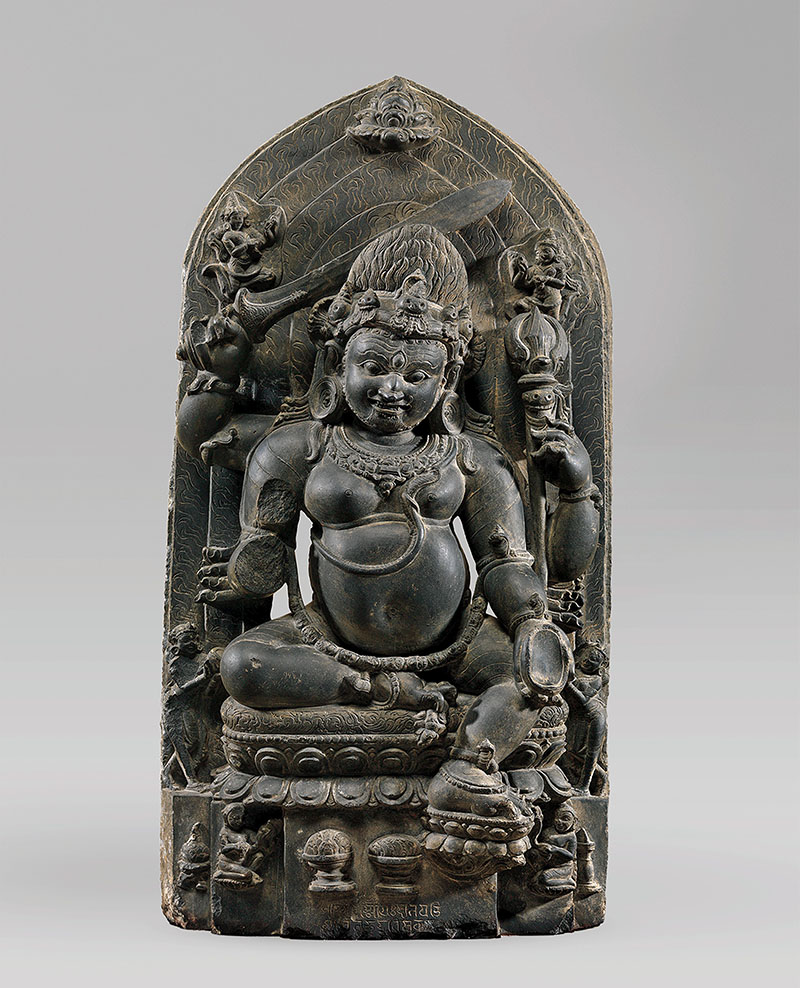
A deity common to Buddhism, Hinduism and Sikhism, whose name is composed of the Sanskrit maha, meaning “great,” and kala meaning “time” or death,” thus denoting “the one who is beyond time or death.” In Hinduism, he is considered to be a manifestation of the deities Shiva and Vishnu, as well as consort to the goddess Mahakali. Within Vajrayana Buddhism and Tibetan Buddhism, he is a protector deity and is also known as dharmapala, while in Sikhism, he is known by the name Kala.
More Definitions
Yana
A metaphor for a mode or method of spiritual practice in Buddhism, which refers to the vehicles of teaching imparted…
Upanishad
A body of texts written in Sanskrit and considered to be the latter part of the Vedas. They cover issues…
Jinas
Also known as Tirthankaras, jinas are teachers and guides who lead their followers on the path of dharma and are…
Shakti
The primordial cosmic energy that represents the dynamic forces of the universe in the Shaktism sect. The figure is the…
Sundereshwara
A form of the Hindu deity Shiva worshipped as one of the principal deities of the Meenakshi Temple, Madurai, in…
Pasupatastra
A destructive weapon attributed to the Hindu deities Shiva, Kali and Mahadevi. The weapon is considered powerful enough to destroy…
Mahabali
A Daitya king and the grandson of Prahalad, he is mentioned in a number of texts and myths within Buddhism,…
Kaushalya
The seniormost queen of King Dasaratha, she appears in the Hindu epic Ramayana epic as the mother of Rama.