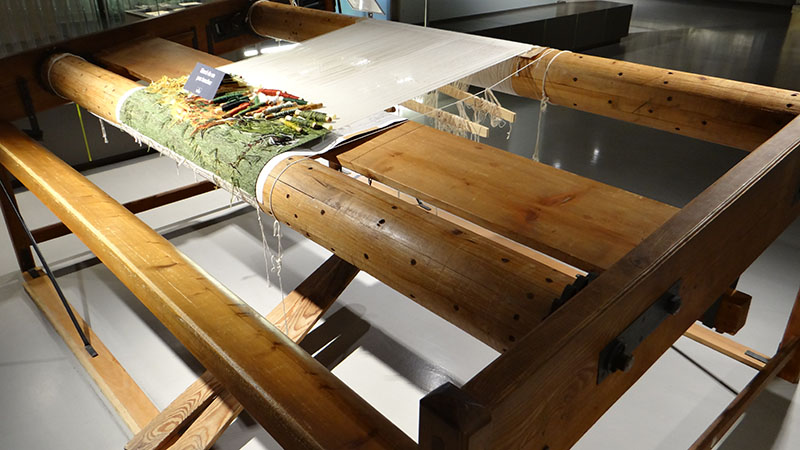
Handloom commonly used for traditional tapestry and carpet weaving, in which the warp threads are stretched parallel or nearly parallel to the ground between two rollers that help control the tension. The shed or gap for the weft threads to pass through is opened using treadles, leaving the weaver’s hands free and making the weaving process faster than with the hand-operated mechanism of the upright high-warp loom. The weaver works weft patterns into the back of the warp using a reference image placed underneath, typically viewed by tilting the frame or using a mirror.
More Definitions
Three-Shuttle Loom
A loom that uses three shuttles to create saris with a dense weave and solid colours. It utilises two shuttles…
viewfinder
The eyepiece on a camera that allows the photographer to compose and determine the focus of the image received through…
developer
In photography, a chemical solution used to reveal the latent image that has been captured on the photographic film, as…
Heald
Also known as a heald wire or heddle, it is the part of the loom through which warp threads are…
Ambar Charkha
A version of the traditional charkha which uses multiple spindles as opposed to a single spindle and is intended for…
box camera
Simple camera consisting of a light-sealed cuboidal box that has a lens fixed to one end, and the photographic film…
Frame Loom
Made of rods and boards fixed at right angles, it is a compact, box-shaped loom. It is portable and can…
Medium Format Camera
Film cameras that produce images larger than 24 mm x 36 mm but smaller than 4 inches x 5 inches.