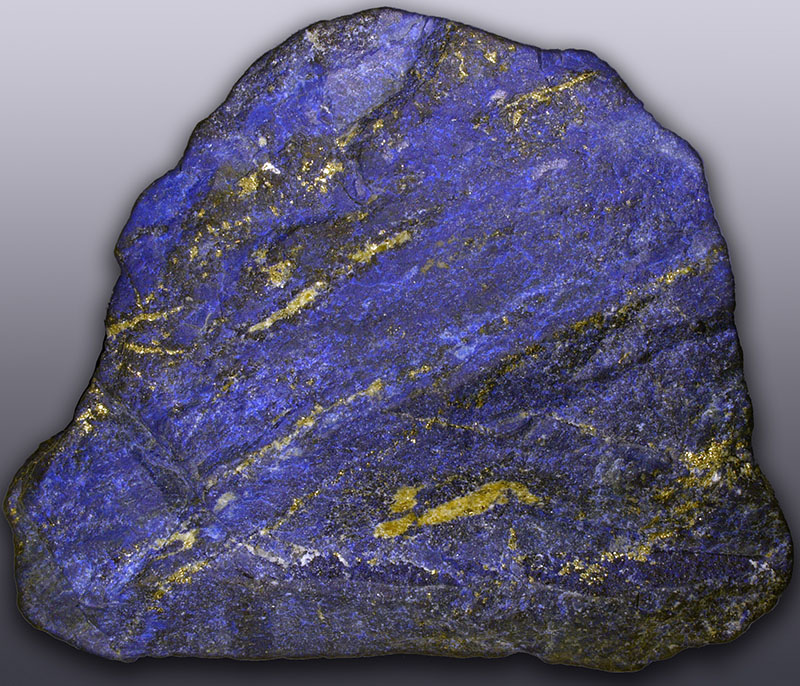
Mostly opaque semi-precious stone of a brilliant blue colour, and the natural source of ultramarine pigment. Lapis lazuli (Latin, lapis: ‘stone’; lazuli from Persian lajaward, denoting ‘azure’ and the stone itself) is a metamorphic rock of varying composition primarily comprising lazurite, which lends it the blue colour; calcite, deposited as white streaks or spots; and pyrite, seen as metallic yellow flecks or veins. Varying proportions of these minerals give lapis lazuli a range of hues and homogeneity, from an even, deep blue with golden flecks and no visible white — the most highly valued — to a muddy green or pale blotchy blue. The mountains of Badakhshan in Afghanistan are, historically and to the present day, the source of the finest lapis; other major deposits are found in the Coquimbo Region in Chile and near Lake Baikal in Siberia.
The use of lapis lazuli as a gemstone dates back to Ancient Mesopotamia and Egypt. Among the earliest known uses of pigment ground from lapis are sixth–seventh century cave paintings in Bamiyan, Afghanistan, as well as Chinese paintings and Indian murals from the tenth and eleventh centuries, and thirteenth–fourteenth century Persian miniatures. Though extremely expensive, it became popular in illuminated manuscripts and paintings of fourteenth–sixteenth century Renaissance Europe, where it was often reserved for the blue cloaks of Jesus and the Virgin Mary. In 1828, ultramarine was first synthesised artificially in France and Germany, at one-tenth the price of the natural pigment, leading to its burgeoning commercial production.