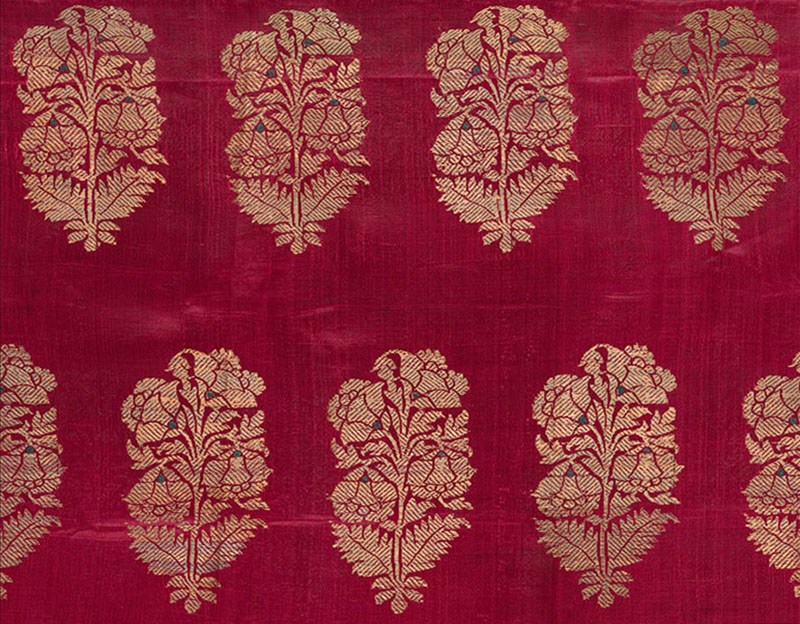
Meaning “little dream,” it is a woven brocade, characterised by a dense and rich zari work on the surface that renders the underlying silk fabric almost invisible. The complex weave was popular in the Mughal era, at which time production was centred in present-day Gujarat and the city of Benaras (Varanasi). Benaras remains an important centre of kinkhwab-weaving today.
More Definitions
Plain Weave
Also known as tabby weave, it is the most common weave in textiles. In this weave, each weft yarn passes…
Impasto
A painting technique in which paint is thickly applied to the canvas, creating a surface texture. This can aid in…
Mukaish
A variant of badla embroidery in which metallic wires are sewn onto the fabric with the help of a needle…
chamfer
A slope or bevel, typically at 45º, at the intersection between planes in woodwork, architectural and engineering detailing, and other…
Sapma and Thrima
Discontinuous patterning techniques in Bhutanese weaving, using supplementary weft to create single-faced motifs and patterns (invisible on the reverse of…
Wax Resist-Dyeing
A technique of resist-dyeing in which molten wax is applied to portions of a textile, using blocks or a pen-like…
Carding
The process of untangling and cleaning raw plant or animal fibre to produce a continuous fibre suitable for spinning into…
Tiraz
Textiles with embroidered inscriptions produced in Iran during the early Islamic period, until the fourteenth century CE. Robes made of…