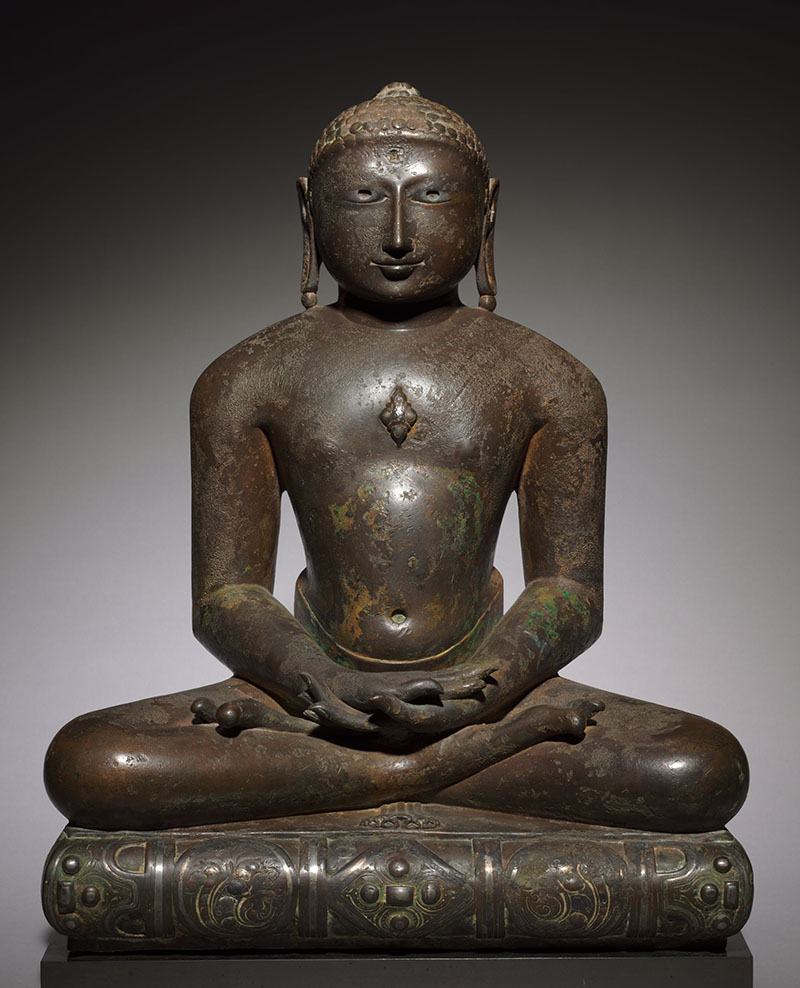
A concept in Jainism that pertains to omniscience or the attainment of supreme wisdom. It is the last in the fourteen stages of spiritual development in Jainism. According to Digambara beliefs, a kevalin (someone who has attained kevala) does not experience hunger and thirst, whereas according to Svetambara beliefs, a kevalin has human needs and travels to preach. From the Sanskrit word kevala, meaning “one and only.”
More Definitions
Jataka
A large collection of approximately 550 stories about the Buddha’s former lives in both human and animal form. The stories…
Tarikh-i-Khandan-i-Timuriya
An illustrated manuscript that details the history of Timur and his descendants in Iran and India. It was commissioned by…
Lotus Sutra
A collection of scriptures associated with Mahayana Buddhism, which influenced the creation of the Tiantai, Tendai, Cheontae and Nichiren schools.…
Moksha
Also called vimoksha, vimukti, mukti and nirvana, it is an Indian philosophical concept that signifies liberation from the cycle of…
Sangam Period
The early historical period of the southernmost region of India, corresponding to present-day Tamil Nadu and parts of Kerala. Dating…
Hiranya
A Sanskrit term meaning “golden.”
Brihat Samhita
A Sanskrit text written by the astronomer Varahamihira in the sixth-century CE, during the Gupta period. Primarily centred on astrology,…
Puranas
A genre of ancient and religious texts written in Sanskrit, Tamil and other languages. The texts are encyclopaedic and cover…