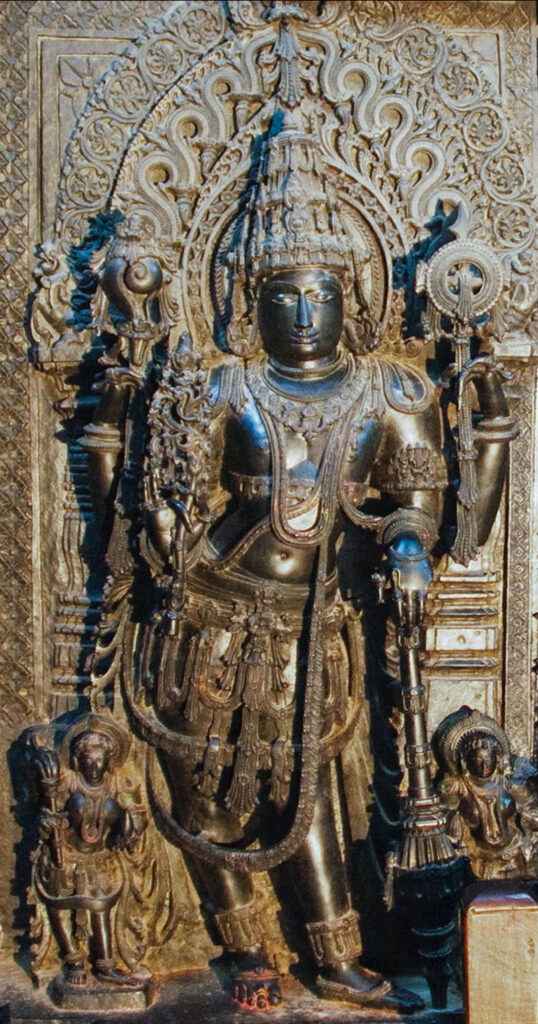
In Hindu religious mythology, he is an attendant of the deity Vishnu. Along with Vijaya, he is a dvarapala or a dvarapalaka (gatekeeper) of Vaikuntha, Vishnu’s abode. The pair are frequently depicted at the doorways and entries of temples dedicated to Vishnu.
More Definitions
Mahakala
A deity common to Buddhism, Hinduism and Sikhism, whose name is composed of the Sanskrit maha, meaning "great," and kala…
Khadgapurusha
The anthropomorphic representation of Vishnu's sword as a male figure, following the Ayudhapurusha tradition.
Parshvanatha
Parshvanatha (b. c. 872 BCE; d. c. 772 BCE) was the twenty-third Tirthankara (propagator of dharma) of Jainism. He is…
stambha
Sanskrit for ‘pillar’, historically appearing in various contexts, including Vedic liturgy, Brahmanical mythology, and Brahmanical treatises on architecture, theatre and…
Samhara
Meaning "destruction" or "withdrawal" in Sanskrit, it is one of the cosmic acts of deities in the Hindu religious tradition.…
Aiyanar Sasta
The guardian deity of several folk and Hindu traditions in south India. Temples to Aiyanar Sasta are usually built at…
Himavata
In Hindu mythology, Himavat is the lord of the mountains and the father of Ganga and Parvati, the consort of…
Nadanta
An alternate name to describe the anandatandava, the cosmic dance of Nataraja, a form of the Hindu deity, Shiva.