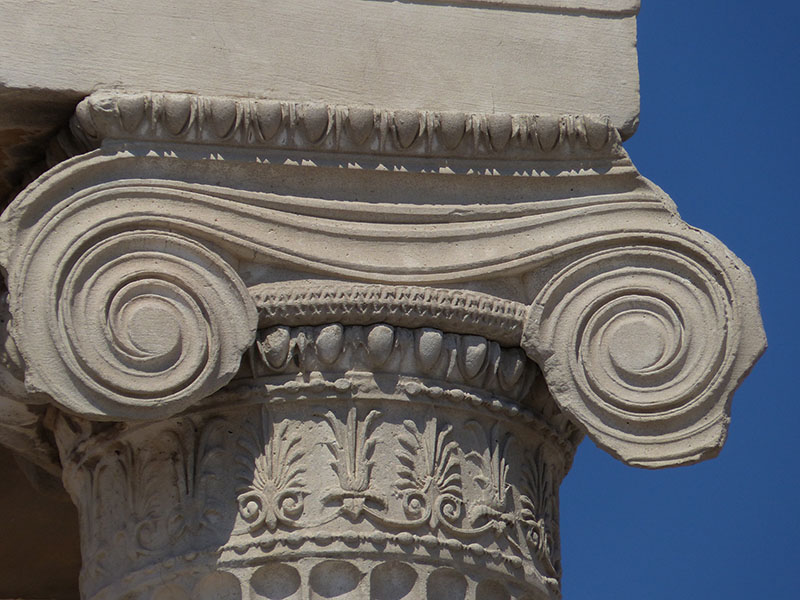
One of the three canonical orders of Western Classical architecture, it originated in the mid-sixth century in Ionia (present-day Turkey). It is characterised by the use of two symmetrical volutes on the pillar capital. Below the volutes, the column is typically designed with a wide collar or banding that separates the capital from the shaft of the pillar.
More Definitions
Colour Field Painting
An abstract painting style categorised within American Expressionism, it is characterised by large-scale canvases painted expansively with flat, solid colour…
Lyrical Abstraction
Romantic, expressive and abstract paintings made using loose and gestural brushstrokes. The style developed in France and the United States…
Open Sculptures
Sculptures which have an opening and are not a solid mass. These sculptures are usually made with intersections of lines…
Art Nouveau
A cultural movement in art, architecture and applied and decorative arts that sought to modernise design and free it from…
Literalism
A term often used synonymously with minimalism, it refers to a style of art and literature characterised by the portrayal…
German Expressionism
An art movement that emerged in early twentieth-century Germany, characterised by irregular brushstrokes and gestural marks which eschewed realist depictions…
Happenings
A precursor of performance art, they are events or situations where the artwork is created by the conditions produced by…
Architectural Views
A genre of painting that focused predominantly on buildings and their interiors rather than treating them as background. Architectural painting…