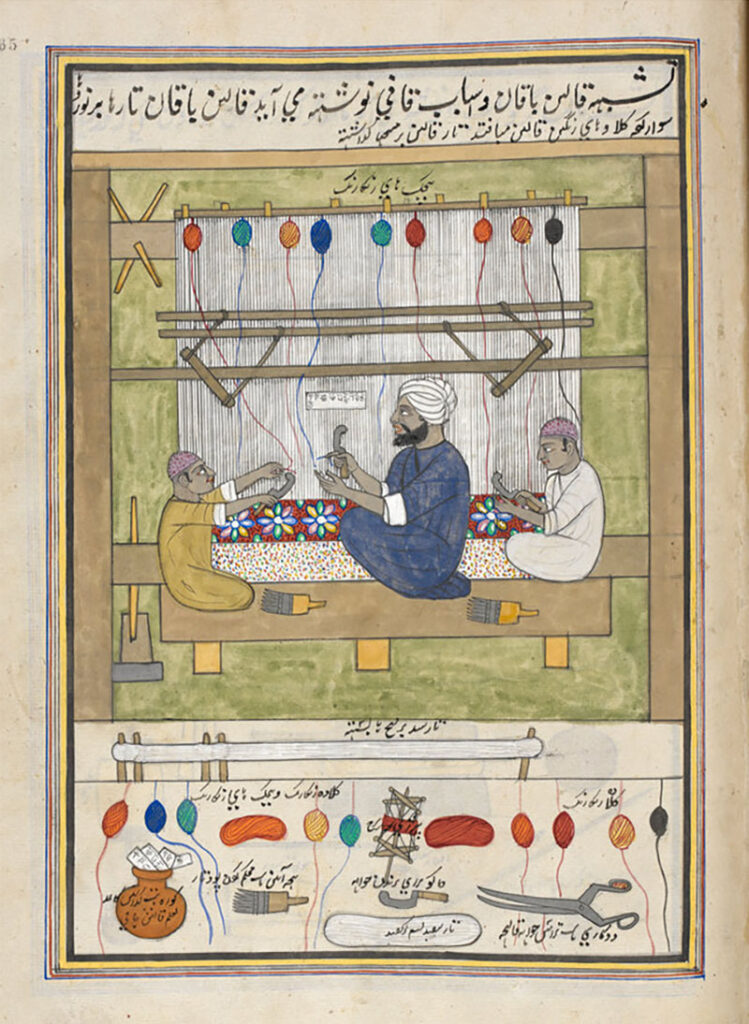
Upright handloom traditionally used for tapestry and carpet weaving, in which the warp threads are stretched vertically between roller-beams at the top and bottom, or, in early versions, suspended from a cross-beam at the top and weighted at the bottom. The shed or gap for the weft threads to pass through is opened by a hand-operated mechanism, making the weaving process slower than the treadle-operated low-warp loom. Facing the loom, the weaver works weft patterns into the back of the warp, ensuring consistency with the reference image by going around the loom or using mirrors. The high-warp loom is speculated to have originated in Syria or Mesopotamia.
More Definitions
Camera Lucida
An optical device and precedent to the camera, which was used as an aid for drawing and sketching. Developed in…
box camera
Simple camera consisting of a light-sealed cuboidal box that has a lens fixed to one end, and the photographic film…
Collodion Wet Plate
A nineteenth-century method of producing photographic negatives using a glass plate coated with a silver emulsion. While relatively inexpensive and…
fixer
In photography, a chemical solution used in the final stage of processing photographic film. It contains sodium or ammonium thiosulphate,…
Bageshwari charkha
Treadle-operated charkha or spinning wheel used in the Indian subcontinent to spin carded wool, cotton, silk, nettle or hemp into…
Gadh
Also spelt gad, it is a type of block used in textile block-printing. The image in the block is carved…
Medium Format Camera
Film cameras that produce images larger than 24 mm x 36 mm but smaller than 4 inches x 5 inches.
Enlarger
A transparency projector used to produce photographic prints from negatives and transparencies. Enlarging became popular in the mid to late…