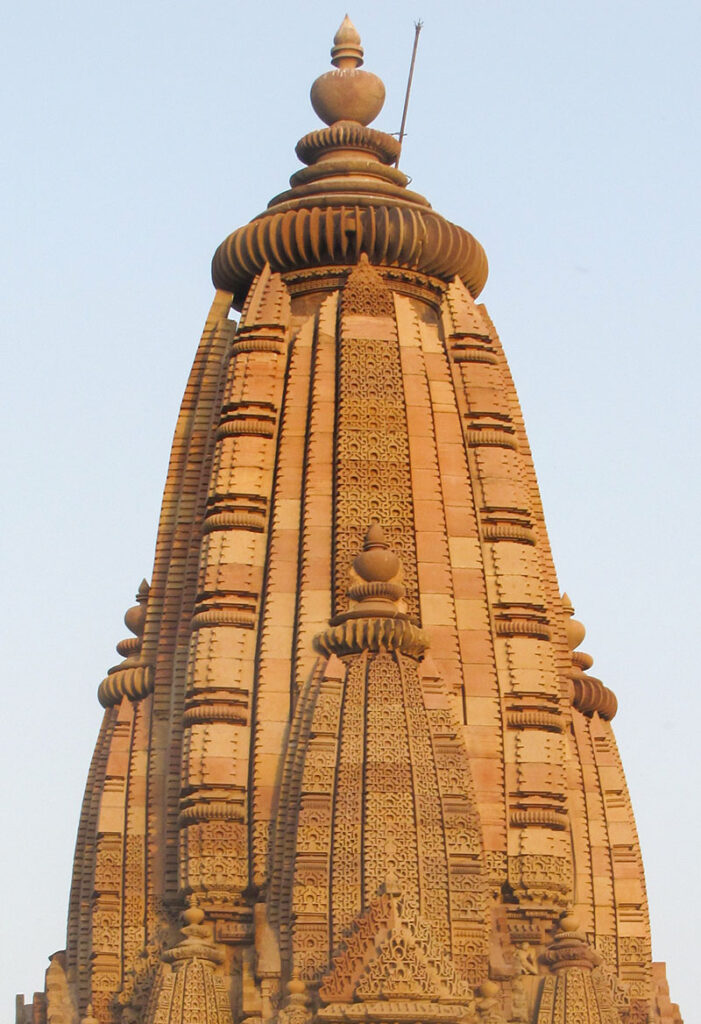
Ribbed or notched stone disk that is part of the crowning segment in Kalinga and Nagara temple architecture. The amalaka is placed on top of the temple’s superstructure or shikhara, and surmounted by a kalasha or vase finial. It is said to be named after the Indian gooseberry, amala (fruit of the tree Phyllanthus emblica), and symbolises either a lotus — the seat of the temple deity — or a gateway to the heavens.
More Definitions
Torana
Meaning ‘gateway’ or ‘arched entrance’ in Sanskrit and Pali, torana refers to a free-standing gateway marking the entrance to a Buddhist shrine or…
Panchayatana
A layout in traditional Hindu temple architecture in which the central shrine is surrounded by four subsidiary shrines, each at…
Pilaster
A decorative architectural motif where a narrow portion of the wall projects outwards and resembles a rectangular pillar-like structure. In…
Cornice Moulding
A horizontal decorative moulding applied to the edges at the top of an interior wall, ceiling or pedestal. They date…
Ardhamandapa
A half-open pillared hall in Hindu temples. The ardhamandapa serves as an open porch at the entrance of the temple…
Kalyana Mandapa
A pavilion found within a temple complex that is used to celebrate the divine wedding of the temple’s principal deity…
Hirka-i-Sharif Mosque, Istanbul
Mosque in Istanbul, Turkiye, built in 1851 to house the cloak relic of Prophet Muhammad, from which it receives its…
Kapotabandha
In Indian temple architecture, it is a style of decorative moulding seen on a tier of the adhisthana, the raised…