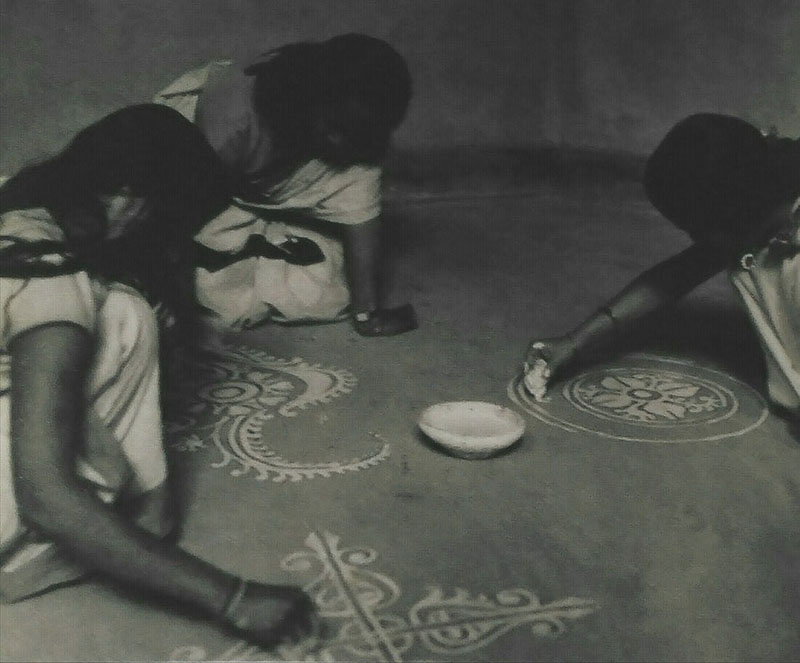
A ritual Bengali practice of making designs and paintings featuring religious motifs and patterns, typically made in white using a pigment derived from rice powder. It is traditionally made by women during festivals and ceremonies. From the Sanskrit alimpana, meaning “to plaster” or “to coat with.”
More Definitions
Alam
A religious processional object used by the Shi’a community on Ashura, the tenth day of Muharram. It is considered a…
Pradakshina
A ritual act in Hinduism, Buddhism, Jainism and Sikhism, it is a clockwise circumambulation in which a devotee takes a…
Agamic Texts
Meaning “tradition” or “received knowledge” in Sanskrit, the term refers to a set of scriptures within Hinduism, Jainism and Buddhism.…
Karva Chauth
A Hindu festival, it is primarily celebrated by women in northern India during the Hindu month of Kartika. On this…
Meenakshi Thirukalyanam
A temple festival held annually at the Meenakshi Temple in Madurai, Tamil Nadu to mark the ritual coronation of Meenakshi…
Rathyatra
A public chariot procession associated with the worship of the Hindu god Jagannath and predominantly celebrated in the states of…
Vanamala
An important motif in Vaishnavite Hinduism, it is offered as a garland to Krishna and Vishnu. It is usually identified…
Utsavamurti
Processional idol in Indian temples, usually made of metal. During temple festivals, a representation of the temple’s central deity/deities is…