-
ChicagoImpart Encyclopedia of Art. "Chitrakathi." August 5, 2026. https://imp-art.org/articles/chitrakathi/.
-
MLA"Chitrakathi." Impart Encyclopedia of Art, Aug. 5, 2026, https://imp-art.org/articles/chitrakathi/.
-
HarvardImpart Encyclopedia of Art (2026) Chitrakathi. Available at: https://imp-art.org/articles/chitrakathi/ (Accessed: 10 October 2026).
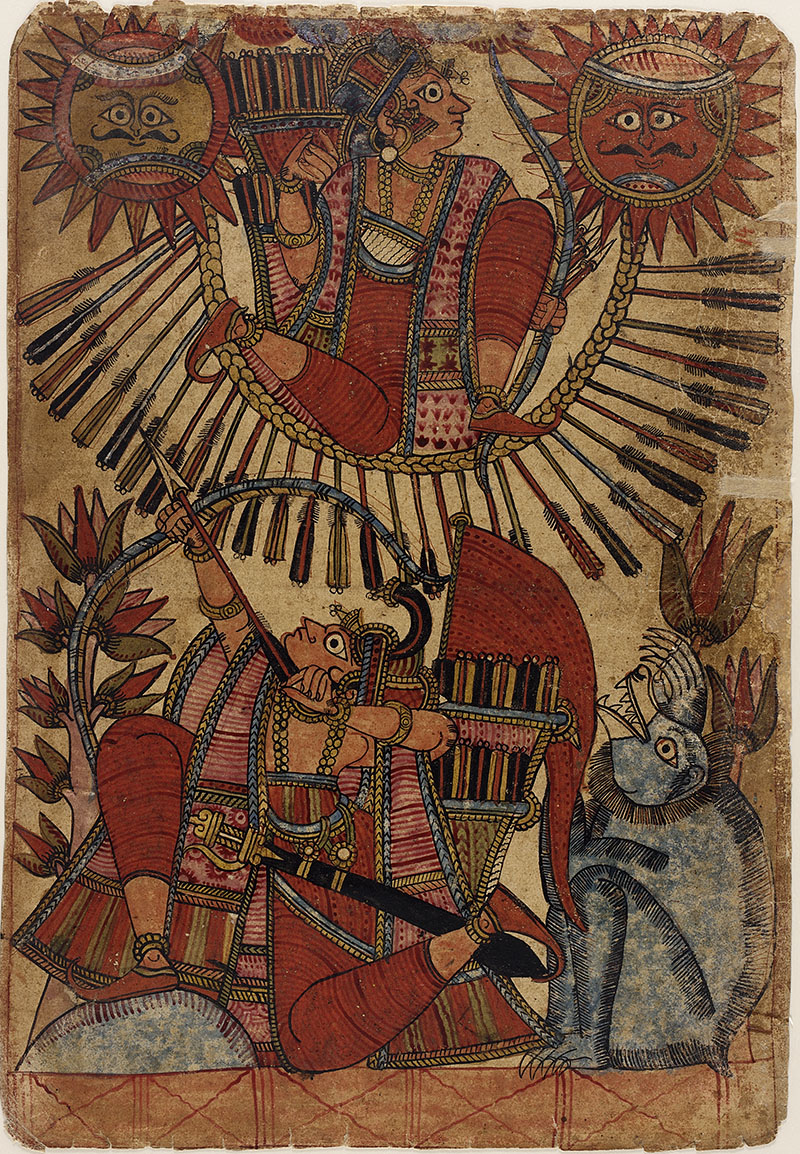
A pictorial and oral performance tradition of the western Deccan in India, chitrakathi (from the Sanskrit chitra: ‘painting’ and kathi: ‘story’) is practised by members of the Thakar community, an Adivasi group from the Konkan coast and western Sahyadri hills. A typical chitrakathi performance involves one to four performers, known as sutradhar (Sanskrit, ‘narrator’), who display a series of small paintings as they narrate stories from folklore and Hindu mythology, particularly the Ramayana, the Mahabharata, and the Puranas.
Historical background
Visual narrative recitation and performance have been described in Indian textual sources from the ancient period on, including the Sanskrit grammarian Patanjali’s Mahabhashya (second century BCE), the Jain Bhagavati Sutra (fifth century CE), and the eighth-century Prakrit novel Kuvalayamala. Chitrakathi is one of several such practices still extant in the subcontinent today, including the patachitra of Bengal and Odisha, the phad and kavad of Rajasthan and the Garoda scrolls of Gujarat. It is distinguished, however, by the use of individual paintings on rectangular sheets, with each painting depicting a distinct narrative moment or scene, instead of the more common running-scroll style.
Chitrakathi has historically been practised by artists from the Adivasi Thakar community, whose numerous other performance traditions also include shadow puppetry (charma bahuli natya) and string puppetry (kalasutri bahulya). Once itinerant bards, they have since settled and no longer travel from village to village. The precise origins of the tradition are unknown, but historically its geographical scope is thought to have included most of present-day Maharashtra, Telangana, northern Karnataka, and parts of Andhra Pradesh.
As per the Thakars’ oral tradition, their ancestors migrated to the western Deccan from Rajasthan; here, their performances were noticed by the Maratha ruler Shivaji Bhonsle (r. 1674–1680) while he was hunting in the forest. Impressed by their artistry, he offered them patronage and provided them with a steady supply of handmade paper for their paintings. He is also said to have employed them as informants, as the itinerant performers had legitimate cover to enter villages, perform in their temples, and mingle with the locals. It is also believed that a land grant from the king allowed the Thakars to settle down in the Pinguli village in the Ratnagiri district of Maharashtra — where they reside today — and possibly other villages.
Nineteenth-century colonial surveys documented the presence of chitrakathi practitioners in parts of the erstwhile Bombay Presidency, including Pune, Satara and Nasik, and the neighbouring administrative region of the Central Provinces and Berar, recording a substantial population in parts of what is now eastern Maharashtra. These documents — census reports, gazetteers and anthropological surveys — describe codified professional norms observed by the practitioners in Bombay; failure to comply with these was penalised with fines likely levied by an internal community organisation. Colonial records identify a distinct Chitrakathi caste in these regions, noting wide variation in surnames and occupations of sub-castes; but the relationship between the caste and contemporary practitioners is unclear. The Thakars of Pinguli, the only extant chitrakathi practitioners, are now a notified Scheduled Tribe and are the most documented lineage of chitrakathi-practising communities. Other groups have likely taken up other occupations; still others may be extant and unknown to scholars. Part of the erstwhile princely state of Sawantwadi, Pinguli is the only known major chitrakathi painting centre that scholars are aware of.
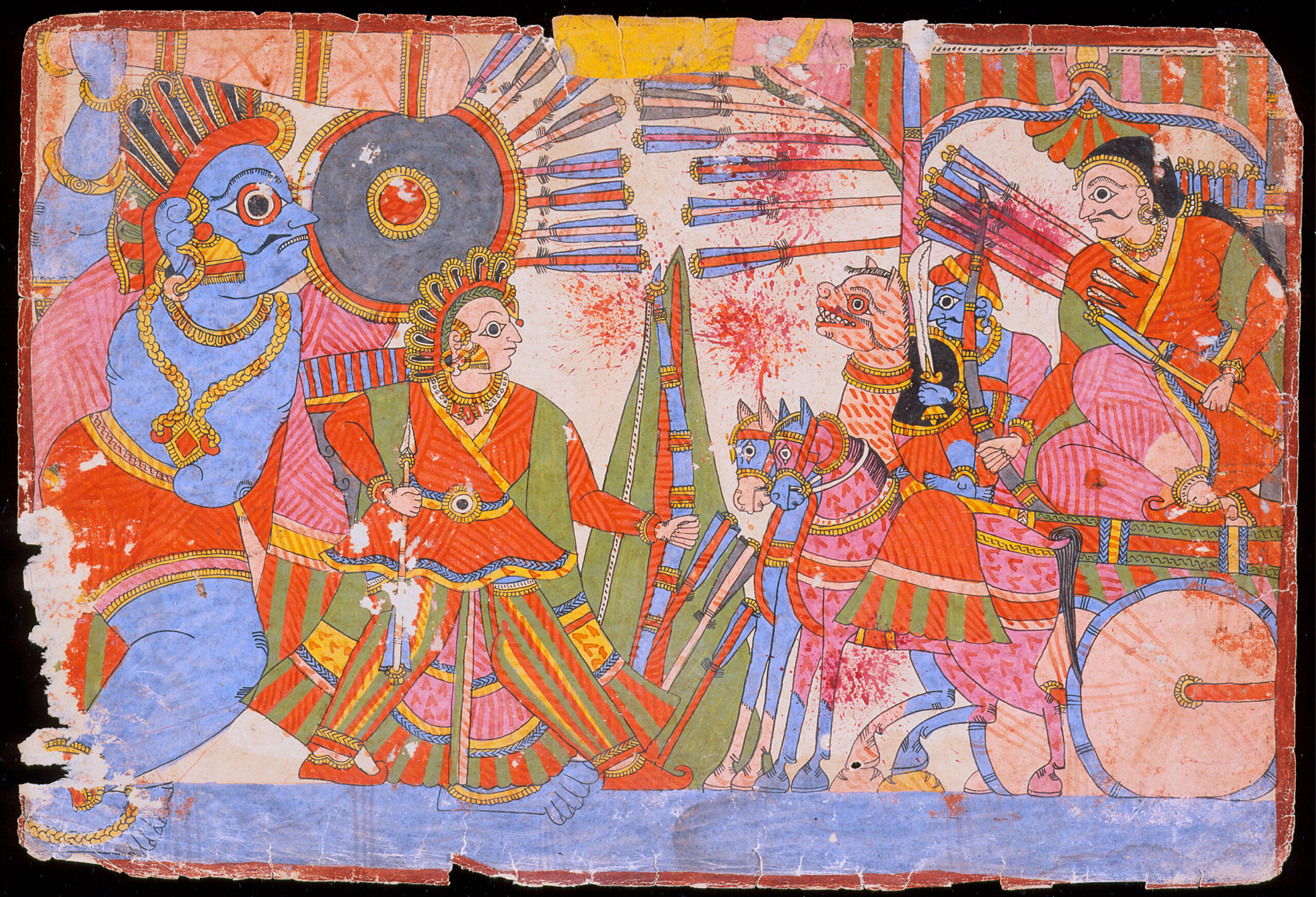
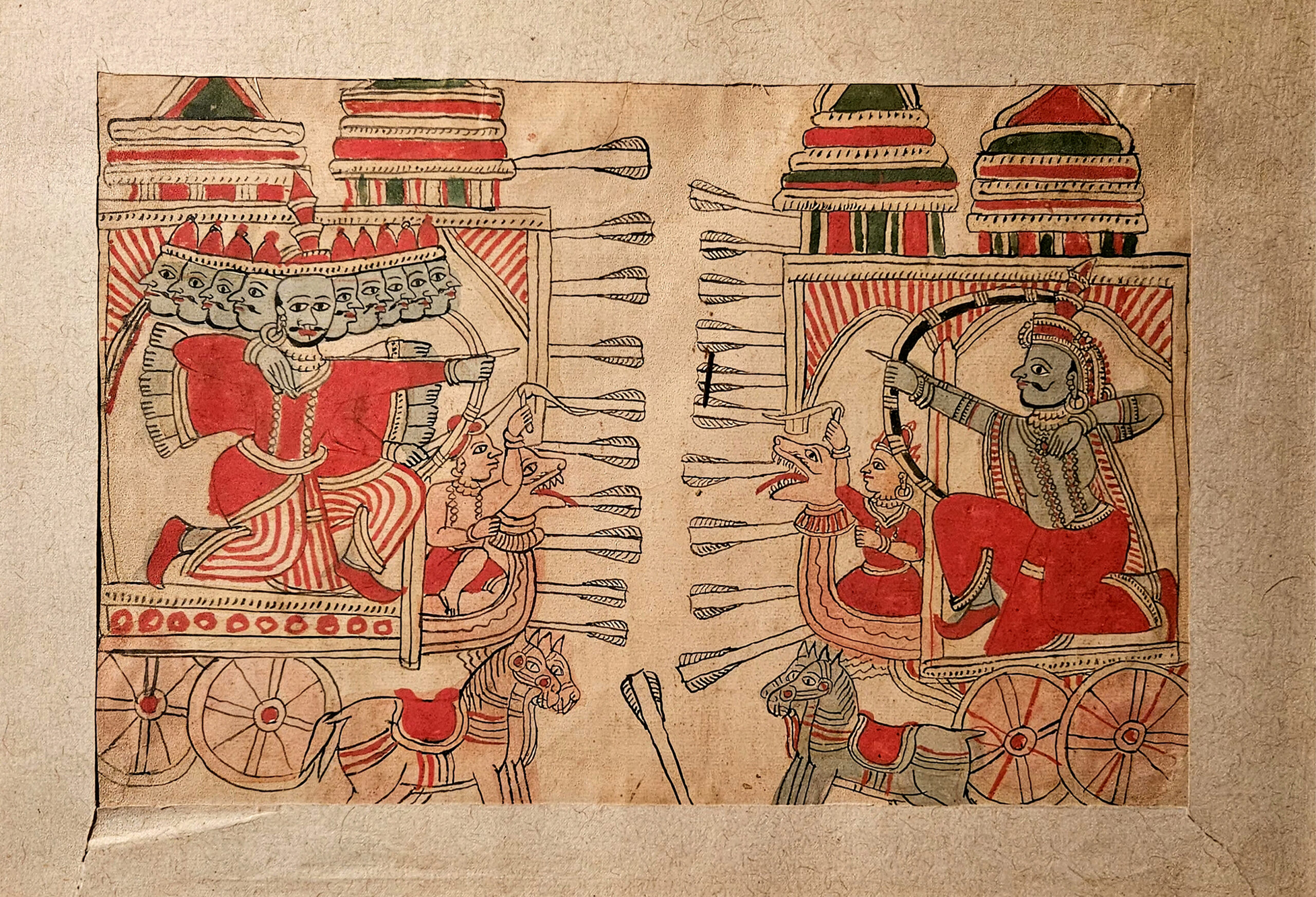
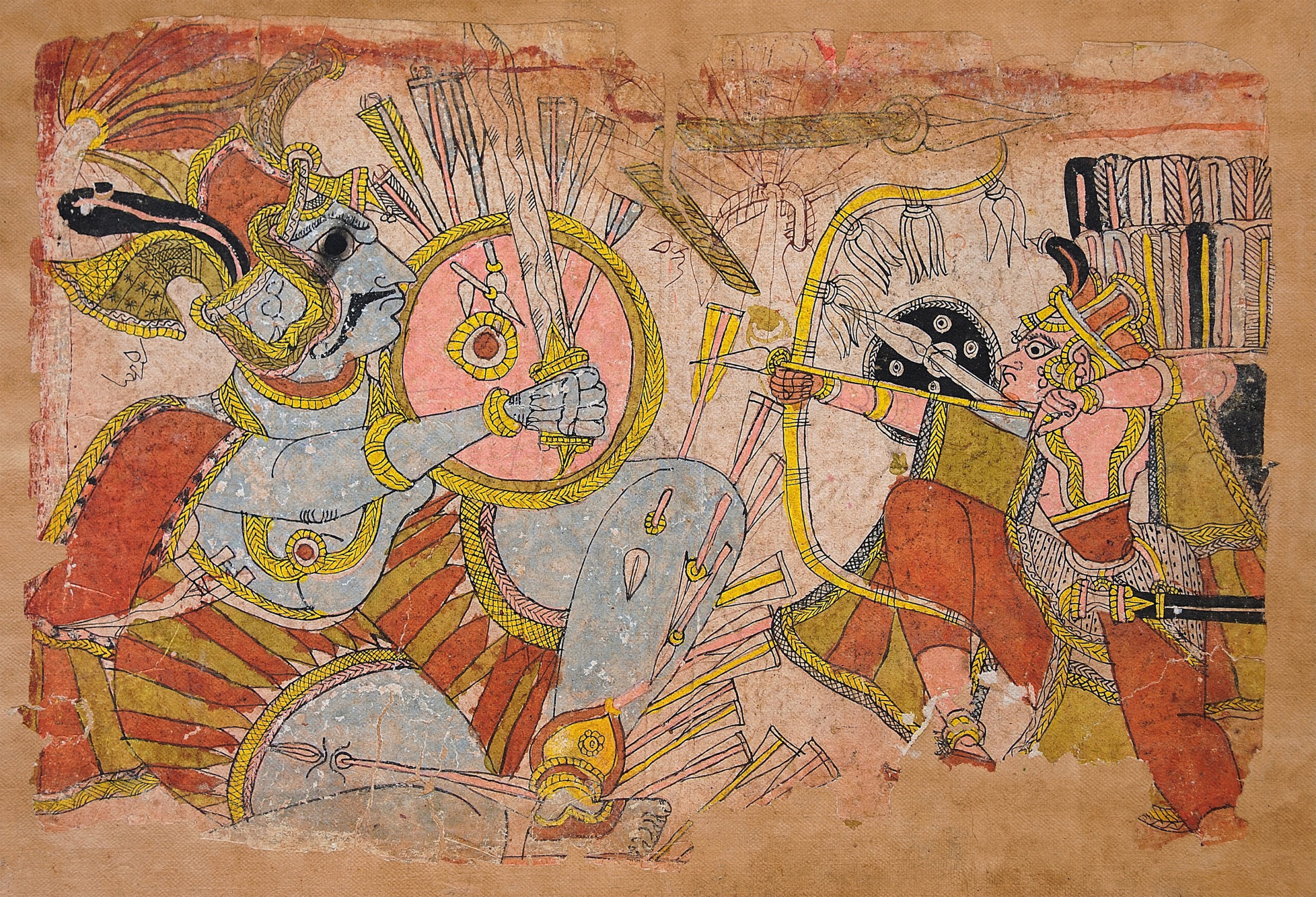
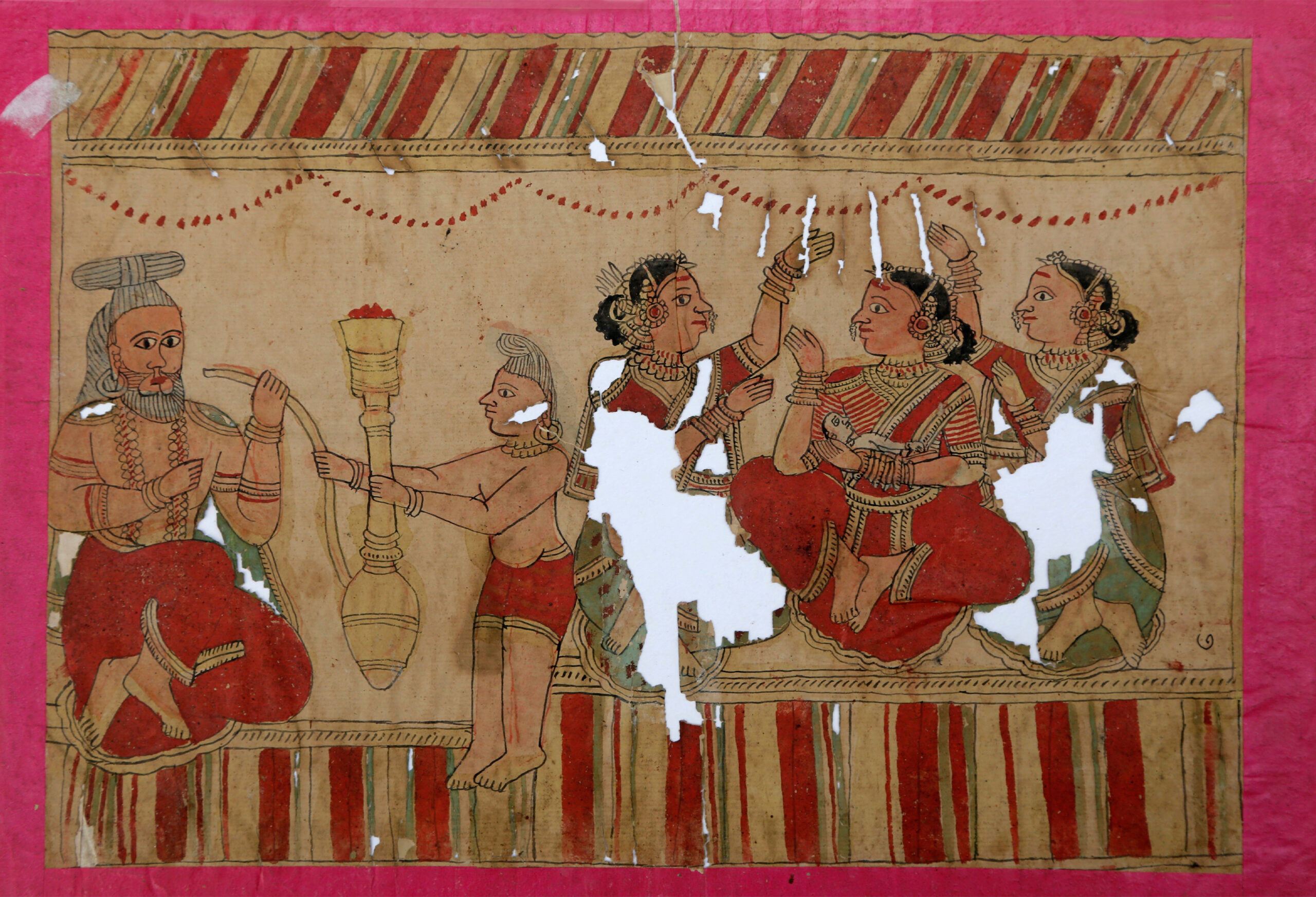
Historically, performances took place across a range of settings including village fairs and other public gatherings. Performers also went from door to door narrating stories in exchange for alms. Though chitrakathi practitioners have historically been subject to caste-based discrimination and treated as untouchable, from the seventeenth or eighteenth century exceptions were sanctioned on festival days such as Navaratri, when they would be allowed to enter and perform in temples. Each family was likely assigned hereditary rights to serve a specific temple or patron. The offerings they received from audiences were their primary means of livelihood. It has also been noted that chitrakathi practitioners once performed in the Sawantwadi Palace on important festival days.
Chitrakathi went into decline during British rule, partly because colonial officers were suspicious of the Thakar performers’ history of espionage for the Maratha empire. Many were forced to abandon the craft and seek other means of livelihood, precipitating a steady drop in the number of practitioners.
Visual characteristics
Two distinct visual styles have been identified within the broader chitrakathi painting tradition; the living tradition belongs to the Pinguli style, while the other is known as the Paithan style. Extant specimens of the two styles suggest that they depicted narratives drawn from different sources. Some visual features are common to both styles. Each painting depicts a distinct event in a sequence, though sometimes one painting shows two closely related events or movements, with the protagonist appearing twice. Pairs of paintings depicting consecutive scenes are typically pasted back to back for strength and ease of handling during performance. A blank sheet is sometimes inserted between two thin or brittle sheets for extra support. A set illustrating one narrative is bundled as a folio or pothi. Depending on the length of the narrative, a folio may range from roughly thirty to sixty paintings.
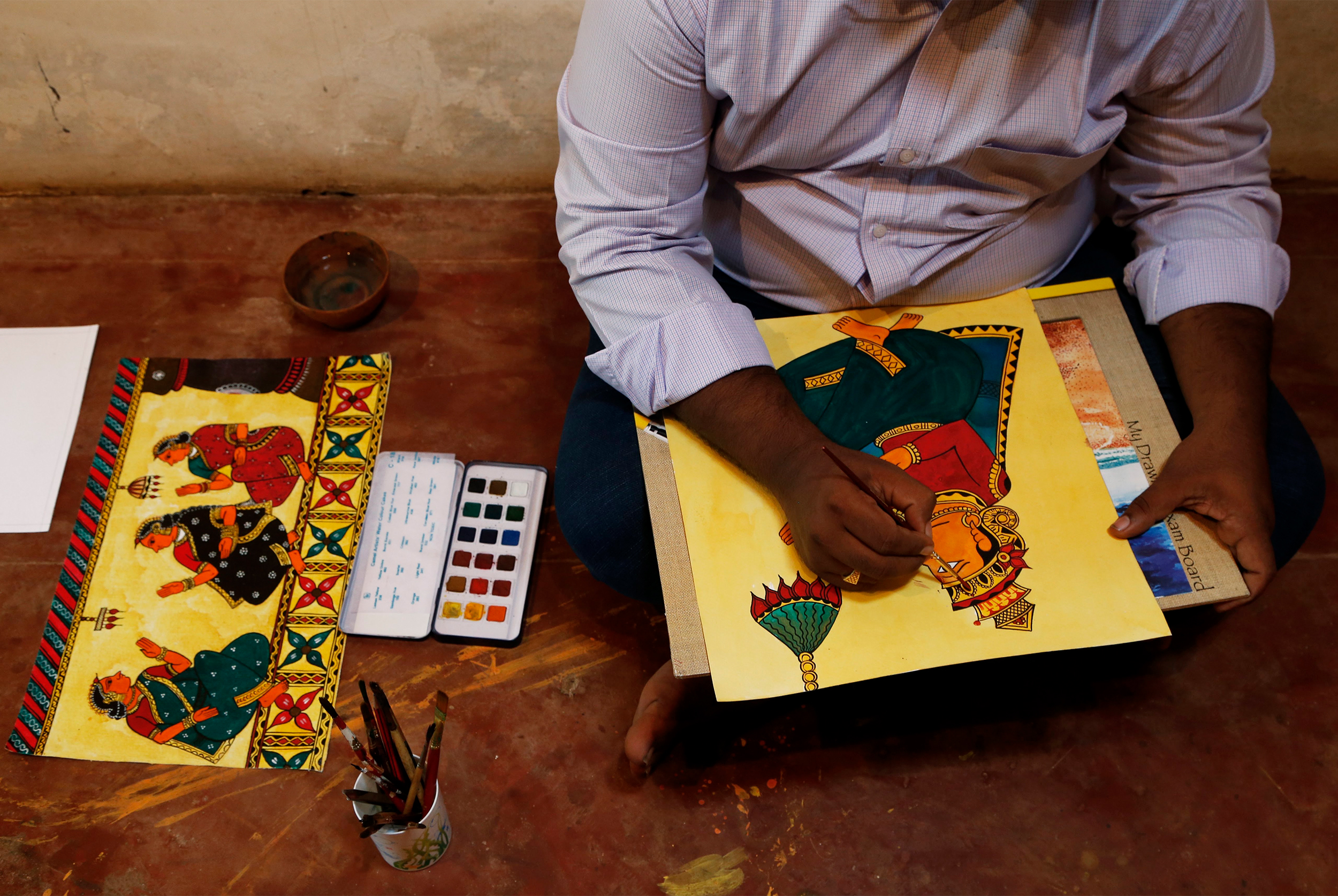
Most historical specimens are made on imported foolscap paper, with a few on handmade paper. The paintings are generally 30 centimetres high and between 35 and 45 centimetres wide. In the past artists may have made the pigments themselves; contemporary artists have adopted poster colours and watercolours, sometimes working on canvas. The painting begins with a preliminary sketch; blocks of flat colour are then filled in, followed by a final outlining in bold, dark lines that give the paintings their characteristic graphic clarity that ensures visibility across a crowd.
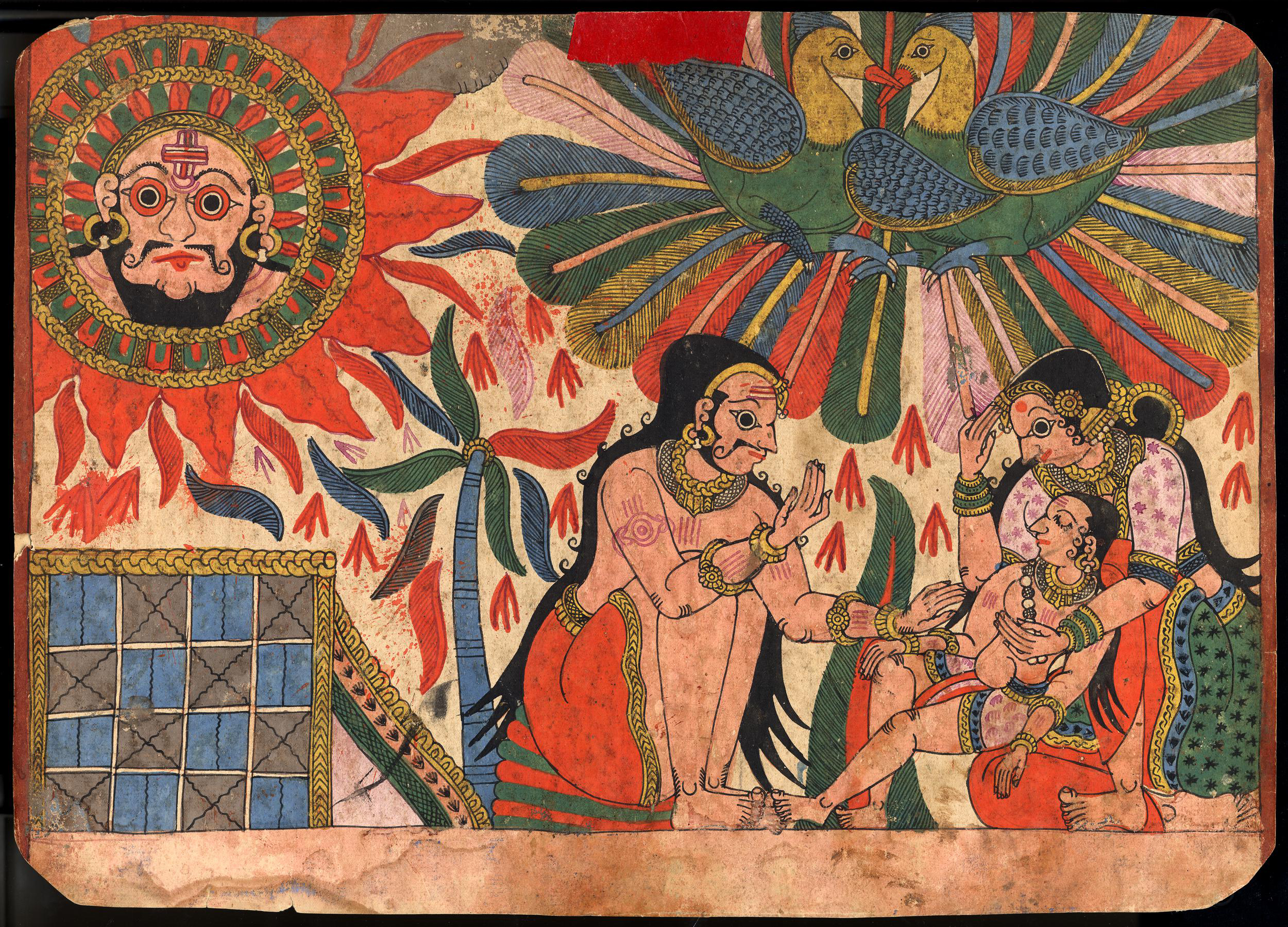
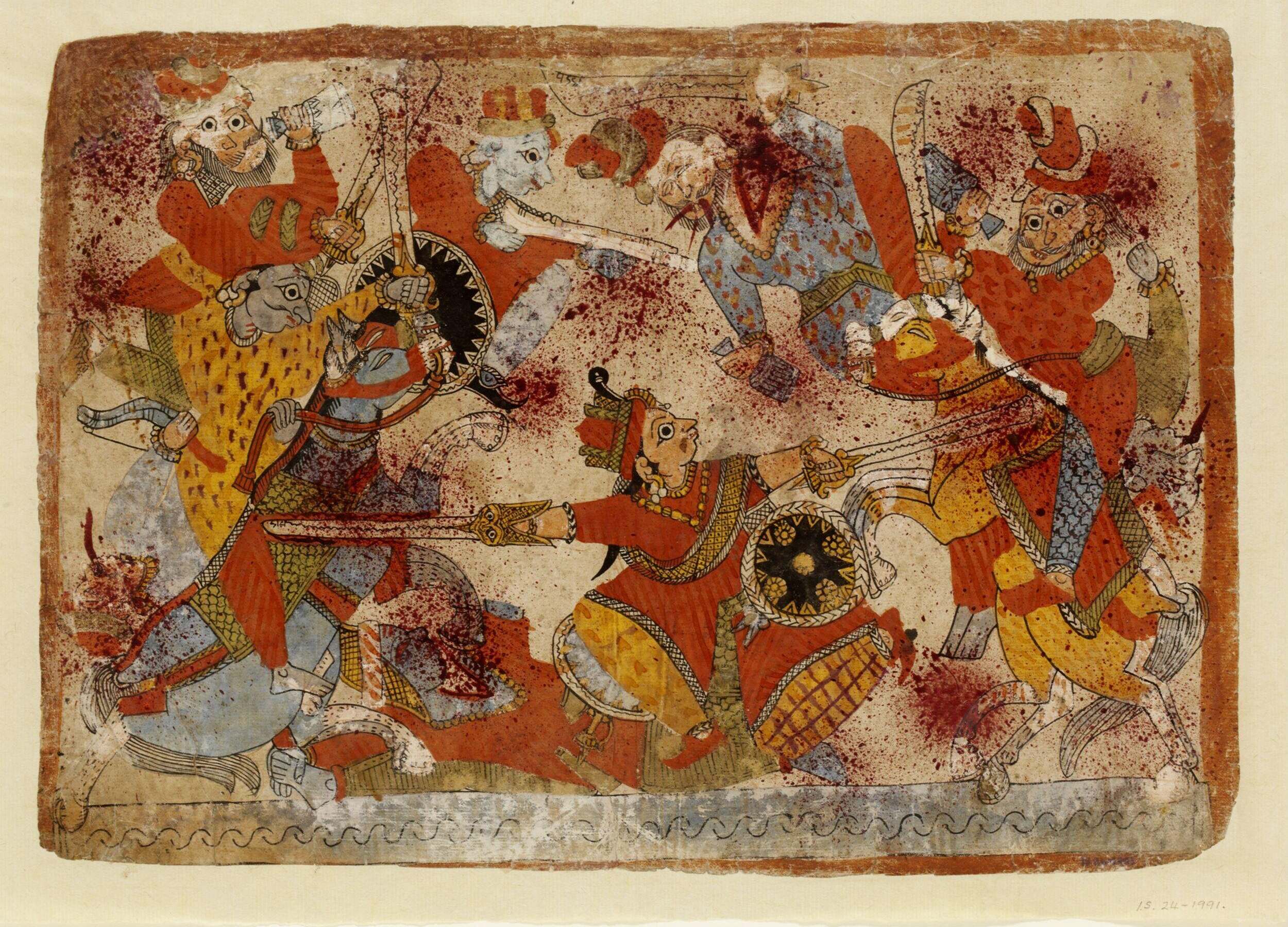
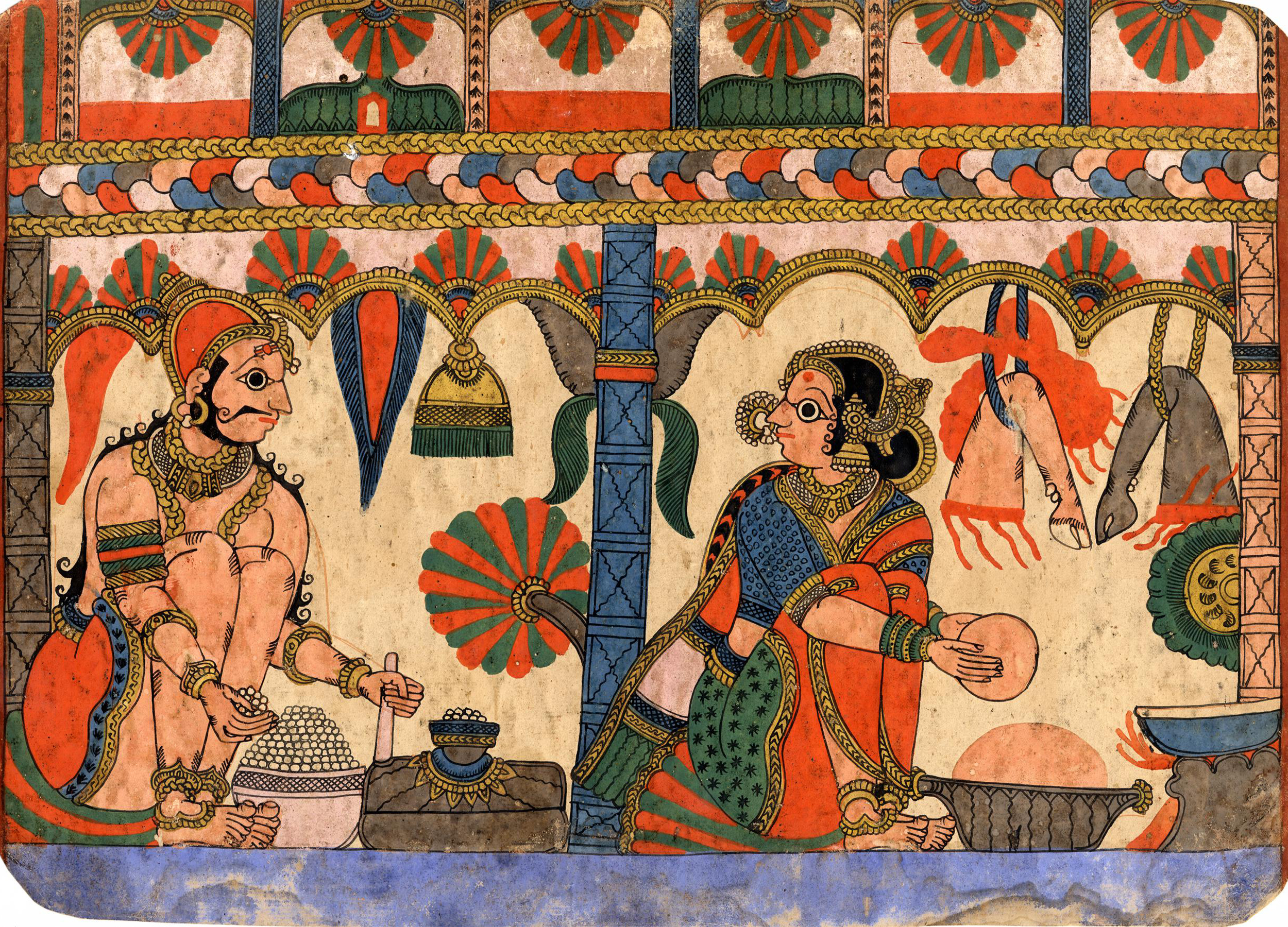
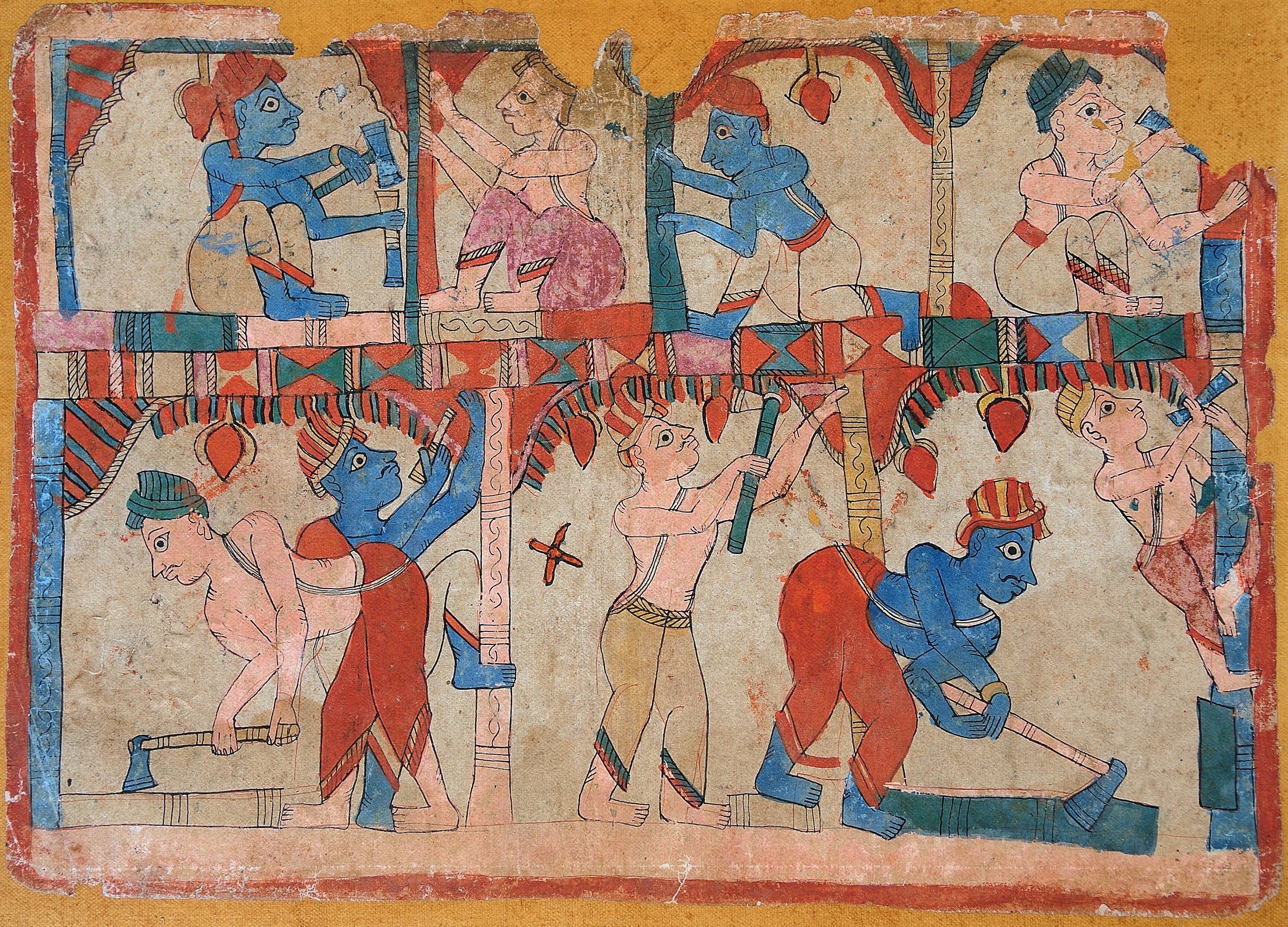
Human figures are most prominent in the paintings’ compositions; their emotional expression relies on stance, spatial position and gesture rather than the face. Backgrounds are simplified, with buildings often reduced to their facades and interior spaces indicated by architectural elements such as pillars or arches. A battlefield may be indicated by irregular red patches representing blood. Landscape elements such as trees are highly abstracted; stylised forms like triangular or tulip-shaped trees with intertwining trunks are common. A pillar sometimes interpreted as a ranasthamba (a memorial or victory-pillar) occasionally appears between combatants in a duel scene. Each folio has its own unique border design; borders typically appear at the top and bottom of each painting, with the latter more prominent than the former — these also helped keep the main image safe from damage through repeated touching as the performers held up the painting. Some images depicting war lack borders altogether.
Paithan style
Known only through surviving nineteenth-century specimens, the so-called Paithan style is now extinct, though the paintings have received considerable attention from scholars. The style is named for the town of Paithan in the Chhatrapati Sambhajinagar (formerly Aurangabad) district of Maharashtra where folios of these paintings were first found, though there is no evidence to indicate that these paintings were made there, or to definitively identify their makers.
With a few exceptions, Paithan paintings are oriented horizontally. The colour palette is generally confined to red, yellow, green, and blue, against an uncoloured background. A typical Paithan painting is densely composed, with very little background space left visible. Some paintings are made exclusively in red and blue while others combine the four colours; still others are made in muted beige and pink shades. Each folio has a unified colour scheme, with some painted in cool colours and others in earthier reddish hues.
The figures consolidate multiple viewpoints in a flat, two-dimensional form, with the head and limbs in profile and the torso shown frontally. They are outlined in bold, smooth lines, and parallel strokes at the joints and folds of the body create a limited impression of depth or shadow.
Compositions balance pictorial elements on either side of a central line, sometimes only implicit or suggested, and other times explicitly indicated by a tree or another vertical element relevant to the scene. This format is especially used to depict narratives of confrontation and war, with opposing parties on each side and their weapons meeting on the vertical line. Specific standard compositional layouts are commonly used to convey certain themes; for example, a diagonal organising principle indicates fear or flight. Crowds or armies are rendered through repetition of the same figure, sometimes overlapping. The protagonists are drawn larger and in the centre, clearly contrasted against the background characters.
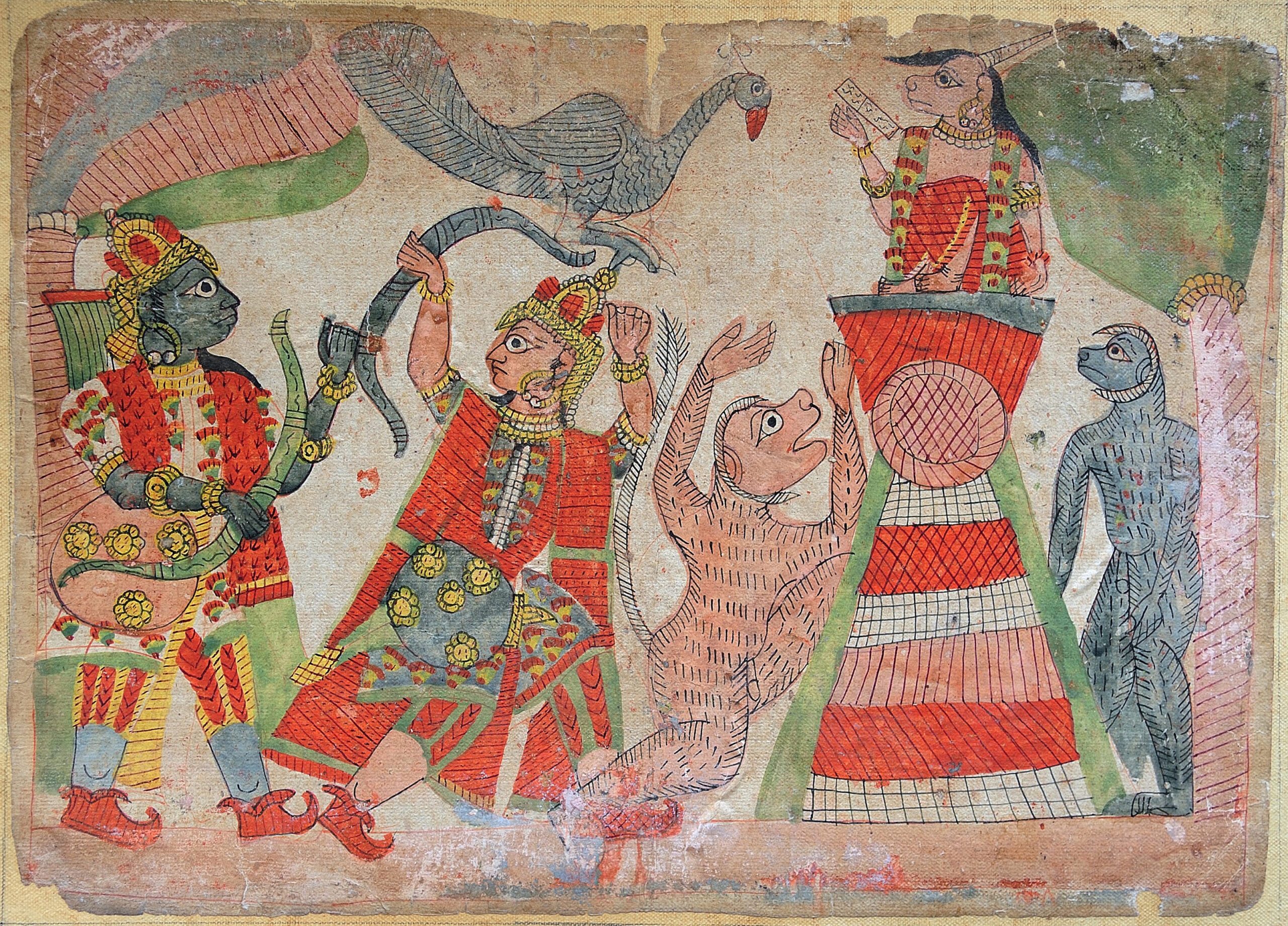
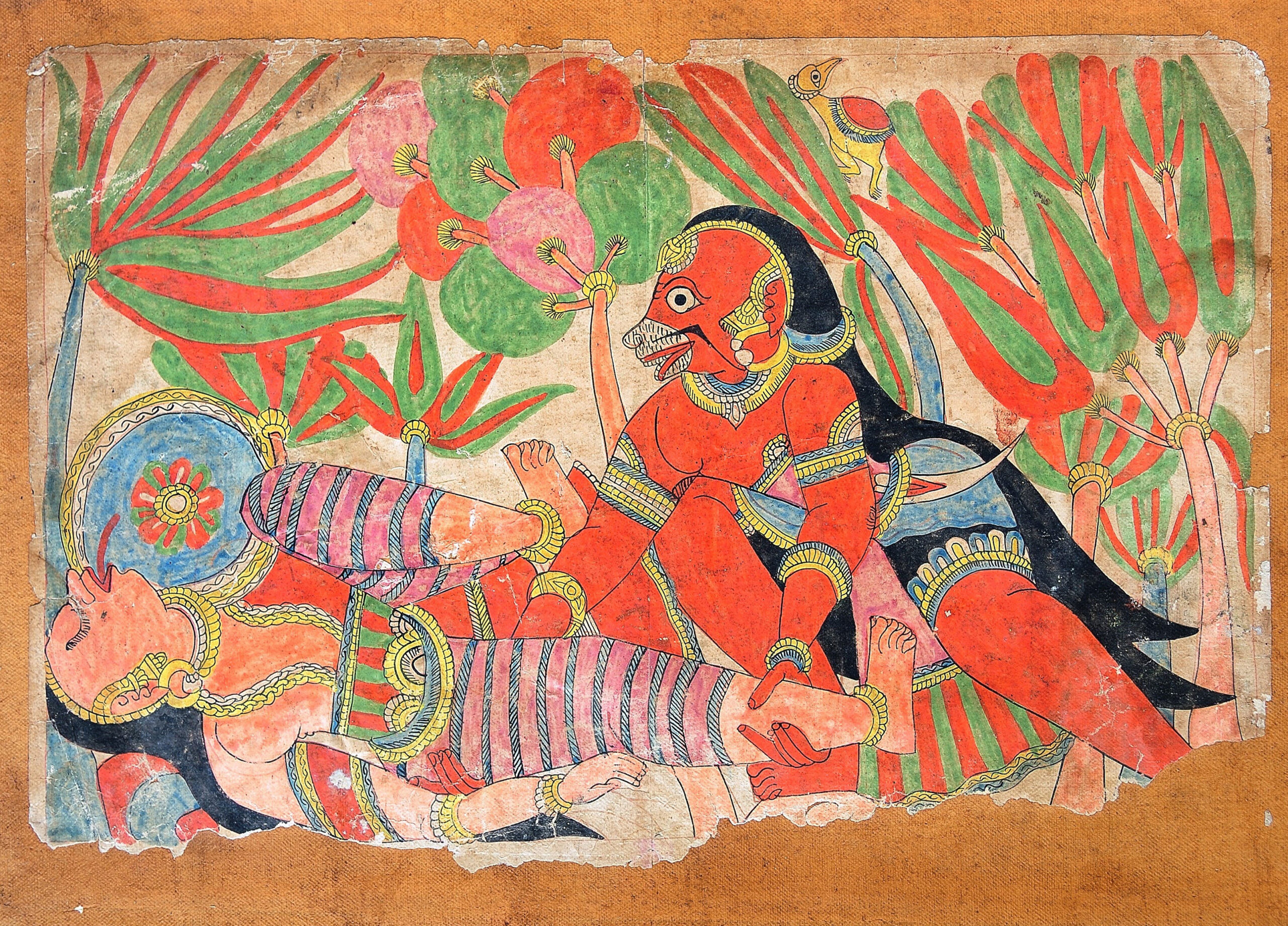
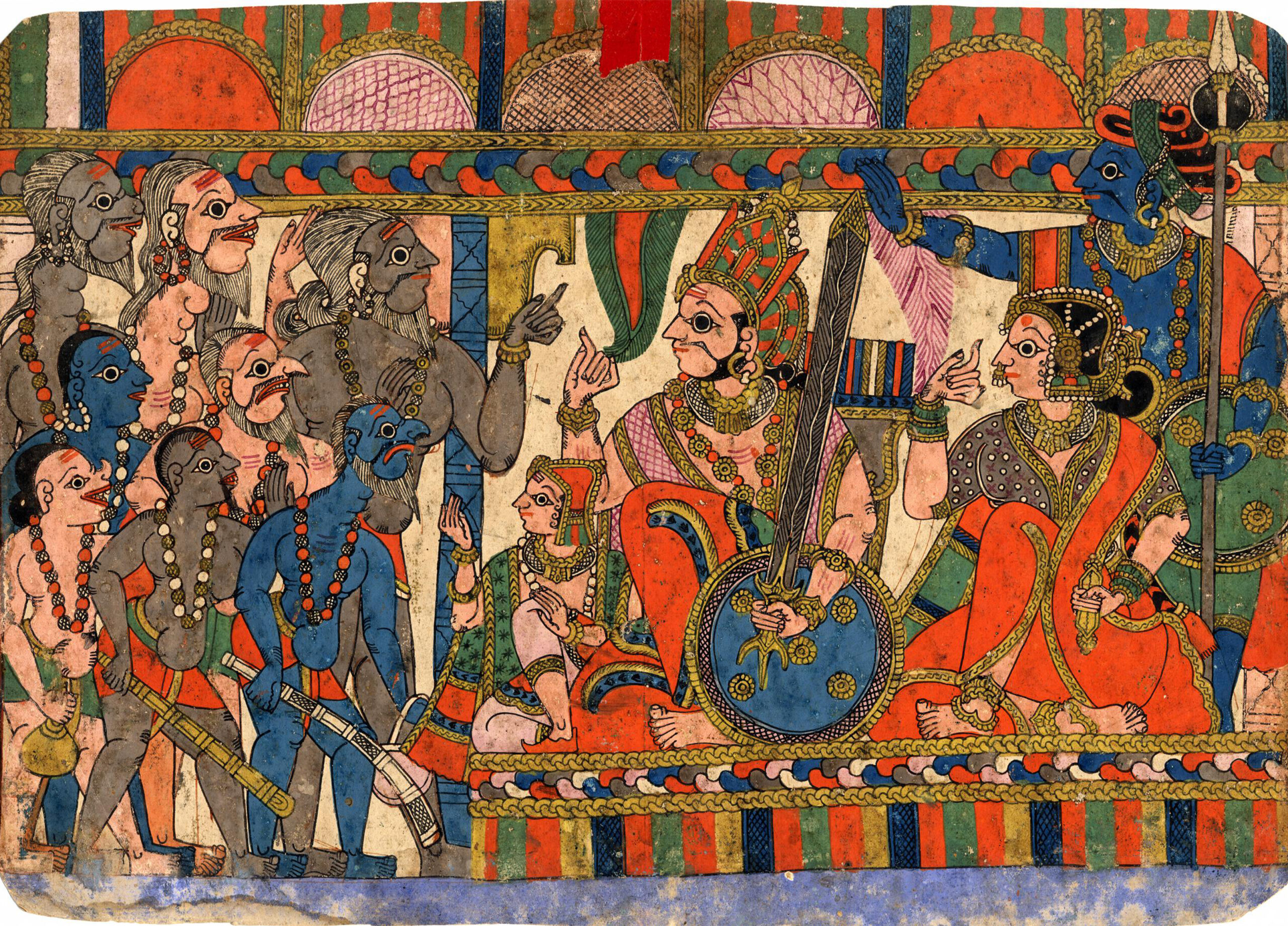
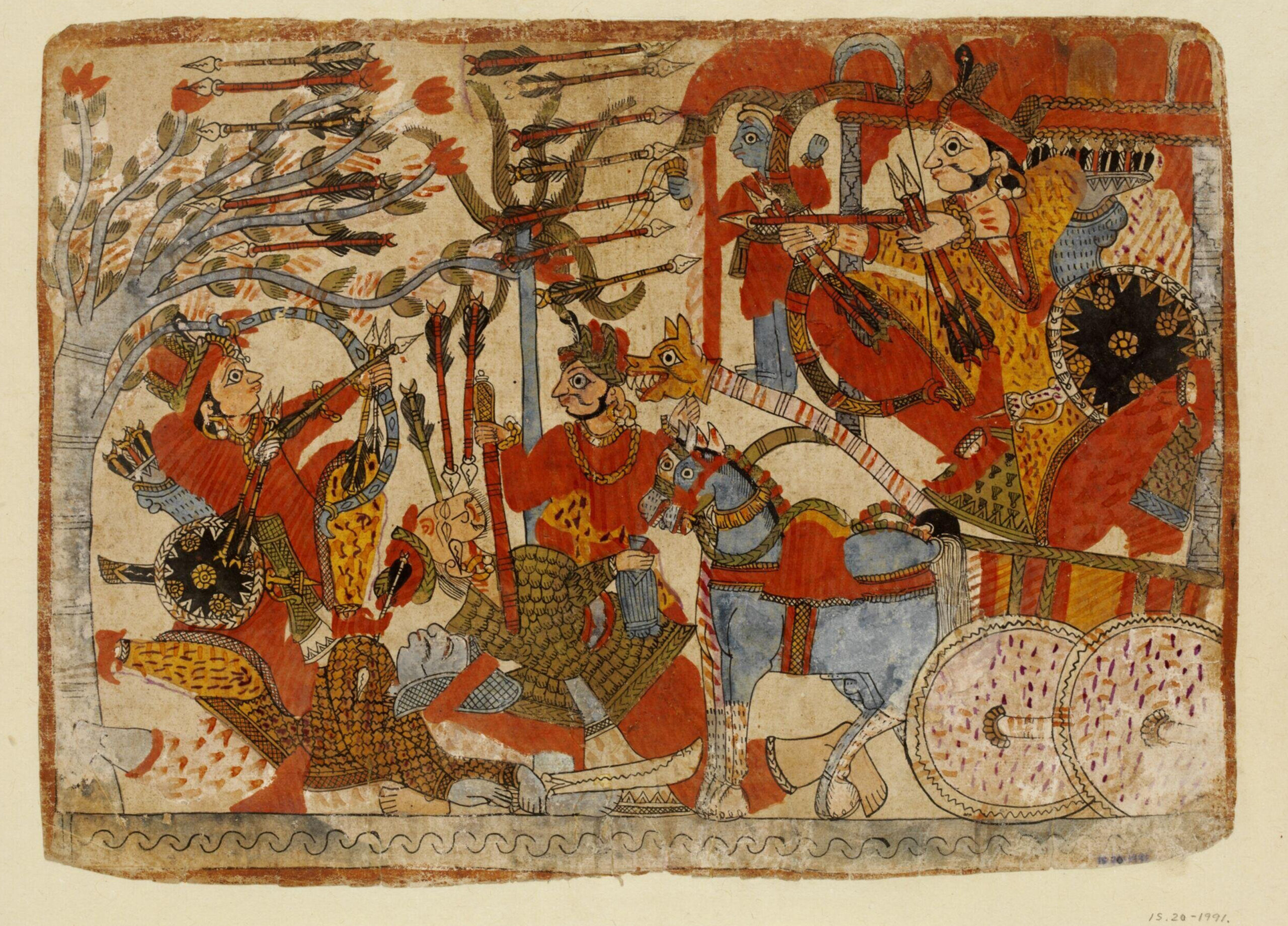
Faces are drawn with very wide eyes to accommodate an oversized, circular pupil. A characteristic feature of Paithan paintings, the bulging eye contributes to dramatic tension; when closed, it signifies death or unconsciousness. Expressions are static and generally uniform; mouths are mostly rendered with a short line curving down at the end. A hand gesture with the index finger and thumb joined indicates that the character is speaking.
Lower garments of the male protagonists are typically the dhoti or pajama; the upper garments may be the uttariya or jama. Women are typically dressed in saris with their heads covered. The clothing is rendered with detailed patterning and embellishment. Headdresses are elaborate and varied, and include turbans, crowns, helmets, and caps, with gods and heroes typically shown in a tall, multi-panelled headdress banded along the hairline; ascetics are shown with matted hair piled on their head instead of headgear. These, as well as motifs of servant figures, tigers, and certain types of monkey, are rendered similarly to those seen in the leather shadow-puppets of Karnataka.
The stories often depicted in Paithan paintings include versions of episodes from the Mahabharata, such as the story of the prince Babhruvahana and the warrior Abhimanyu; the regional folktale of Abhimanyu’s elopement with his lover Vatsala is widely depicted. Others include the Lankadahana episode from the Ramayana where Hanuman sets Lanka on fire, and the story of the king Harishchandra, which appears in various Puranas.
Pinguli style
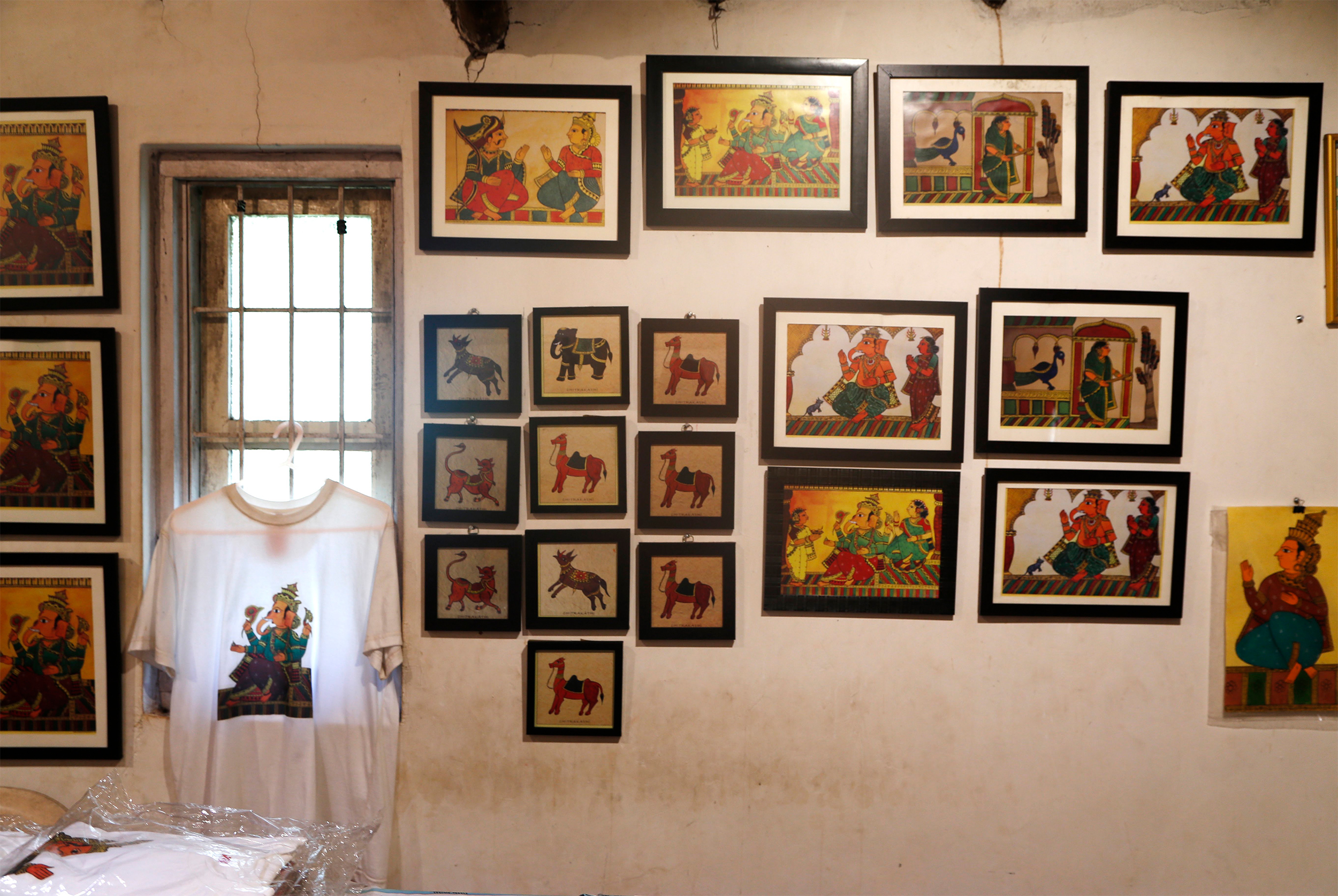
Pinguli figures are more naturalistic than those in Paithan paintings, with almond-shaped rather than circular eyes, and three-quarter and full facial views appearing more often alongside the standard profile. More background space is visible; as in the Paithan style, it is left uncoloured. The costumes are more regionally specific. Men wear dhotis or trousers with jackets, while women are shown in skirts or saris, and occasionally the 9-yard Maharashtrian sari. Instead of Paithan-style multi-panel headdresses, a simpler tiered crown is common. Pinguli figures generally wear simple, circular earrings, rather than the more ornate ones seen in Paithan work.
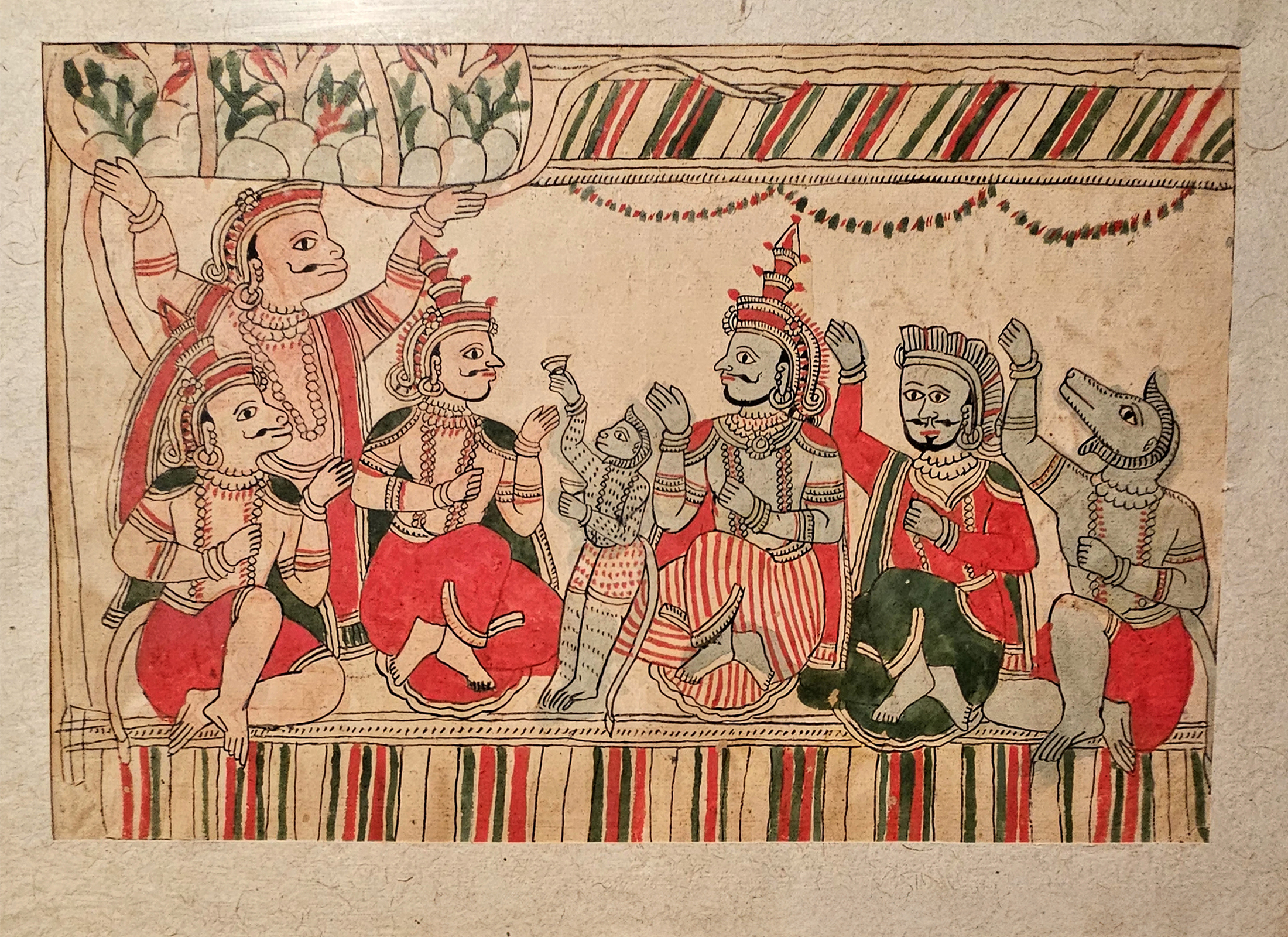
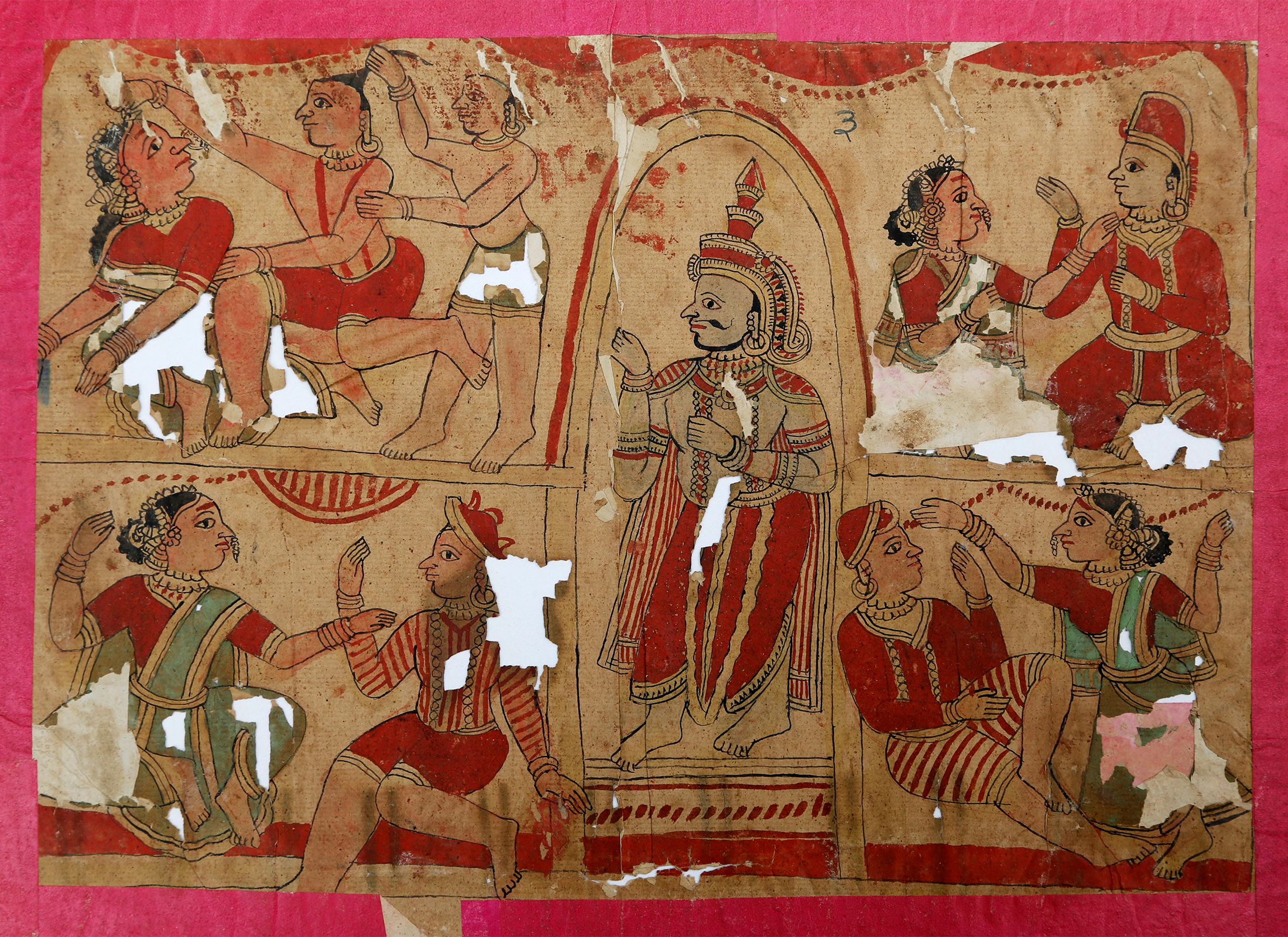
Documented Pinguli paintings draw largely on episodes or books from the Ramayana, including the competition to win the hand of Sita in marriage (Sita svayamvara), the forest exile of Sita, Rama and Lakshmana (Aranyakanda), the invasion of Lanka (Yuddhakanda), a regional telling of Hanuman’s journey (Patalakanda) and the final book Uttarakanda. They also narrate stories from the Mahabharata, the Dangipurana, and the Nandipurana.
Performance
Chitrakathi performances have historically served a didactic function, imparting social and moral messaging through tellings of folktales and myth. Historically, chitrakathi performances took place at night, and went on for three or four hours. Now they generally last thirty or forty minutes, given the popularity of other mediums of entertainment and the community’s changing relationship with rural audiences.
Most chitrakathi performers are men. Some accounts state that women were not allowed to attend temple performances and have not traditionally participated in painting or performing. However, ethnographic studies from the recent past state that sutradhar were sometimes a married couple or group of three men, alternatively reciting and singing the narrative to the accompaniment of musical instruments. Chitrakathi performers usually appear in groups of two or three, though the occasional solo performance has been recorded, in which a seasoned practitioner simultaneously sings, plays accompanying instruments, and displays the paintings. Performers typically narrate in standard Marathi or vernacular Malvani; both may be used in one performance, often with the former used for narration and latter for dialogues. Typical accompaniments include the stringed veena and tambura, huduk (a two-headed drum), or cymbals (jhinjh).
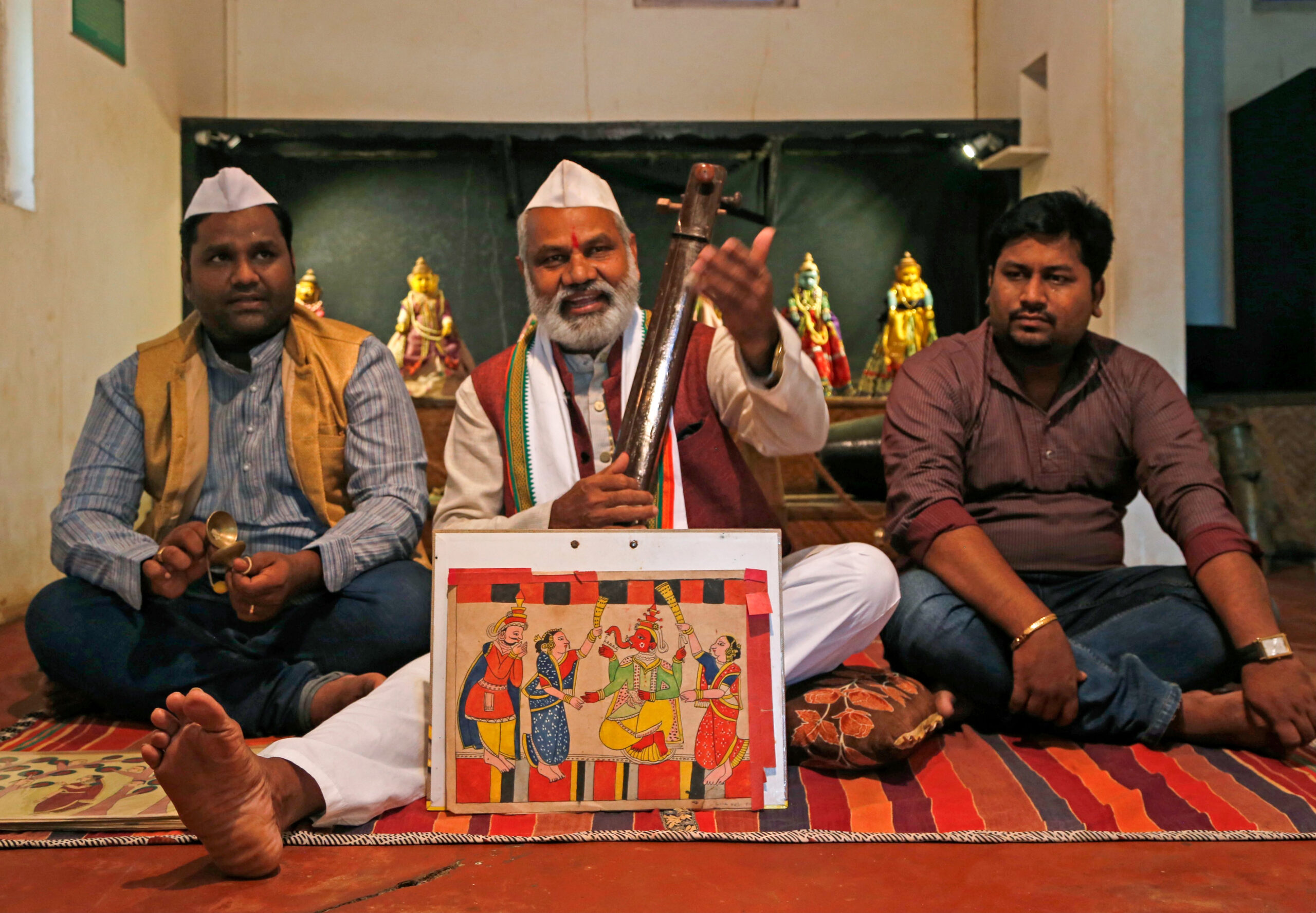
The paintings for a performance are made based on the songs that the artists select for the narrative. The finished paintings are paired and adhered back-to-back, separated by a thin bamboo stick that the narrator uses to hold up and turn the piece. In an alternative style, each painting may be adhered to a wooden board, with the entire set propped up against the narrator’s knee; once each picture is displayed, it is set aside. Performances typically begin with invocations to the Hindu deities Ganesha (associated with auspicious beginnings) and Saraswati (associated with culture, speech and the arts), whose images are displayed at the onset — these are not necessarily part of the folio for the performance.
Historical specimens
The oldest known Paithan-style chitrakathi paintings are held in the Salar Jung Museum in Hyderabad; these folios are dated between 1700 and 1799. Other early specimens, dated by the commercial watermarks on the paper, are traceable to 1834. Another set of paintings was first acquired from an individual from Paithan and passed down to prominent art collector DG Kelkar; they are now held at the Raja Dinkar Kelkar Museum in Pune.
The British Museum houses a complete folio of sixty Paithan paintings with watermarks dating to 1834–35. Other institutional collections include those at the Los Angeles County Museum of Art (LACMA); the Victoria and Albert (V&A) Museum, London, which holds a nineteenth-century Paithan painting from Sawantwadi; and the Rijksmuseum in Amsterdam, which holds a nineteenth-century Paithan painting from Andhra Pradesh.
Contemporary status
Despite challenges, chitrakathi has survived to the present day, in large part due to the efforts of extant practitioners, notably the Gangavane family in Pinguli. Parshuram Gangavane and his sons Chetan and Eknath have converted their old cowshed into the Thakar Adivasi Kala Aangan Museum, displaying chitrakathi paintings, traditional puppets, and musical instruments, offering visitors an overview of the Thakar community’s various performance art traditions. Parshuram Gangavane’s work earned him the Indian government’s Padma Shri award in 2021. He conducted chitrakathi workshops as part of a Ministry of Textiles project between 2004 and 2008.
Chitrakathi artists have now adapted the craft to suit the contemporary context, using digital prints and expanding beyond mythological narratives to address social issues such as female foeticide, public sanitation and the Covid-19 pandemic.
First published: 5 August 2026
Image Gallery
Bibliography
Dallapiccola, Anna L. “‘Paithan’ Painting: The Epic World of the Chitrakathi.” In Picture Showmen: Insights into the Narrative Tradition in Indian Art, edited by Jyotindra Jain, 100–115. Mumbai: Marg Publications, 1998.
Dastkari Haat Samiti. “Chitrakathi Art.” Google Arts & Culture. Accessed October 14, 2024. https://artsandculture.google.com/story/chitrakathi-art-dastkari-haat-samiti/YAWBibTpIqG7KA?hl=en.
Dastkari Haat Samiti. “Contemporary Interpretations of Chitrakathi Art.” Google Arts & Culture. Accessed October 14, 2024. https://artsandculture.google.com/story/rQXRZiuUOkLeLA?hl=en.
Dastkari Haat Samiti. “Old Chitrakathi Art.” Google Arts & Culture, n.d. Accessed October 14, 2024. https://artsandculture.google.com/story/old-chitrakathi-art-dastkari-haat-samiti/kwXhwLREm72yKQ?hl=en.
Gaonkar, Manik. “Contemporary Practices of Chitrakathi in the Twenty-First Century Art Market.” Chitrolekha Journal on Art and Design 2, no. 2 (2018). https://dx.doi.org/10.21659/cjad.22.v2n203.
Giles, David. “Re-housing 60 Double-Sided Indian Paithan Paintings.” Journal of the Institute of Conservation 34, no. 2 (2011): 209–14. https://doi.org/10.1080/19455224.2011.607261.
Pawar, Nivedita Jayaram. “Meet the Gangavane Family, Masters in Chitrakathi Painting, Who Wants to Make Sindhudurg the Cultural Hub of Maharashtra.” The Hindu, June 10, 2024. https://www.thehindu.com/society/meet-the-gangavane-family-masters-in-chitrakathi-paintings-who-wants-to-make-sindhudurg-the-cultural-hub-of-maharashtra/article68273446.ece.
Ray, Eva. “Documentation for Paiṭhān Paintings.” Artibus Asiae 40, no. 4 (1978): 239–82. https://doi.org/10.2307/3249820.
Rijksmuseum. “‘Paithan’ (Chitrakathi) Narrative Painting.” https://www.rijksmuseum.nl/en/collection/object/-Paithan-Chitrakathi-narrative-painting–18656b30d09f3c816be83b7783fe7aea.
Rossi, Barbara. From the Ocean of Painting: India’s Popular Paintings, 1589 to the Present. New York: Oxford University Press, 1998.
Stache-Rosen, Valentina. “Story-Telling in Pingulī Paintings.” Artibus Asiae 45, no. 4 (1984). https://doi.org/10.2307/3249740
Victoria and Albert Museum. “Painting (IS. 27-1991).” https://collections.vam.ac.uk/item/O82770/painting-unknown/.
Feedback