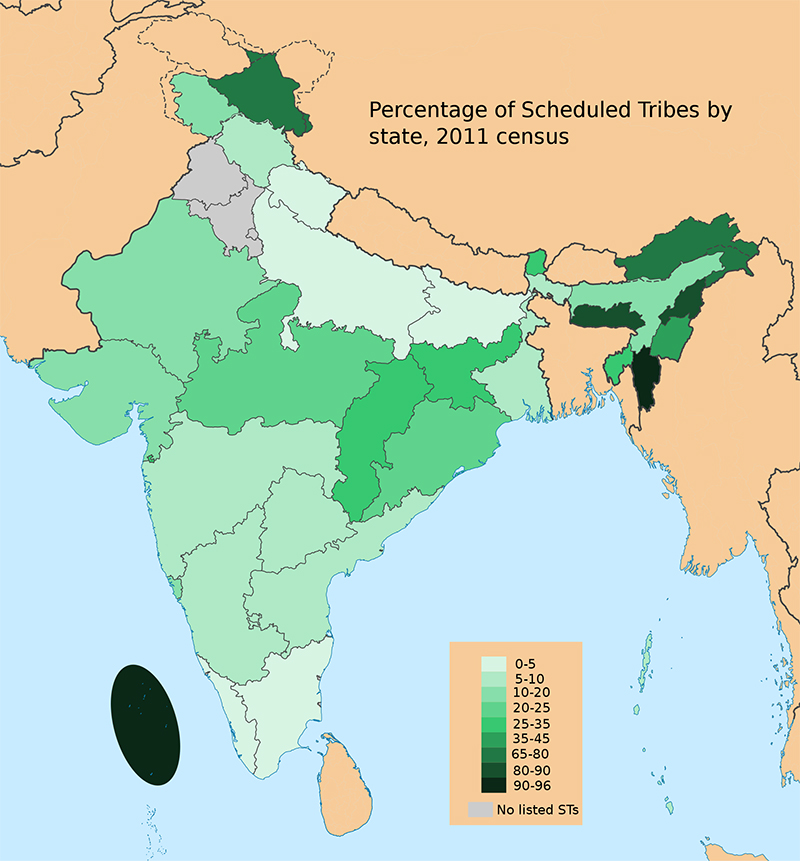
Administrative classification for specific population groups as per the Constitution of India. Communities listed as Scheduled Tribes (STs) are often Adivasis. The classification of peoples in India as tribes began under British rule in the nineteenth century, when the census labelled them ‘Animists’, and their areas ‘Excluded Areas’. Since Independence, there has been much debate and revision regarding the criteria for ST status, though the criteria recommended in 1965 continue to be used as of writing: ‘primitive traits’, ‘backwardness’, ‘distinctive culture’, ‘geographical isolation’, and ‘shyness’ with regard to broader society. The 2011 census counted an ST population of about 105 million or 8.6% of the Indian population. A fixed percentage of central government jobs and university seats are reserved for members of STs as per India’s affirmative action policy — this may be much higher in Scheduled Areas, or areas with a significant tribal population. In Mizoram, for instance, it is about 80%. The power to notify groups as STs rests with the President in consultation with the respective state’s Governor.
Scheduled Tribe
Link copied!