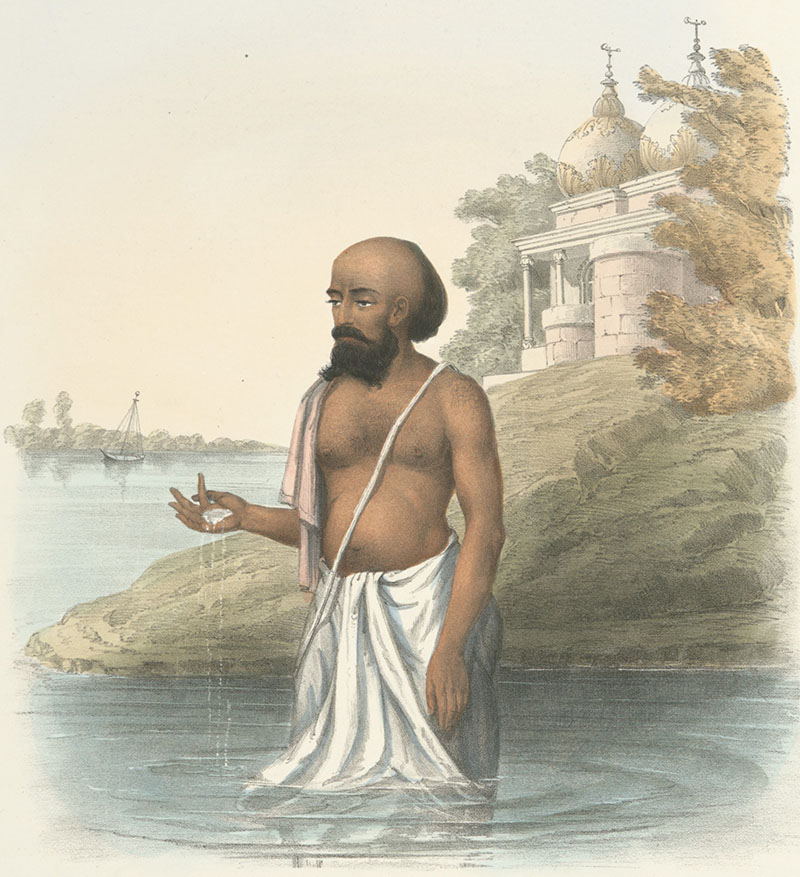
A sacred thread worn over the left shoulder and crosswise over the torso, which symbolises a Hindu rite of initiation into a stage of learning. This rite is limited to males of the Brahmin, Kshatriya and Vaishya varnas (social classes) of Hindu society and the thread itself is considered a marker of caste. Within Indian iconography, it is also appears in religious sculptures and paintings.
More Definitions
Khapa Sari
Also known as patiya sari, it is a tussar silk sari characterised by extra weft rib weaves in the pallu…
Chadar
A length of cloth worn by women as a loose veil or wrap to cover the head and shoulders, and…
Khil’At
A loose, long-sleeved outer robe made of silk or cotton, commonly worn in parts of Central and South Asia. Historically,…
Amli
Also known as amlikar, it is a needle-embroidered Kashmiri shawl dating to the nineteenth century. While it is likely to…
Suhaag Chunari
A traditional bridal odhani (veil) worn by women from the Malwa region of Madhya Pradesh on their wedding day. Made…
Khombi
An odhani (veil) worn by brides of the Khatri community and Muslim communities in Gujarat. Made using the tie-and-dye bandhani…
Chandrakali Sari
A type of sari made in Ilkal in Karnataka, India, woven in dyed silk and decorated with embroidery. Traditionally considered…
Sanghati
An outer garment of Buddhist monastic significance resembling a long robe, it is typically used for additional warmth. It is…