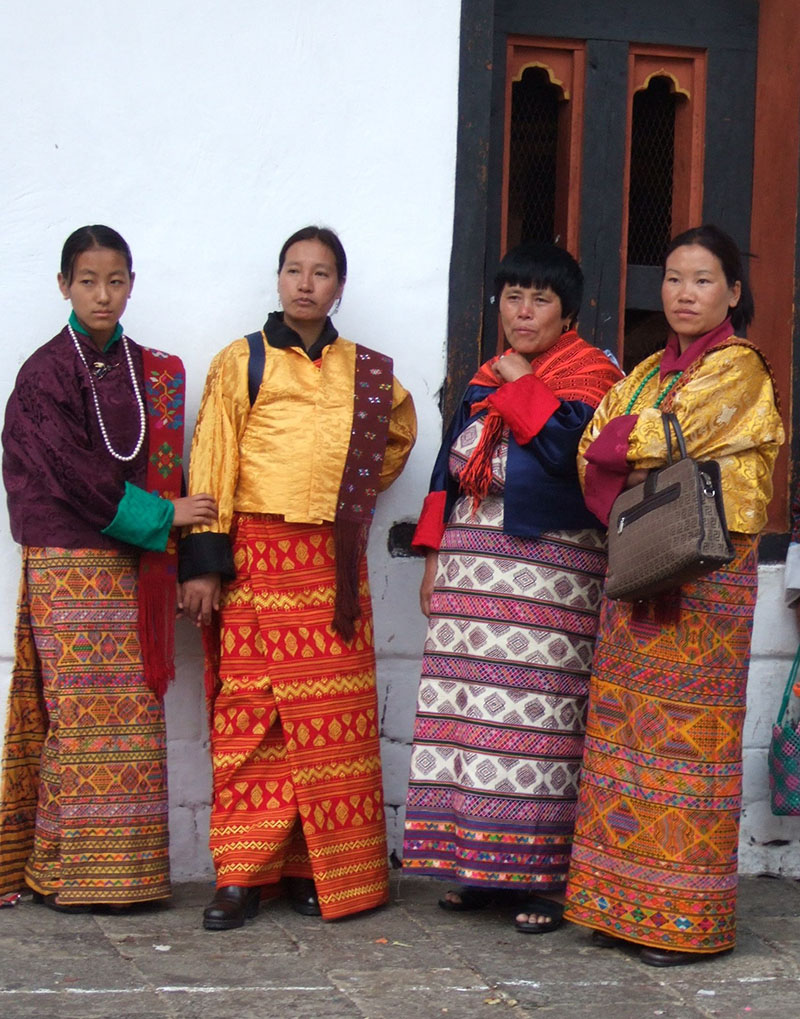
Short, loose jacket for women, with broad lapels and cuffs, worn over the kira as part of traditional Bhutanese attire. It is often paired with a wonju or undershirt of a contrasting colour, whose collar and elongated sleeves are folded over those of the toego to create an accent. It can be closed with a brooch (koma), and is formally topped with a ceremonial shoulder-cloth (kabne or rachu). Traditionally made using indigenous silk, toegos for the elite have also used brocaded Hong Kong silk and Thai silk, while others use cotton or polyester. Some recent adaptations include a slimmer fit, and an integrated contrasting collar and cuff to eliminate need for the wonju. Also spelled tögo or tego, and not to be confused with the Bhutanese men’s undershirt of the same name.
More Definitions
Lehenga
Ankle-length flared skirt for women, worn mainly in the northern and central parts of the Indian subcontinent — with similar…
antariya
Unstitched lower garment worn by men and women in ancient India, particularly during the Vedic period. It was either wrapped…
Amli
Also known as amlikar, it is a needle-embroidered Kashmiri shawl dating to the nineteenth century. While it is likely to…
Karanda Makuta
A conical, multi-tiered headdress or crown found in Indian iconographic traditions, it is commonly depicted on female deities. The term…
Pallu
The end-piece of a sari, it typically hangs loose when draped over the shoulder and has a colour and pattern…
Mathapaar
A sari with a plain, broad border without patterns or embroidery and woven in colours such as vermillion.
Khapa Sari
Also known as patiya sari, it is a tussar silk sari characterised by extra weft rib weaves in the pallu…
Sanghati
An outer garment of Buddhist monastic significance resembling a long robe, it is typically used for additional warmth. It is…