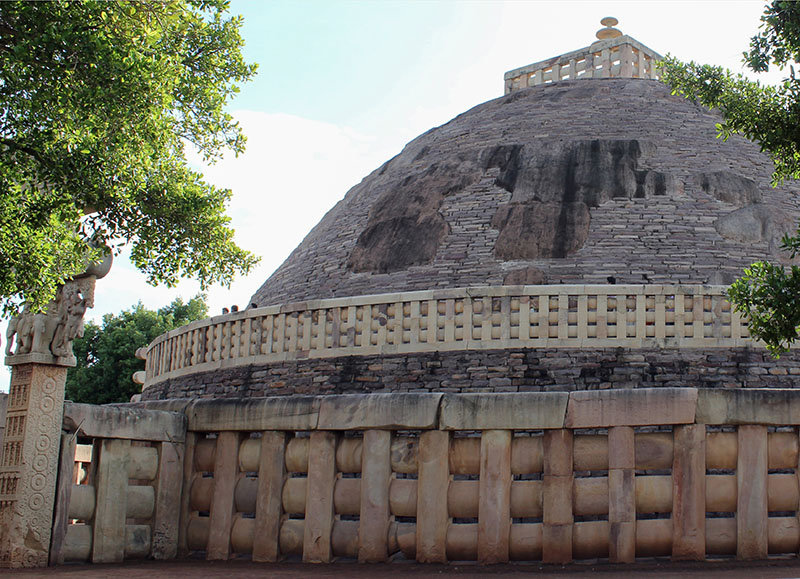
Meaning ‘railing’ or ‘raised platform or altar’ in Sanskrit and Pali, vedika refers to the outer railing around a sacred monument or object in Buddhist and Hindu architecture. Constructed around sacred trees, mounds or stupas, it usually bears low-relief inscriptions depicting protective deities, mythological events and other religious iconography. It often encloses a space for circumambulation around the central shrine.
More Definitions
Vaulted
An architectural descriptor for ceilings or roofs that feature self-supporting arches known as vaults. In its simplest form, the vault…
mezzanine
Platform or balcony projecting as a partial, intermediate storey between the floor and ceiling of a full-heighted space. The mezzanine…
Garbhagriha
Translating to 'womb chamber' from Sanskrit, it is the innermost sanctuary in Jain, Buddhist and Hindu temples, within which the…
Uttaranga
In Indian temple architecture, it is the term for the lintel located above a doorway. It is often a carved…
Stucco
A type of fine plaster or coating material used to cover walls and ceilings with decorative patterns, it is also…
amalaka
Ribbed or notched stone disk that is part of the crowning segment in Kalinga and Nagara temple architecture. The amalaka…
Tala
A tier or storey in a shikhara, vimana or gopuram, found primarily in Dravida temple architecture.
Groyne
A long, rigid hydraulic structure constructed perpendicular to the seashore or riverbank to interrupt flow of water. They are usually…