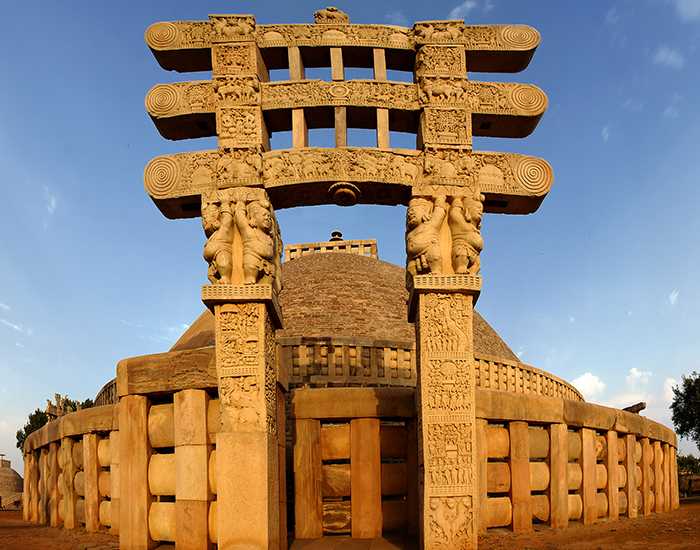
Meaning ‘gateway’ or ‘arched entrance’ in Sanskrit and Pali, torana refers to a free-standing gateway marking the entrance to a Buddhist shrine or stupa, or a Hindu temple. Usually made of stone, it comprises two pillars supporting two or three transverse beams extending beyond the pillars on both sides, or an ornamented arch forming a single structure. The oldest surviving Buddhist torana is at the Bharhut Stupa, dated to c. 250 BCE.
More Definitions
Shikhara
A superstructure, tower or spire characteristic of North Indian temple architecture, it usually rises above the innermost sanctuary or the…
Cantoned Pillar
An architectural term used to denote a pillar that emerges at an angle in a building or a structure.
Panchayatana
A layout in traditional Hindu temple architecture in which the central shrine is surrounded by four subsidiary shrines, each at…
belfry
Bell tower; or the upper part of this or a steeple, which houses bells; or specifically the timber structure by…
pediment
Triangular gable-like structure surmounting the end of a portico or doorway at the entrance of buildings, especially religious or other…
Cornice Moulding
A horizontal decorative moulding applied to the edges at the top of an interior wall, ceiling or pedestal. They date…
Roll Bracket
Also known as taranga potika, it is a corbel-bracket with a roll-like pattern or moulding.
mezzanine
Platform or balcony projecting as a partial, intermediate storey between the floor and ceiling of a full-heighted space. The mezzanine…