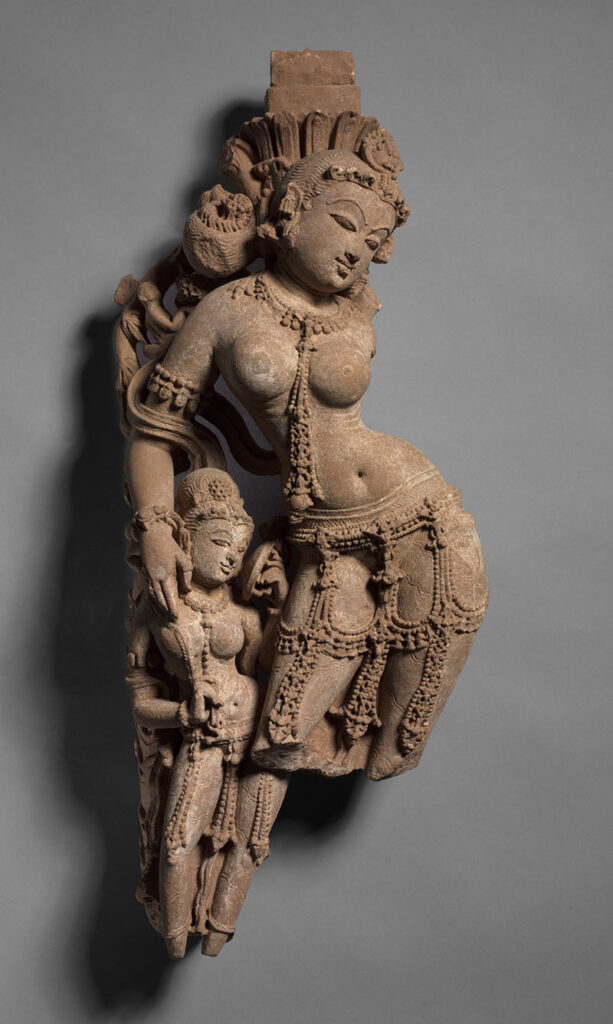
A prominent feature of Indian sculpture, it depicts a female deity with stylised and sometimes exaggerated feminine features, elaborate hairstyles and jewellery shown holding the branch of a tree, usually the sala tree, or standing near one. It is believed to have emerged from ancient Indian tree deities and signifying fertility. According to the Buddhist text Avadanasataka, the festival of salabhanjika parva was celebrated to mark the flowering of the sala tree. From the Sanskrit, meaning “breaking the branch of a sala tree”.
More Definitions
Ayudhapurusha
The anthropomorphic representation of divine weapons in the Hindu pantheon. These personified weapons are depicted either in human form or…
Yogishvara
An aspect of the Hindu deity Shiva, where he is depicted seated in padmasana and worshipped as the lord of…
Ganas
In Hindu mythology, they are attendants of Shiva who live with him on Mount Kailasa. They are usually depicted alongside…
Tathata
A central concept in Buddhism that denotes the essential or true nature of reality, which is beyond the range of…
Agamas
A collection of Hindu literary and scriptural texts that establishes systems of ritual and worship, among other things such as…
Srishti
Meaning "creation" in Sanskrit, it is one of the cosmic acts of deities in the Hindu religious tradition. It is…
Vrishabhavahana
A benevolent form of the Hindu deity Shiva in which he appears with the bull Nandi, his mount or vahana.…
Jaya
In Hindu religious mythology, he is an attendant of the deity Vishnu. Along with Vijaya, he is a dvarapala or…