-
ChicagoPadil, Aranya. "Fishing for Stories: Inside Parag Tandel’s Koli Cosmologies." Impart Perspectives, October 30, 2026. https://imp-art.org/perspectives/interviews/parag-tandel-koli-cosmologies/
-
MLAPadil, Aranya. "Fishing for Stories: Inside Parag Tandel’s Koli Cosmologies." Impart Perspectives, Oct. 30, 2026, https://imp-art.org/perspectives/interviews/parag-tandel-koli-cosmologies/. Accessed 31 Oct 2026.
-
HarvardPadil, A. (2026) Fishing for Stories: Inside Parag Tandel’s Koli Cosmologies, Impart Perspectives. Available at: https://imp-art.org/perspectives/interviews/parag-tandel-koli-cosmologies/ (Accessed: 31 October 2026).
Fishing for Stories: Inside Parag Tandel’s Koli Cosmologies
Armed with an insider's perspective, the Mumbai-based activist-artist's practice engineers a reversal of the gaze, transforming the Koli people from subjects to observers.
By Aranya Padil
Link copied!
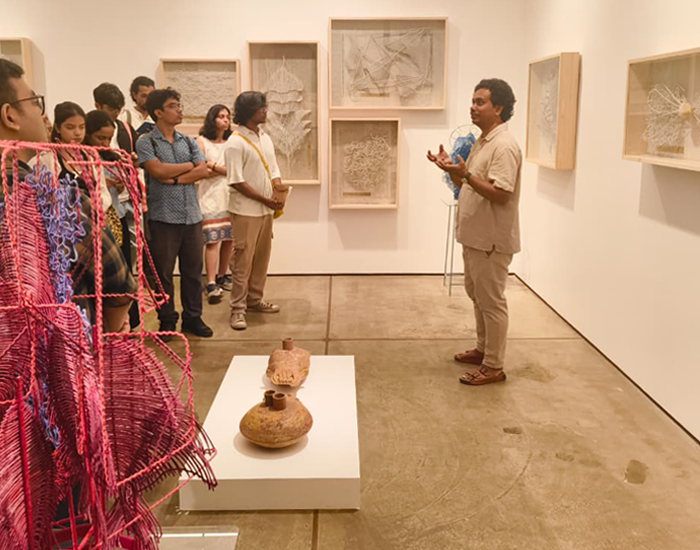
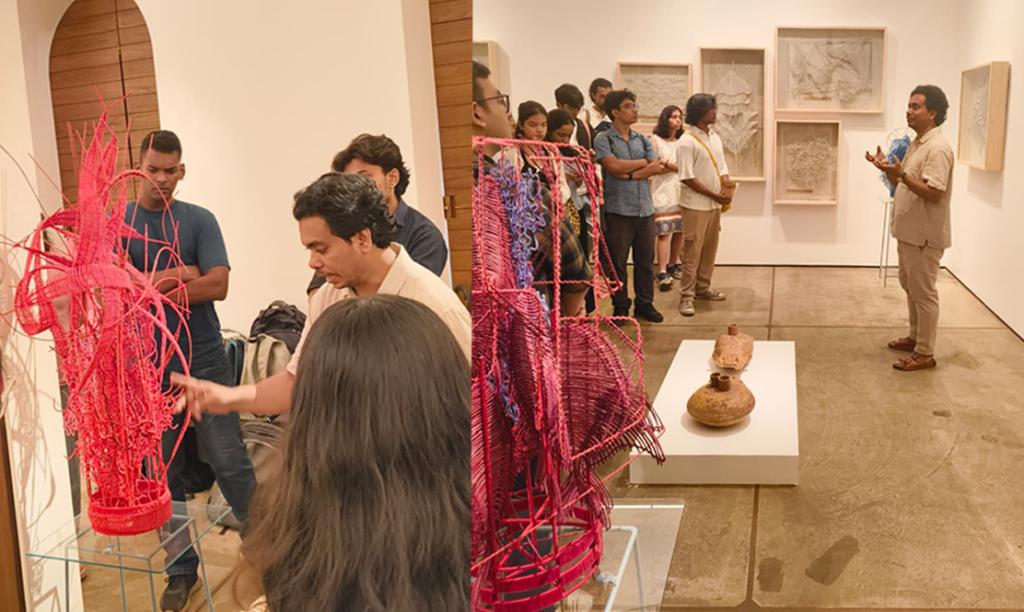
Parag Tandel showing design students his art works from Salt Shrines: Colour Blind | वर्णान्ध (2026) series. Courtesy the author
“But why fish?”
Artist Parag Tandel’s eyes glisten with mischief as he recounts a visitor’s question to him after encountering the marine aesthetics of the works at his show खारी गाबोली | Salted Caviar (2026) at TARQ, Mumbai. “And I said, ‘Why not fish!'” Tandel’s practice is deeply enmeshed with his memories of growing up in the fisherfolk community of Chendani Koliwada, the traditional gaothan (village settlement) of the Koli people in Thane. His works foreground the epistemic knowledge of his community and this approach, he explains to me, is the essence of his art-making that seeks to reverse the conventional relationship that modern human beings share with their more-than-human environments.
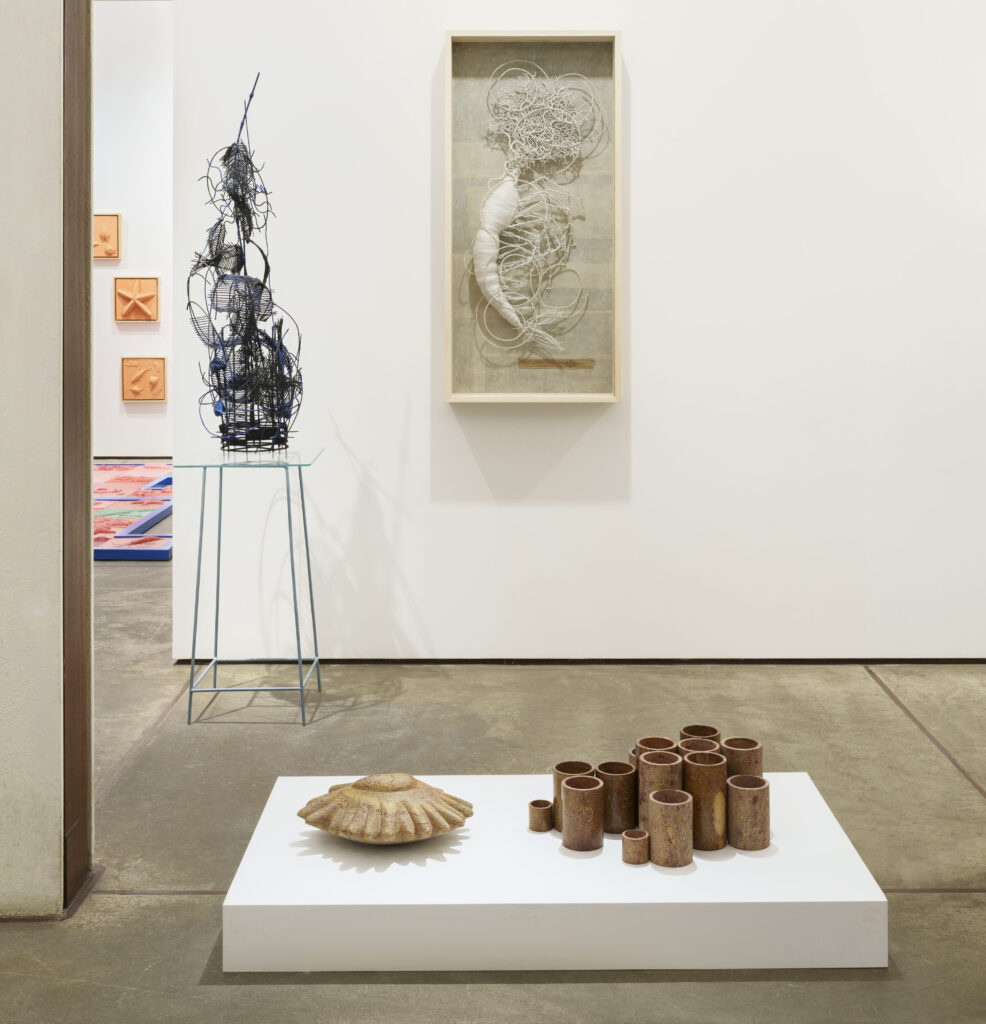
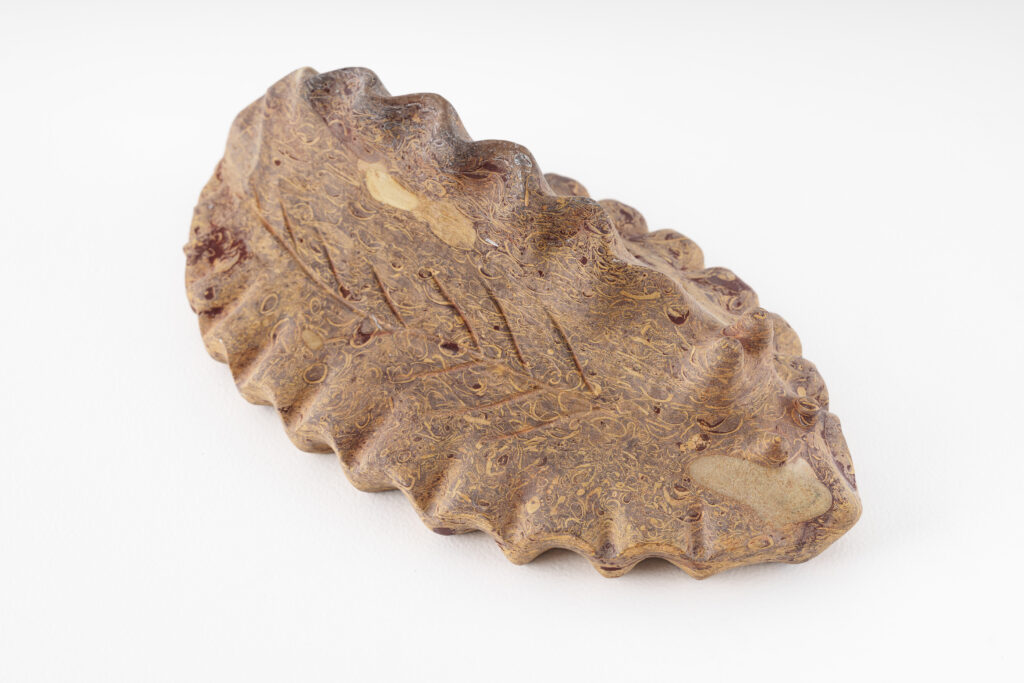
At his studio, he is surrounded by diverse materials — yarn, stainless-steel wire, and a multitude of found objects, such as seashells, stones, and knotted threads, drawn from the ocean and the coast; these are the building blocks of his practice. I marvel at the sculptural forms he has carved in Habur stone from Jaisalmer — “a fossiliferous material that was once an ancient seabed.” His words, slow and measured, evoke a ‘way of life’ that interrogates my own urban, land-saturated, writerly gaze; a gaze that is immediately outed as being representative of the dominant, extractive paradigm that characterises the Anthropocene Epoch.
Hearing that I am a poet, he asks me to share some of my writing, admitting that he writes poems too but only for himself. Some occasionally slip out, like in a social media post. In one such poem, Tandel had declared defiantly: “These lines don’t fit into your cartography.” The poem, and specifically the line, encapsulates the essential ‘reversal’ of gaze that is at the centre of his practice. Situated within the Koli community, as an insider, Tandel mediates a recalibration — one where the indigenous community goes from being an “object of observation” for the anthropologist who “studies” and the museum that “collects” to becoming an evolving, agentic entity. “Koli knowledge” he shows, “examines the city,” and the “Koli archive,” in turn, “interrogates the museum,” even as “Koli memory” questions “official” versions of history. Various meaning-making practices are subverted by the artist’s transformed coastal baseline of indigeneity and embodied ‘being’ to declare a locus of informed resistance and poetics. In Tandel’s work, the Kolis are not being studied and documented; instead “the Koli worldview becomes the position from which the world is being studied and documented.”
Living Fossils: Memory, Ecology, and Community
As one enters the exhibition, the word “immersive” ceases to be that catch-all term used in curatorial notes to describe anything remotely sensory within the exhibition experience. Salted Caviar pulls you into the belly of the whale — the beautiful beast that is a community’s lifeworld, all mottled skin and scaly surface. “Fish” forms an essential vector of Tandel’s art-making, as metaphor, but also as a symbolic marker that contours an ecosystem of practices, histories, stories, artefacts, traditions, and ways of living and working. “When I study Koli archives, and I go to Koli homes, including mine, we want to keep certain kinds of art in our homes. This is familiar with our way of seeing art, which resonates with my practice. There are many expressions, artistic or otherwise, around land-based ways of thinking; but the Koli way of life, which is in constant flux like the ocean, disrupts such patterns of thought — that is what interests me. It is very challenging to bring a marine-centric point of view into practice.” This base also means that his practice is rarely imitative, and placed at a tangent from conventional ‘contemporary art’ modalities and viewership trends. It draws on intuitive, familiar technologies of creation that are rooted in his own childhood, and ontologies of his community. Most people see Tandel’s practice as ecological, but he consciously identifies his work as located within the Koli community and its relationship to the ocean. He identifies as an autoethnographer and an archivist, locating his artistic oeuvre definitively within an evolving social.
If the Habur stone oil pipes question the geopolitics of petrocapitalist extraction in the context of a prehistoric seabed that existed before humans did, a carved sea slug or a barnacle brings the Koli people’s relationship with the organisms of the coastline into sharp relief. The Habur stone represents the mapping of both the archaeological origins of the ocean and the communities that came to live on its edges. In Natasha Ginwala’s essay accompanying the exhibition, she talks of Tandel’s praxis emerging in the context of “more-than-human hydrocommons, livelihood struggles of Koli fisherfolk, spatial justice, and reimaginations of ocean-centered sovereignty.” The aesthetic choices of Tandel’s stonework foreground the tussle with modern anthropocentric exploitative development systems that plague our cities, our seas, and liminal coasts. In many ways, the stone becomes an archival instrumentalisation of the journey from a geologic past into an anthropocentric future, arguing, through its gentle, soft, cool artisanal re-fashioning, for a return to the inherited sensitivity the Koli people embody towards the ocean, working in its waters and living on its shores.
Deep Waters: Koli Knowledge Systems and Culinary Histories
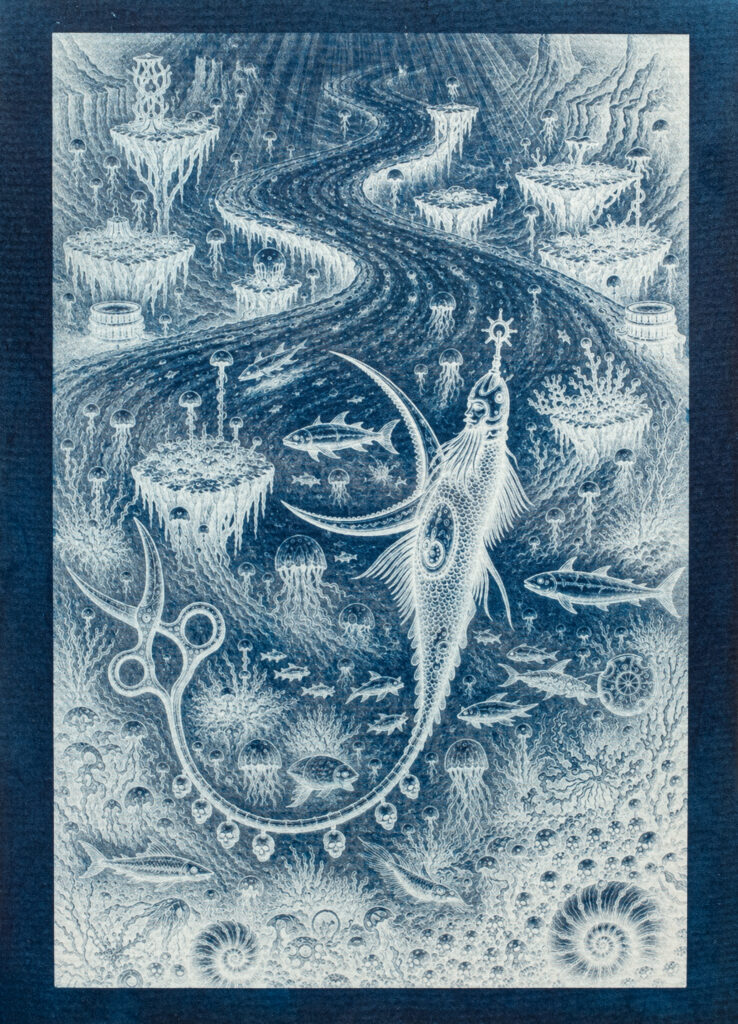
Tandel’s relationship with a Koli past is actualised through a practice that is driven by an archivist’s quest for evidentiary fragments and a researcher’s thirst for knowledge. This is tempered through his own memories as well as ancestral community memories preserved in oral storytelling traditions. He is at his animated best as he explains to a group of art and design students how a cyanotype at the start of the exhibition is inspired by a popular childhood night-time tale among the Kolis about the supernatural sea-creature ‘Maan Kāpya’. “It will cut your head,” Tandel exclaims, as he talks about his speculative artwork, and how he is finding new ways to explore these stories as tools of knowledge making and sharing that have shaped Koli cultural imaginaries. Historically, the Maan Kāpya story was used as a deterrent by parents — a tale of warning that stopped their children from straying too far from home and venturing into the “water bodies that dominated the seven islands.”
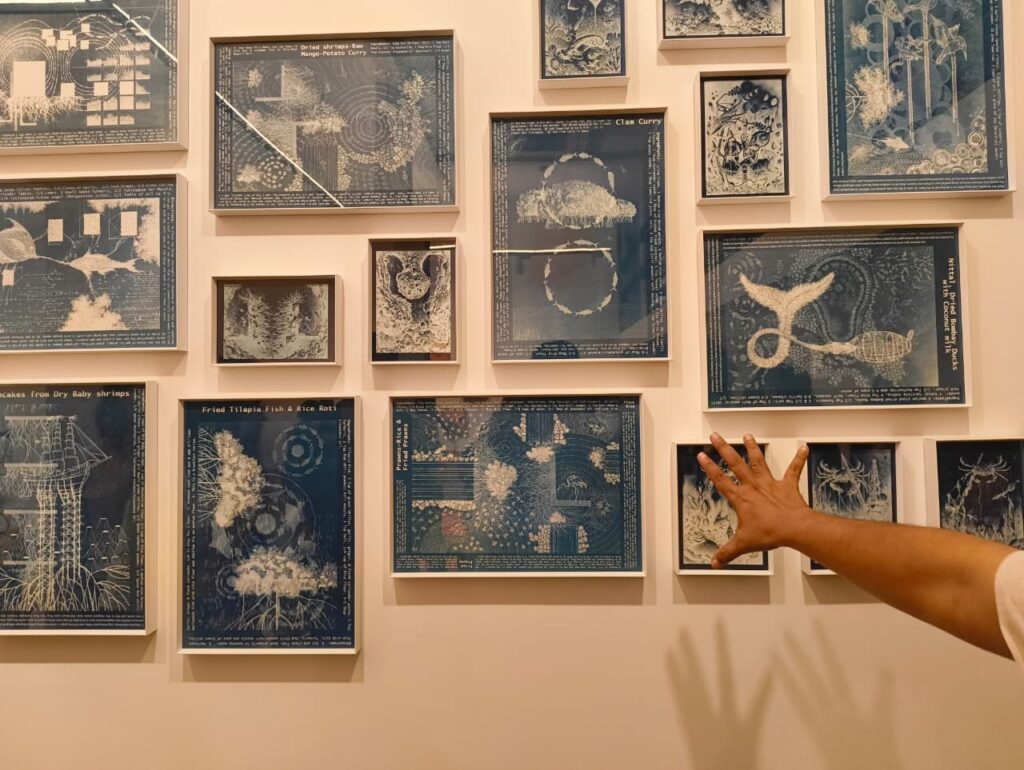
His large series of cyanotypes entitled Worli Koliwada (2026) are constructed through “layered research,” he explains, connected to actual archaeological findings from palaeolithic times that record traces of early human inhabitation alongside large water bodies. “A few years back, I came across the work of British archaeologist KRU Todd who had written papers on what he had found in and around Bombay [now Mumbai]. The title of his 1932 paper was Prehistoric Man Round Bombay.” Tandel blended the archival “fragments” his research brought up into composite cyanotypes in a collage aesthetic that reworks text and image, and comes with the heft of archaeological nous.
During the reclamation filling work that created “Bombay” from the seven islands, he observes that the earth used was transported from Worli, Thane, and places like Pali Hill, and this earth showed traces of prehistoric occupation. “They found stone age tools in the rubble in huge numbers” — evidence of the people who lived and worked there. For Tandel, these reclamation sites became a way of marking the presence of communities that settled along the coast and made a life in communion with water. Tandel also treats food histories and traditional recipes as archaeological “sediments” but of intangible knowledge systems rather than tangible material history. For him collected, found, and passed-on culinary archives are “archaeological sites” too. He digs into dishes and recipes, excavating ingredients that illuminate ancient human practices of hunting, gathering, and fishing.
Tandel has developed a startling asymptotic methodology of cyanotypes, paralleling the act of fishing. Both methods are dependent on sunlight and water. The cyanotype image is formed through the paper’s exposure to sunlight, ‘drawing’ the image to the surface. Similarly, “while fishing, when the sun rises, it activates the phytoplankton through photosynthesis, drawing fish to the surface of the water,” Tandel explains. While preparing the cyanotypes, he used two different types of water to embed a relationality between coastal archives and the historic photochemical method. After exposure, the larger prints were washed in Mumbai’s salty ocean water. The smaller prints were washed in saline “Tethys water,” he tells me excitedly, referring to the geological discovery in Jaisalmer, Rajasthan of saline water — approximately 200 million years old — trapped in rock that came from the Tethys Ocean, an ancestor to the modern Indian Ocean. Citing this connection, the smaller series is called Vitamin Sea Archives: Sediments of Intelligence (2026). Both series of works bring together critical juxtapositions and imagined waterscapes with sea-creatures, both mythic and real, and urban landscapes, machinery and AI-mechanisms that are employed in extractive development practices. Ships and trawlers, and surreal creatures with flashing tails, commune with recipes of ‘Pancakes from Dry Baby Shrimps’ and ‘Stuffed Eggplants with Dried Tiger Prawns’. The cyanotype blue becomes a natural, intuitive choice, deepening the water-worlds of Tandel’s strange glowing speculative Atlantises.
Language as Resistance
A series of sculptural works made with yarn, stainless steel, and found ‘marine’ objects, called Estuaries of Waning Sounds: Koli Dictionary Project (2026) speak to the act of reclaiming Koli identity through language. Rooted in a visualised, sensory manifestation of ‘remembering’, Tandel asks a critical question – “How can language as a vibration dismantle legitimation practices within archives and knowledge systems?” The artworks from this series find their origin in the quest for community through the act of constructing a Koli lexicon. This series began in an institution: “In five-six years, I have witnessed the Tandel Fund of Archives become a forensic laboratory of Koli memory. My uncle, Ramesh Nakhwa, is a Koli folk singer — one of his songs was remixed more than 100 times. We realised that no new songs were being created, so we understood his vision. We talked to young people, and they spoke about a loss of language, of words. We started documenting and finding words and compiled them into dictionaries. In 2022, me and Kadambari [Tandel’s partner] declared September 1 as Koli Bhasha Divas, and now it is celebrated across the 250 fishing villages.” This approach to reclaiming the indigenous language went “viral” and became the seed idea behind the Tandel Fund of Archives, co-founded by Tandel and Kadambari Koli. “My forefathers and Kadambari’s forefathers had a fund — Tandel Fund — which was doing social work for Koli people, since the 1400s, so we used that name. We see it as a type of resistance — a protest archive.”
While Tandel has been working with Koli epistemologies since 2008, the formation of the Tandel Fund of Archives was directly triggered by a 2019 Maharashtra state order that in one sweep categorised the more than 250 Koliwadas or fishing villages as slum settlements. Notices were dispatched to societies, and this led to a drawn out battle with lawyers, archivists, artists, and members from the community at the forefront. “We felt we had to do something,” Tandel emphasises, and as artists, he and Kadambari channeled their anger into an act of “collecting different kinds of fragments that speak of our existence in this area before Bombay was even a city.” Starting with photographs, they moved to language, where each word became an artefact of resistance. The archive raises the question of “Who legitimises Koli knowledge?” — an epistemic swathe that connects thousands of years’ worth of experiential wisdom to a present filled with ecological collapse and precarity.
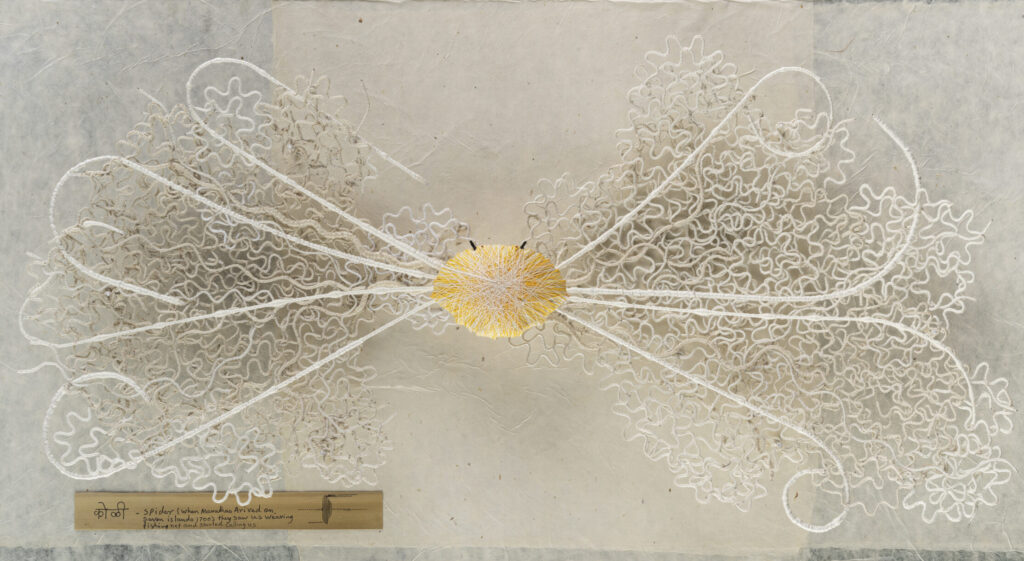
The compilation of the Koli lexicon as ‘word banks’ turned into publications which are updated and revised annually. While the words are written in Devnagri in the Koli dictionaries, the absence of a script inspired Tandel to creatively manifest individual, found-words through logograms that channel sonic vibrations and render them visually. Another illustration of the artist’s multi-sensory semiotic imagination are his sculptural works; yarns, knots and all manner of found tendrils ‘grow’ on beige stainless-steel armatures. One of the first pieces in this series interprets the nomenclature of “कोळी” through an arachnid form. Tandel fishes out the oral etymological history of “Koli” meaning “spider” in dominant Marathi. “When the Marathas first arrived here, they saw us knotting and weaving fishing nets on the shore. So they started calling us ‘Koli’ — spiders that weave webs.”
Sacred Relationalities
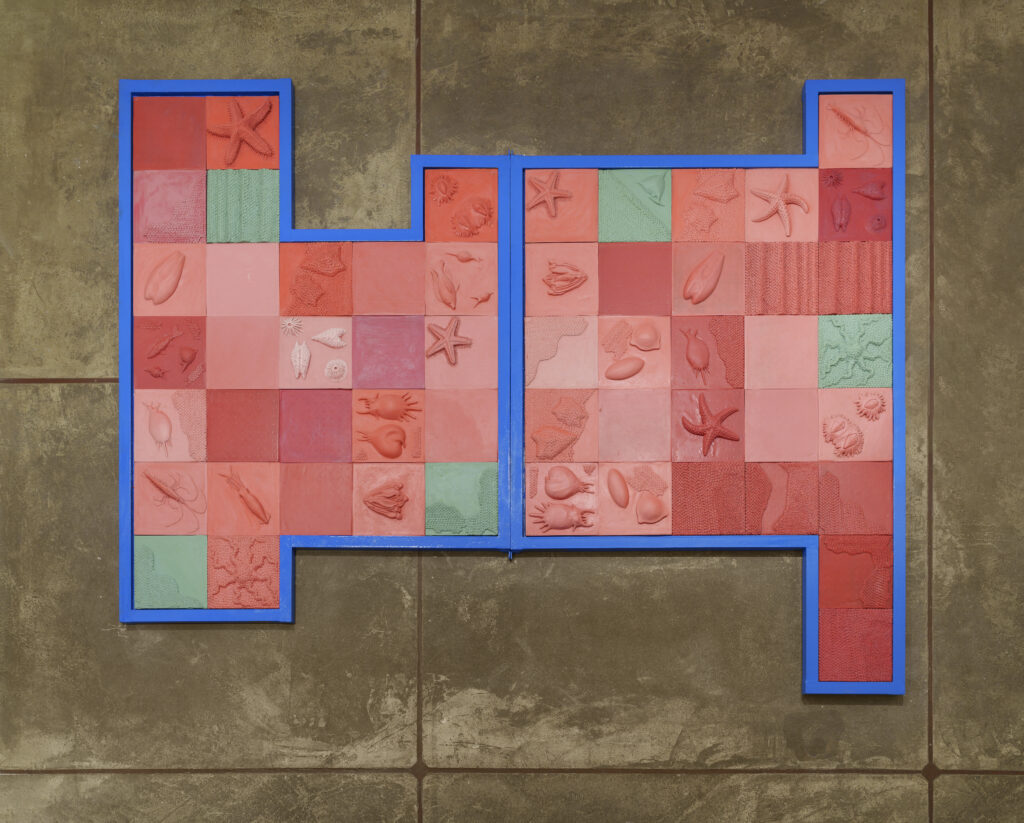
The series, Sea of Relations (2026), frames the seabed in a soft, horizontal formation on the floor, using the material of Silicone rubber, reinforced on marine plywood, with cotton fabric. Visitors walk barefoot on the soft embedded forms — marine creatures, plants, starfish, coral, “fruits of the sea” that fall to the bottom — which deflate and puncture underfoot, simulating a seabed, but also animating ways of experiencing marine biology and geography through play. The grid-like formation is reminiscent of the childhood game of hopscotch or chipri, where players throw stones in the different squares and hop, skip and jump their way to victory.
Perhaps the most colourful works in the exhibition are the thread sculptures that make up the Salt Shrines: Colour Blind | वर्णान्ध (2026) series. Moving away consciously from fishing net as material, these forms used fibres made from jute and cotton. Tandel mounted his “shrines” on stainless steel frameworks using yarn that was traditionally made by the elderly women and children from the community. This scaffolding technique for Tandel’s votive forms is derived from the culture of nature worship and the cults of oceanic deities that exists to this day. “In these ten sculptures there are round rings, and dyeing needles. This is a permanent structure in my village, and it is used in ritual and performance towards the end of September and the beginning of October. The ritual is done to remember people who have lost their lives in the ocean. The needles in the structure are very small, and people decorate it with forest flowers. But this is from my village only, which is Chendni Koliwada. There are more than 250 villages, and each village has their own forms.”
The artist speaks of the symbolic associations of various colours across a range of ethnic groups and objects — such as the use of haldi and chandan at the Shri Vitthal Rukmini Temple in Pandharpur, or how blue is usually associated with Dalit and subaltern communities. He speaks about the Koli community across sacred geographies and imbibing “pilgrimages” of belief in their cultures of worship, depending on what or who they encountered. Tandel’s vision opens up these lived traditions into a phantasmagorical divinity that is threaded together with fish skeletons and intricate seaforms, revitalising Koli rituals to crystallise their presence. “Fish skeletons as a metaphor was important to me,” he says.
It is difficult to inscribe Tandel’s creative vision into a single domain of aesthetics or medium. His attitude of play, layered with irony and subversive humour, embodied most vibrantly in his choice of nomenclature, traverses through the works. One of his previous large sculptural works, for instance, playfully satirises the metaphoric range of Mumbai’s favourite sea creature: HOW TO COOK ‘BOMBAY’ DUCK IN VARIOUS WAYS? (2022). The city itself is taken through the shredder, and deep-fried into a material form using mild steel iron, glass reinforced concrete, dental plaster, silicon rubber, and marine plywood.
Salted Caviar is a metonymic act of world-making, curating an entanglement of more-than-human vitalities through totems of the ocean and the coast. The works extend the ambit of contemporary art demonstrating through illustration, a methodology of “sensing” the archives. The epistemic force of the community’s lifeworld pulls you in through a syntax of touch as much as visuality, making the cumulative impact synesthetic. In the exhibition’s creative heterotopia, time is rearticulated in the “non-place” flux of the ocean. Multiple temporalities submerge and re-emerge as corporeal forms — from the slow, stony sidling of geological time to the affective spontaneous tentacular spread of a temporality felt through the senses, from the archival detritus of fragmentary narrated time to the political explosion of divine, cosmological time. The Koli languages of comradeship sit on our tongues like dried fish, as we wade through their porous, many fingered currents, and Tandel looks on with glee.
First published: October 30, 2026