-
ChicagoImpart Encyclopedia of Art. "Bhuj (Weapon)." October 28, 2026. https://imp-art.org/articles/bhuj-weapon/.
-
MLA"Bhuj (Weapon)." Impart Encyclopedia of Art, Oct. 28, 2026, https://imp-art.org/articles/bhuj-weapon/.
-
HarvardImpart Encyclopedia of Art (2026) Bhuj (Weapon). Available at: https://imp-art.org/articles/bhuj-weapon/ (Accessed: 12 November 2026).
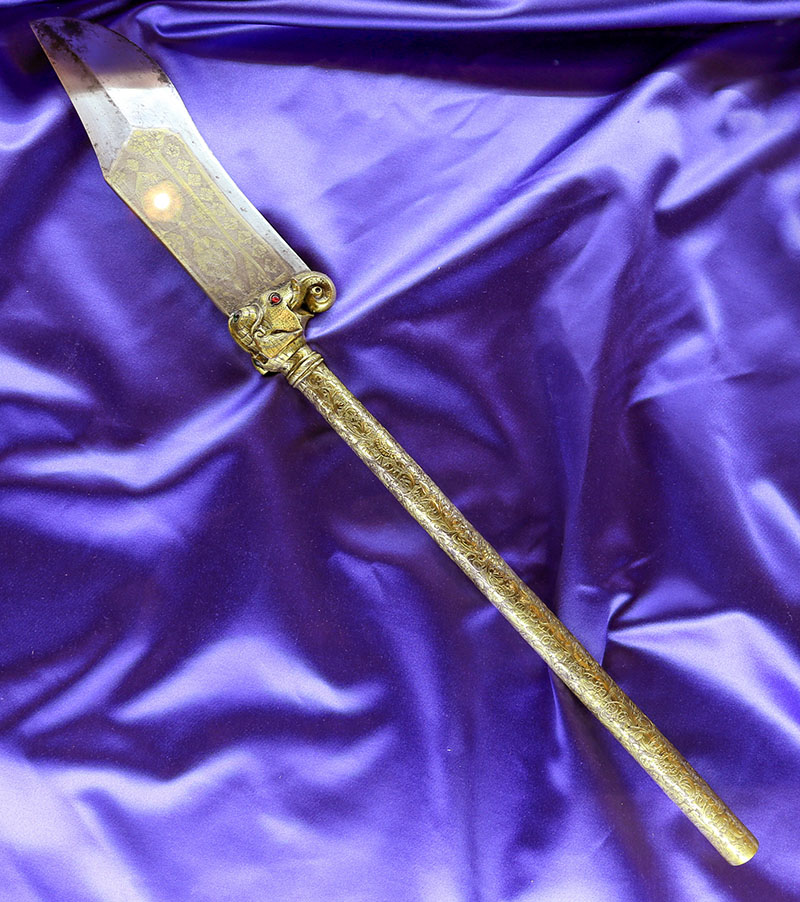
A polearm-style weapon consisting of a short, broad single-edged blade attached to a long, straight hilt that often conceals an additional stiletto blade, the bhuj is believed to have originated in the former princely state of Kutch (1147–1819) in present-day Gujarat, India. It is named after the Kutchi capital. It was used in close combat by cavalry and foot-soldiers of the Kutch state, the neighbouring kingdoms of the Sindh region in present-day Pakistan, and likely to a lesser extent in northern India and the Deccan.
Terminology
The city of Bhuj was a major centre of weapons production in the medieval period. However, the term ‘bhuj’ for the weapon, now the norm among collectors, was popularised by European collectors in the modern period; the precise origins of the name, and of the weapon itself, are both unknown. The weapon was likely known in the Marwari language as mujawli. It is also sometimes known as a bhuj-katti (‘bhuj knife’) or bhuj axe-knife. The term ‘elephant knife’ is also sometimes applied because the base of the blade is conventionally shaped in the form of an elephant’s head.
Historical background
Most extant specimens currently housed in museums and private collections were produced between the eighteenth and twentieth centuries in Kutch and Sindh. Colonial-era documentation has speculated Turkic or Arab influence on the development of the weapon in Sindh and Kutch, given the extensive historical contact between Central and West Asia and these regions. Scholars also suggest that over time, the bhuj came to be produced in other parts of the subcontinent, such as the princely state of Hyderabad; one specimen at the Salar Jung Museum, Hyderabad is a locally made imitation of the northern weapon, ornamented with Bidriware on the sheath and the pole. Other specimens indicate the weapon’s production and use in the medieval kingdoms of the Indian state of Maharashtra, though these lack the otherwise distinctive elephant carving at the base of the blade.
Design and ornamentation
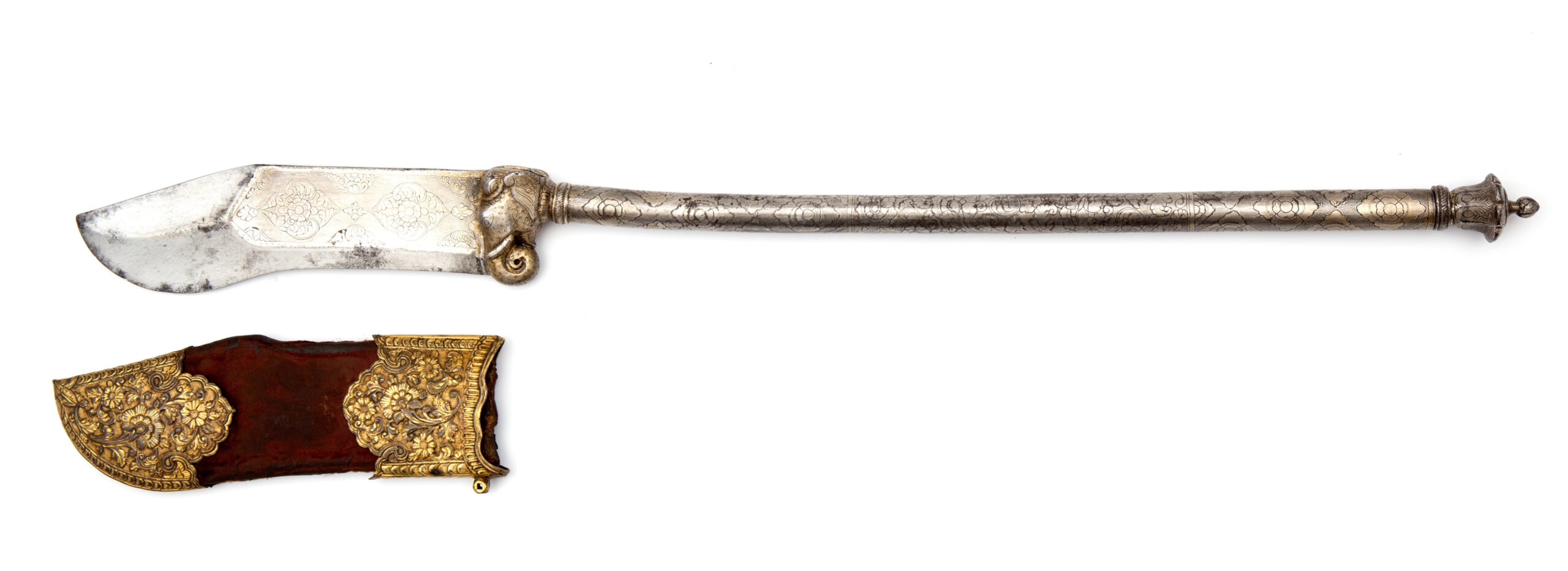
The bhuj generally has a heavy steel blade, with a broad blunt spine like that of an axe. It is single-edged for most of its length, with a subtle recurve ending in a sharp double-edged tip. It is between 18 and 25 centimetres long. In some cases, the cheek of the blade features a decorative panel with low relief carvings or inlay work. The typical bhuj characteristically features an elephant-head carving, often inset with precious and semi-precious gemstones, from which the blade emerges. The sheath for the blade is made of wood or metal — usually copper — decorated with floral and geometric designs using techniques such as silver-gilding, repoussé, parcel-gilt or koftgari. It is sometimes lined with velvet.
The haft or hilt of the weapon is a hollow pole typically longer than the blade itself, roughly between 20 and 40 centimetres long and a few centimetres wide, culminating in a decorative pommel or knob. Typically the pommel can be unscrewed to reveal a concealed double-edged stiletto blade, known as a gupti in various Indian languages (from the Sanskrit gupta, ‘hidden’ or ‘guarded’). The length of the pole allowed for the bearer to use two hands to lend more force while thrusting or stabbing in combat. Like the blade, it is usually made of durable, tempered steel. Other metals such as copper were also sometimes used, often chased, gilded with silver, further inlaid with precious metals or stones, or decoratively engraved or embossed. Colonial documentation notes that the weapon was hung from a chain fixed to the belt.
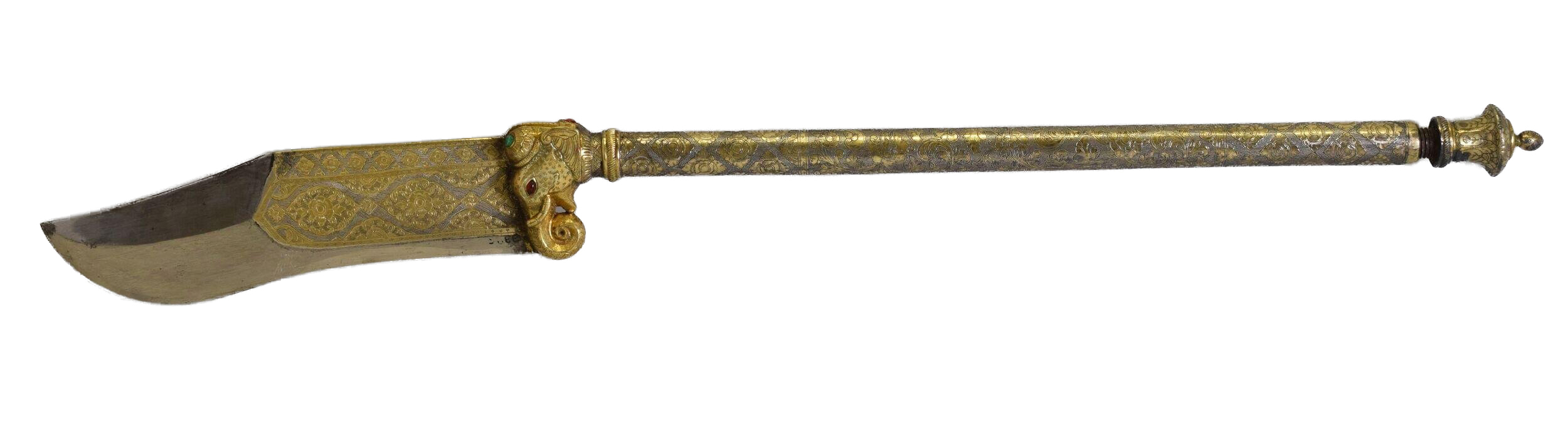
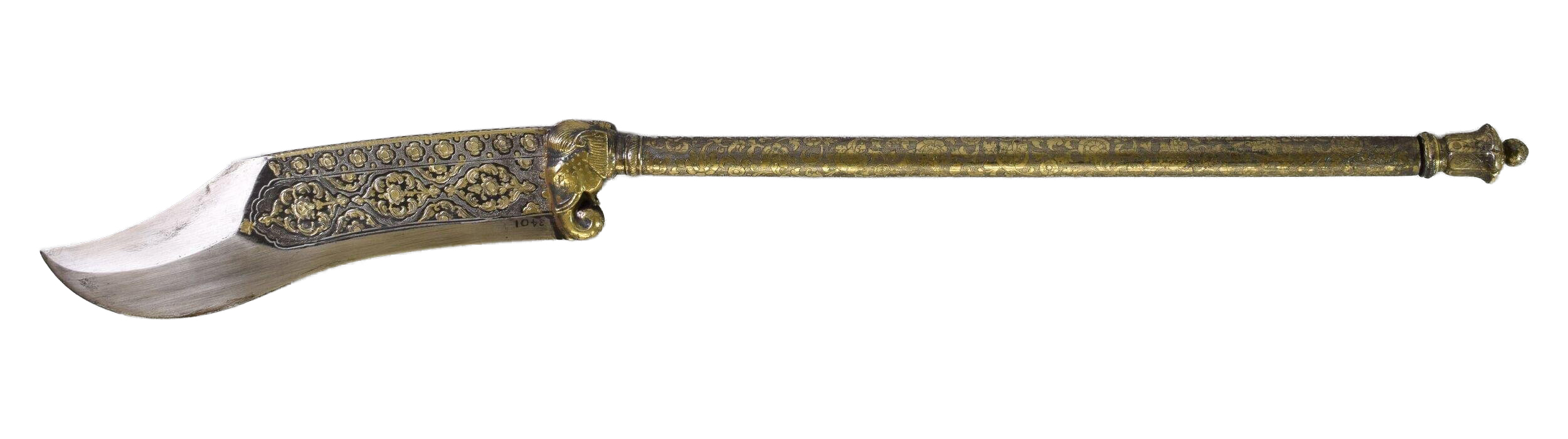
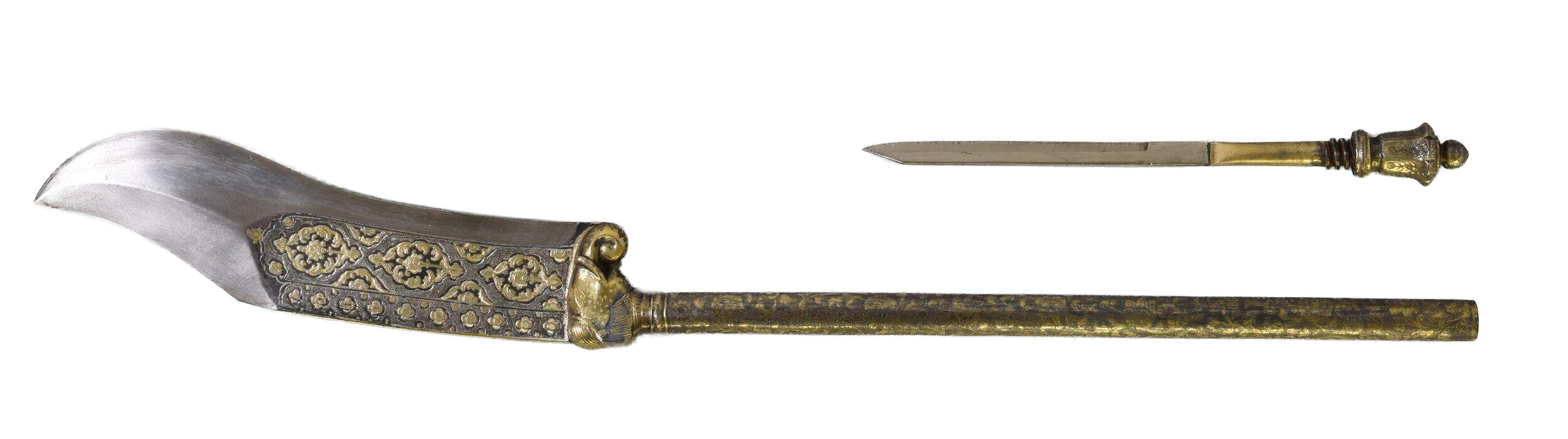
Notable examples of the bhuj are held in the Victoria and Albert (V&A) Museum, London; the National Museum, New Delhi; and the Salar Jung Museum, Hyderabad. A specimen held by the Royal Collection Trust, London, was gifted to the former Prince of Wales Edward VII in 1875–76 by Gambhirsinhji Verisalji, ruler of the former princely state of Rajpipla in present-day Gujarat.
First published: 28 October 2026
Image Gallery
Bibliography
Egerton, Wilbraham Egerton. A Description of Indian and Oriental Armour. London: W. H. Allen and Co., Limited, 1896.
Elgood, Robert. Arms and Armour at the Jaipur Court: The Royal Collection. London: Kodansha Europe Limited, 2015.
Pant, G. N. Catalogue of Edged Arms and Armour in the Salarjung Museum, Hyderabad. Hyderabad: Salarjung Museum, 1989.
Singh, Runjeet. The Goddess: Arms & Armour of the Rajputs. London: Runjeet Singh, 2018.
Tarassuk, Leonid, and Claude Blair, ed. The Complete Encyclopedia of Arms and Weapons. New York: Simon and Schuster, 1979.
Feedback