-
ChicagoImpart Encyclopedia of Art. "Majju, Majus, Sandook." May 15, 2026. https://imp-art.org/articles/majju-majus-sandook/.
-
MLA"Majju, Majus, Sandook." Impart Encyclopedia of Art, May. 15, 2026, https://imp-art.org/articles/majju-majus-sandook/.
-
HarvardImpart Encyclopedia of Art (2026) Majju, Majus, Sandook. Available at: https://imp-art.org/articles/majju-majus-sandook/ (Accessed: 16 October 2026).
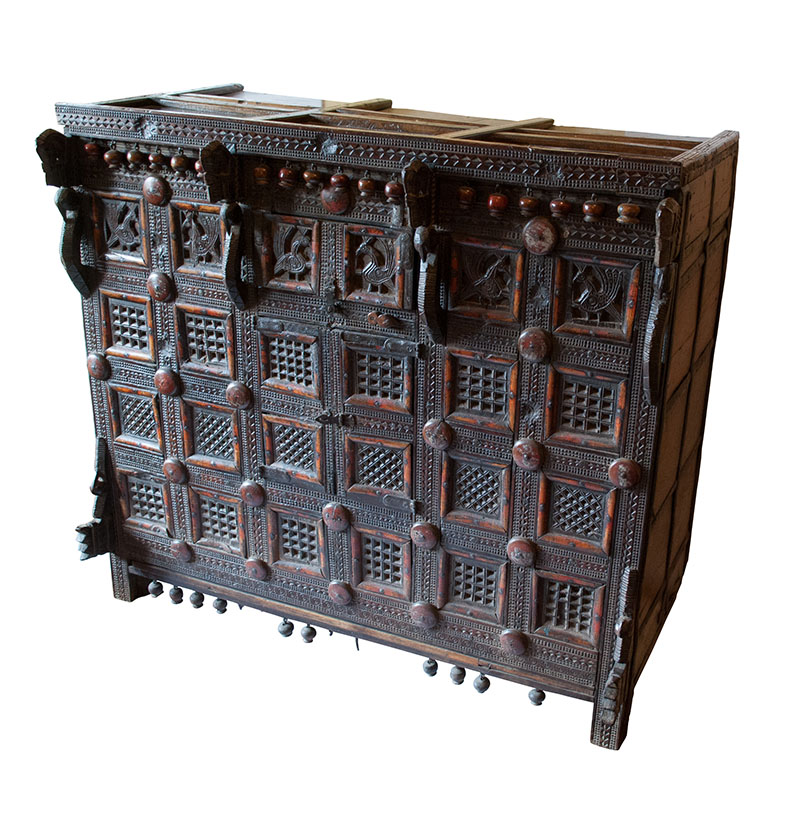
Among the common vernacular furniture of northwestern India is a wooden storage cabinet with shuttered, panelled facades and concealed compartments, known variously as majus, kothla majus, majju, manjush, or sandook. It may be commissioned as a hope chest, as part of the bride’s dowry, or for general use by a family; and holds a range of personal and household effects including bedding, clothing, and valuables.
Terminology
The words for this cabinet depend on region and community, and reflect some associated design variations. In central Gujarat and Saurashtra, the cabinet is known as a kothla majus; the relatively affluent Rajput, Kathi and Mer communities in the region also call it a majus. In Rajasthan, it has wheels and is called majju — as is the wheeled Mer variant. In the Kutch region of Gujarat, the Ahir and Rabari pastoral communities call it a manjush. In Punjab, and in Haryana where it is less common, it is known as a sandook. However, ‘majju’ and ‘sandook’ also refer to a distinct storage chest in Rajasthan and Haryana.
Design and construction
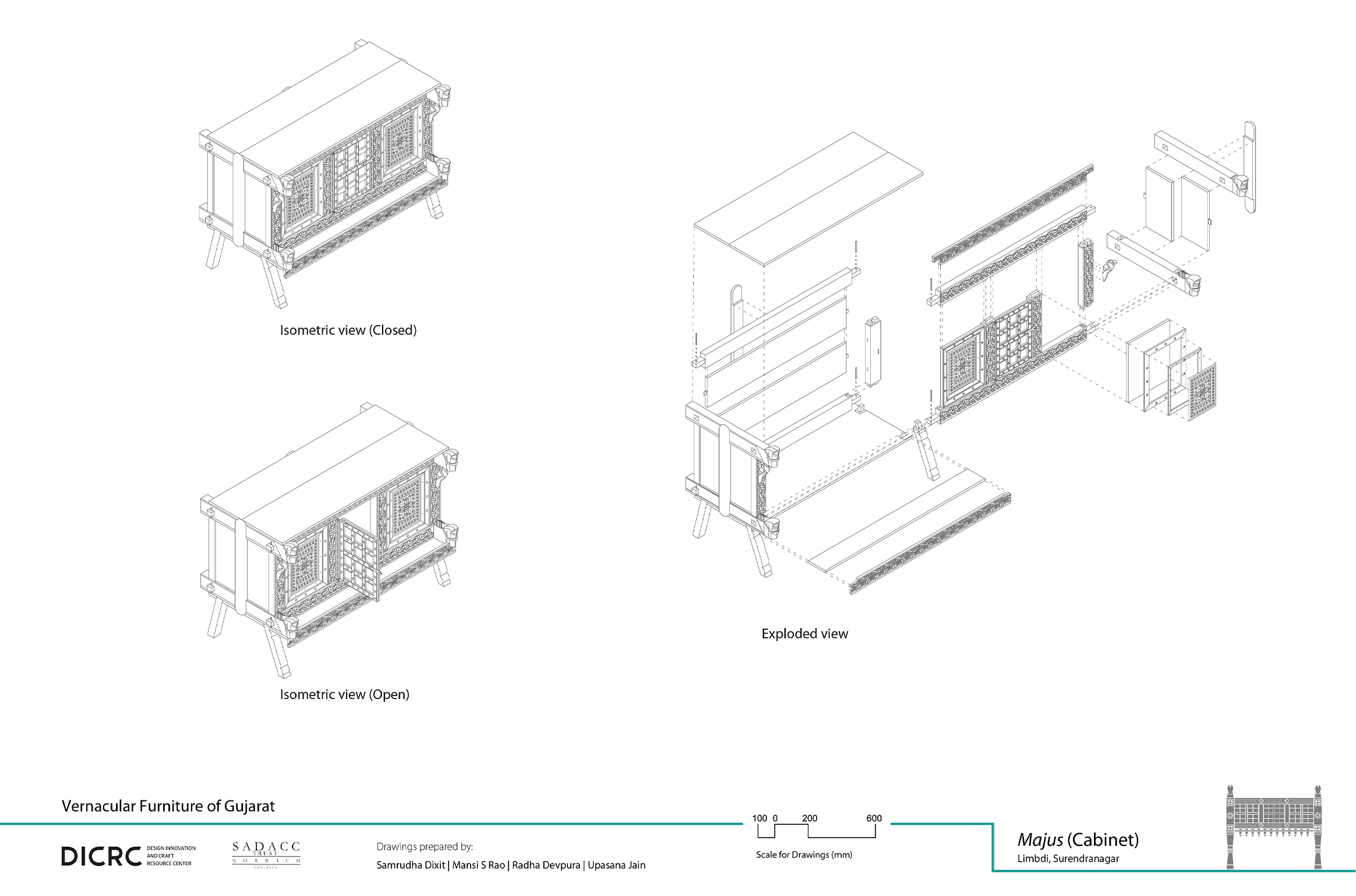
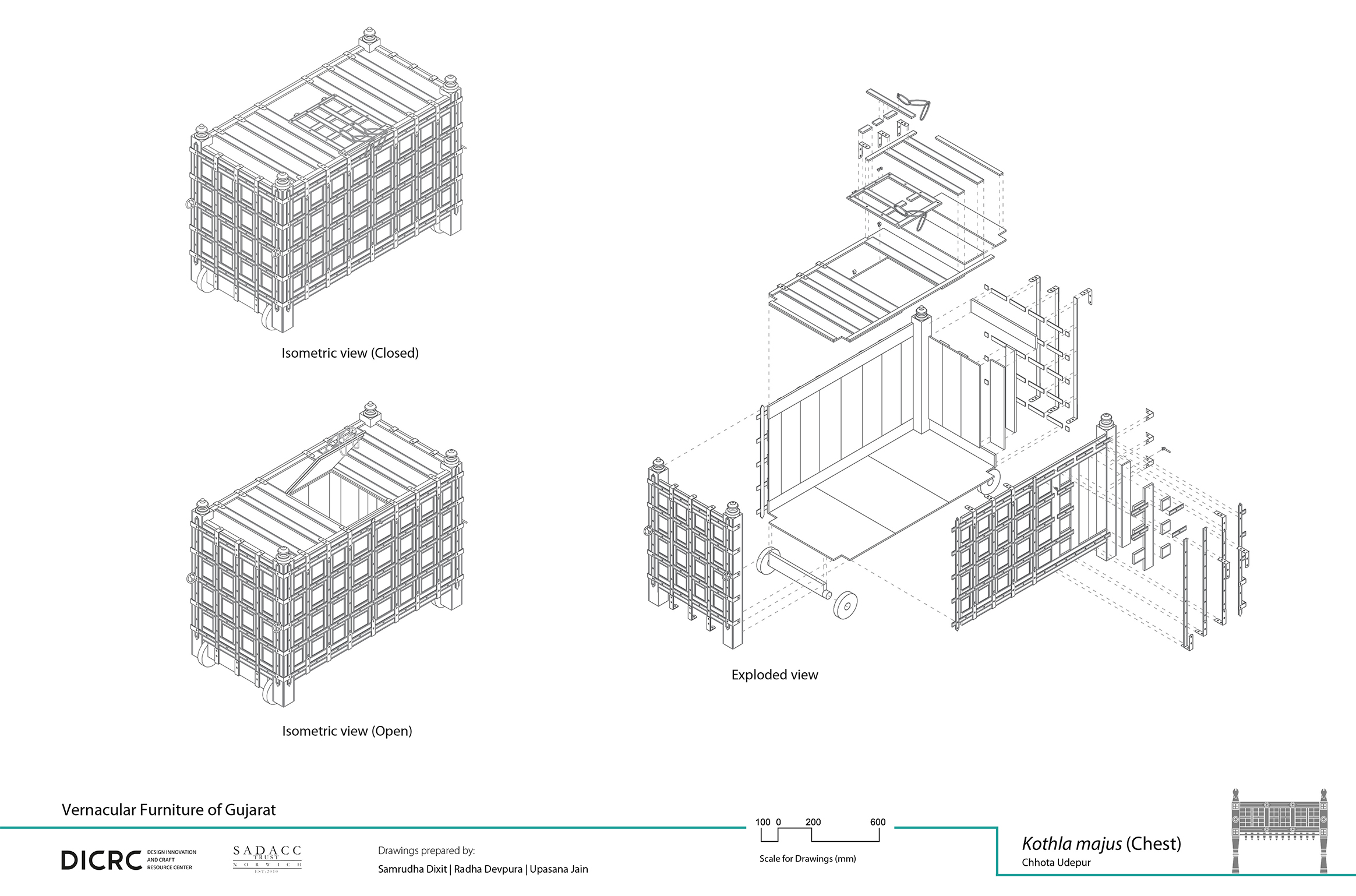
Usually made of wood, the cabinet is rectangular, typically wider than it is tall; it is mounted on four low supports — legs or wheels, and sometimes both. Generally quite large with a single primary internal space, it can store the personal belongings of a few members of a household and other domestic items, usually bedding. Older Punjabi sandook commonly featured an additional side compartment, often used to store clothes, with the main compartment holding bulkier items like bedding. The manjush used by pastoral communities in Gujarat is a little smaller than average, so that it is easier to carry from one settlement to another. By contrast, a Punjabi sandook can weigh up to 200 kilograms. The kothla majus is equipped with iron rings on each side, by which it can be pulled using ropes.
Until the mid-twentieth century, it was common for patrons to commission a cabinet from their village carpenter; the designs of these earlier cabinets reflected the locality or were particular to a family, especially when the cabinet was made as a hope chest for a bride. The carcass of the cabinet is made using a frame and panel construction. Shisham (North Indian rosewood, Dalbergia sissoo) or neem (Azadirachta indica) wood are used for making the cabinet in Punjab, the latter being resistant to termites; teak (Tectona grandis) is used in Vagad, Rajasthan, where it is abundant. More recent specimens may also be made of plywood or metal.
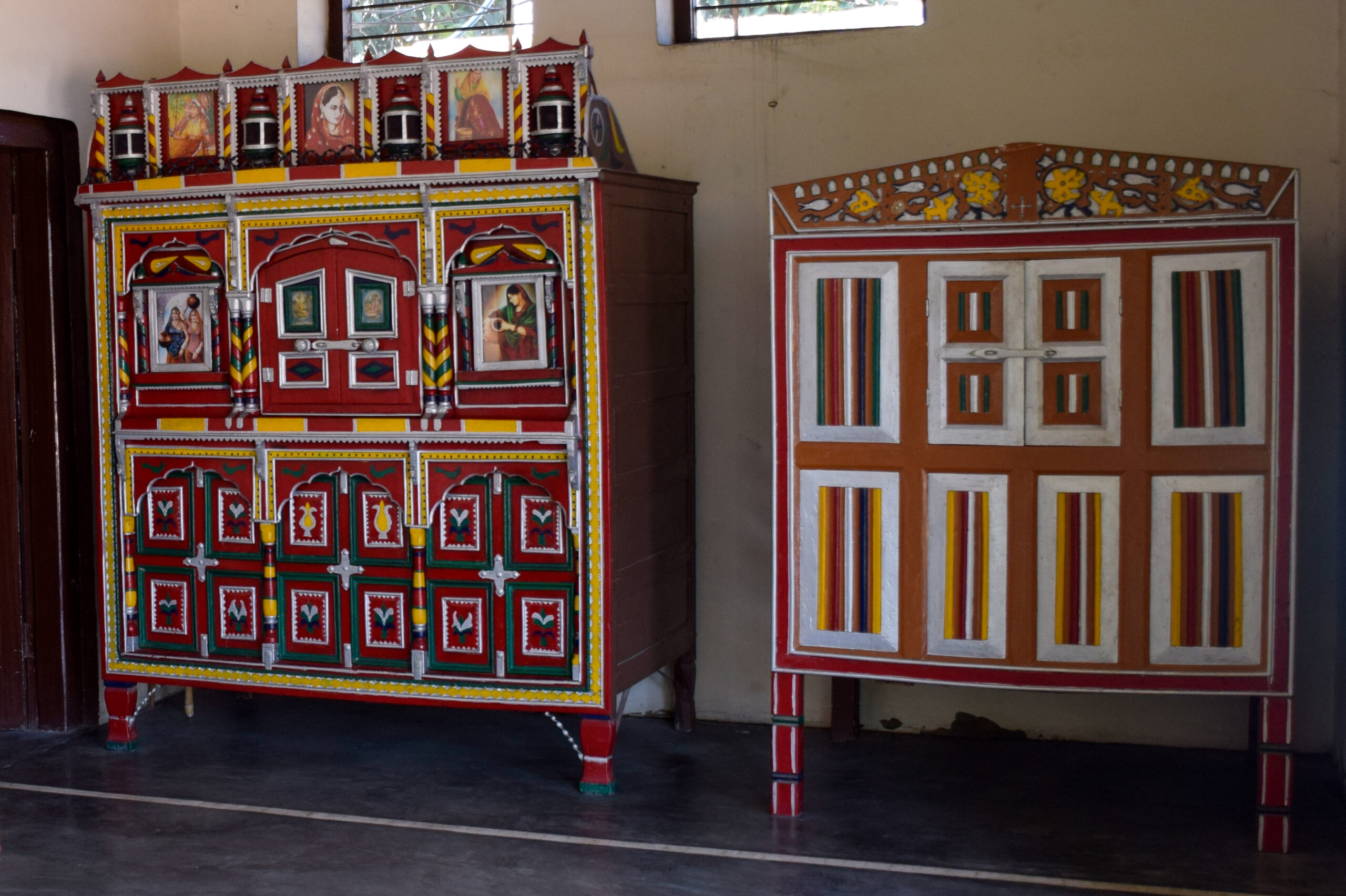
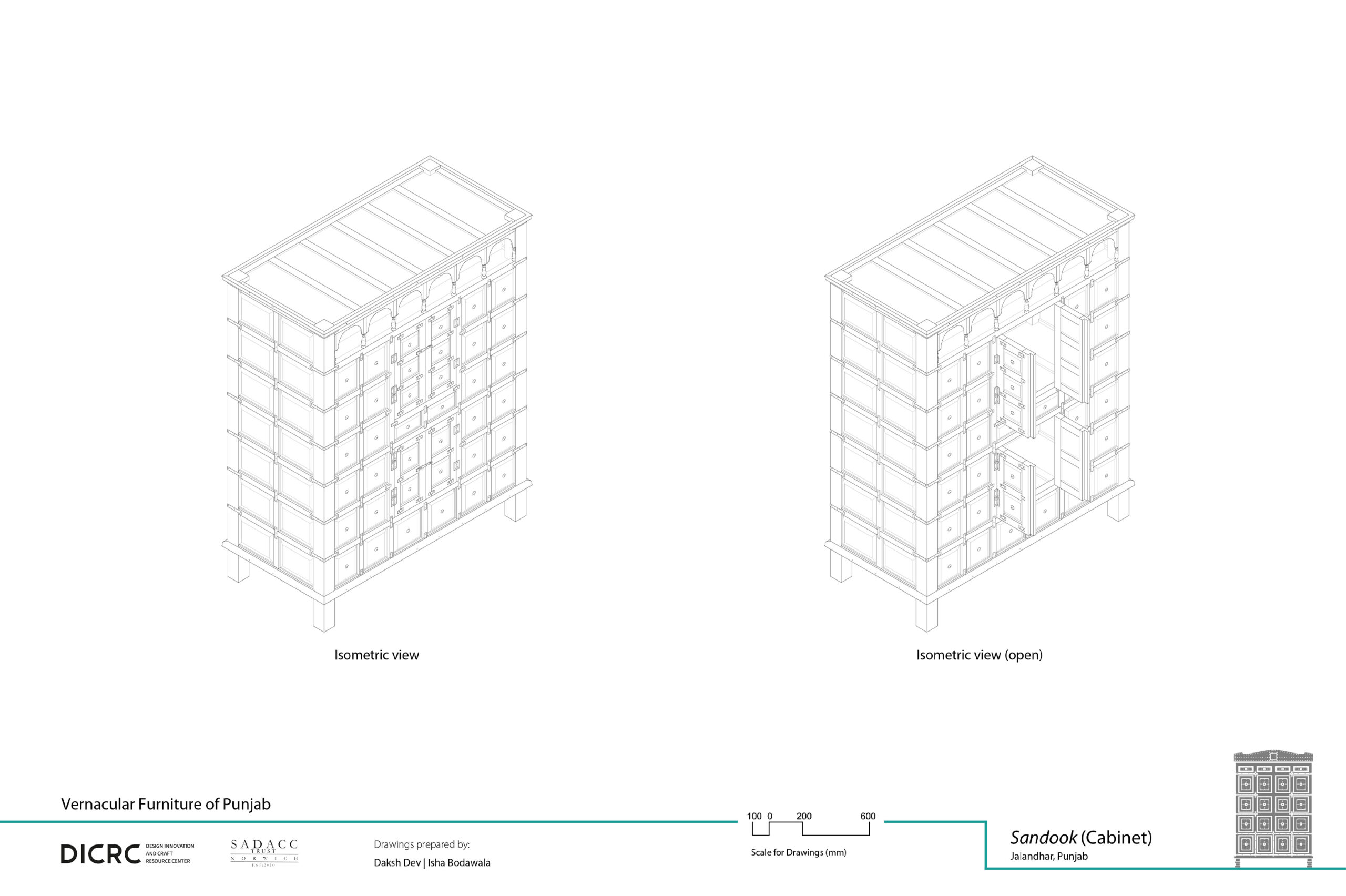
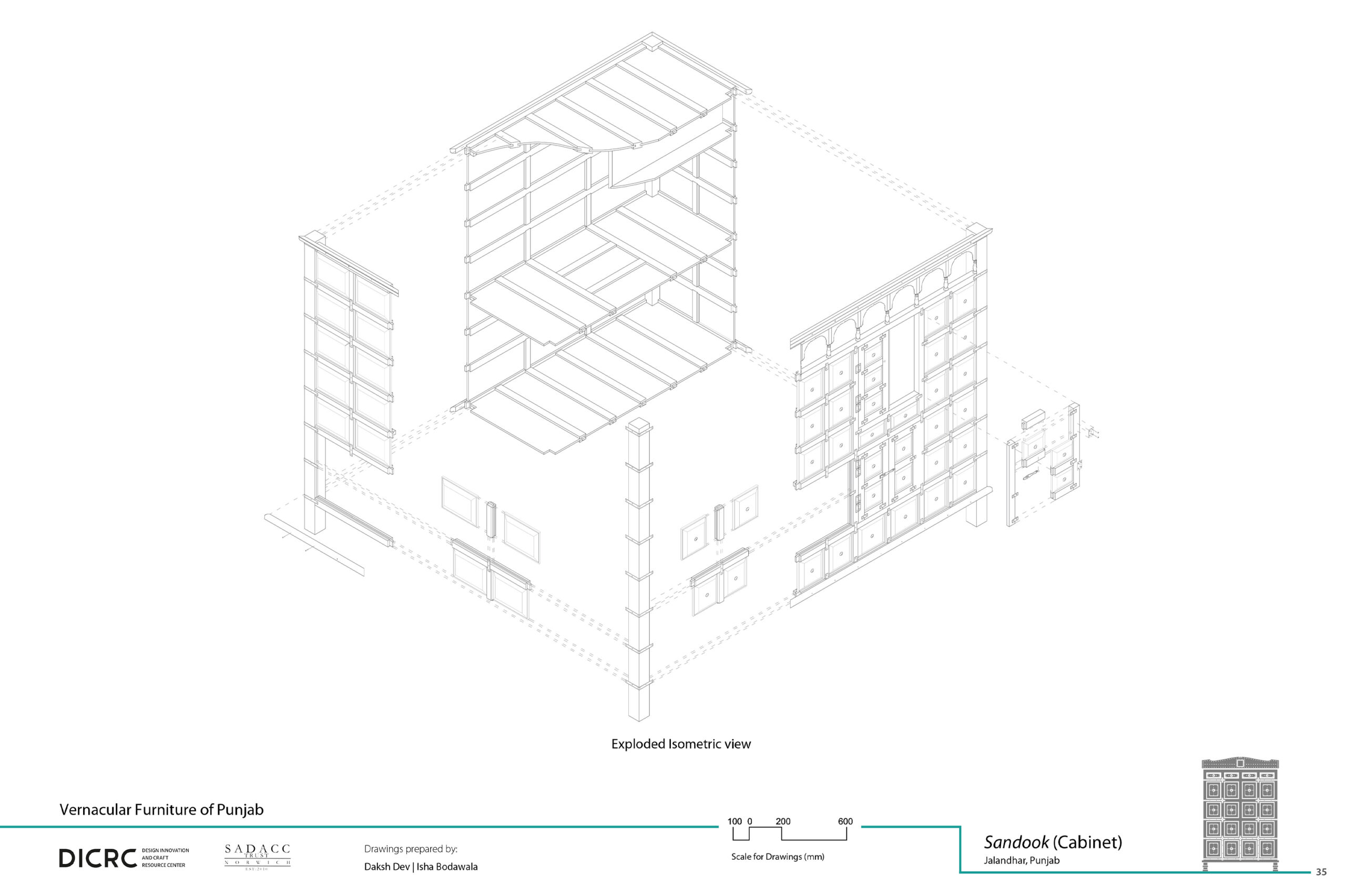
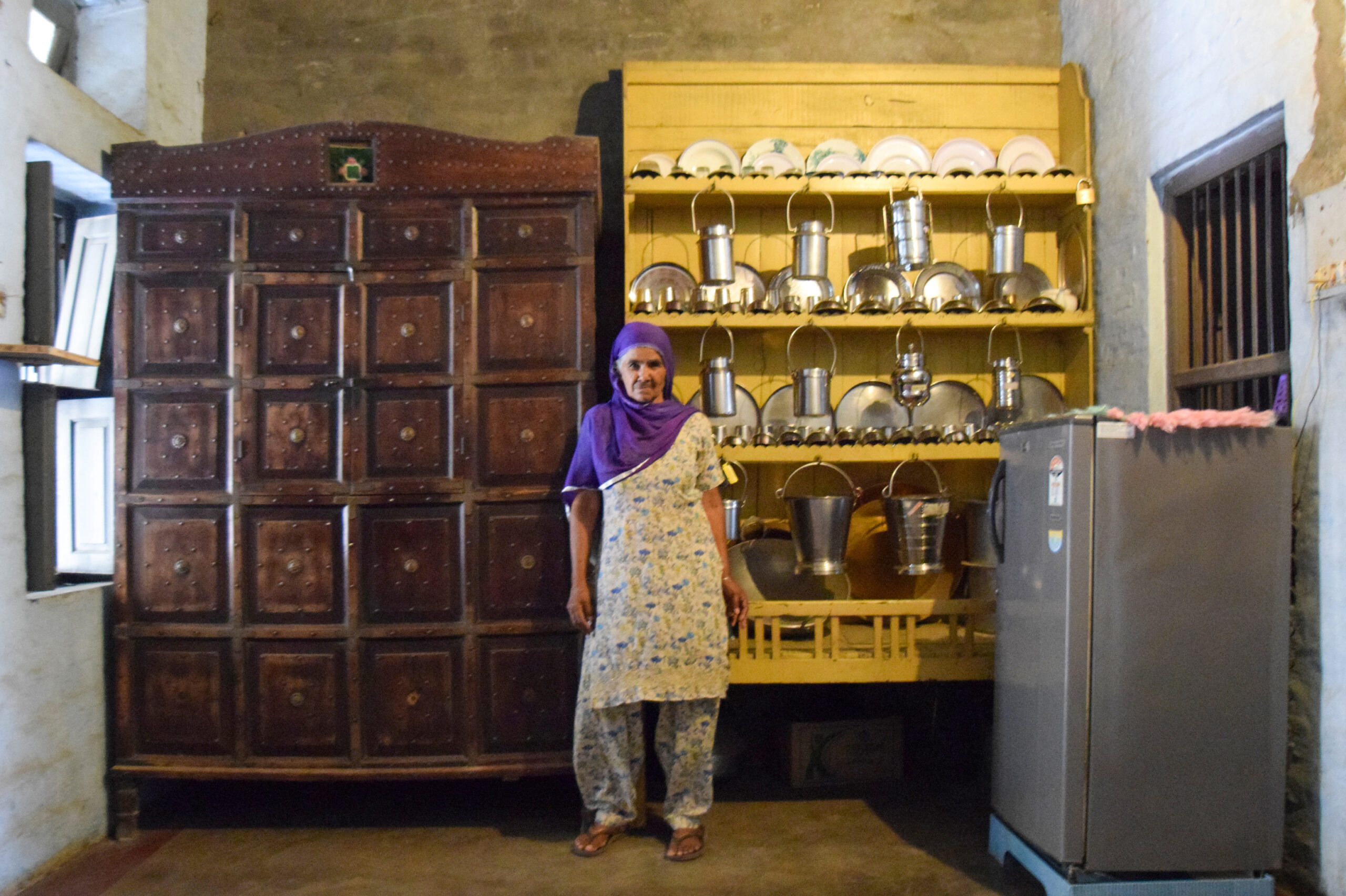
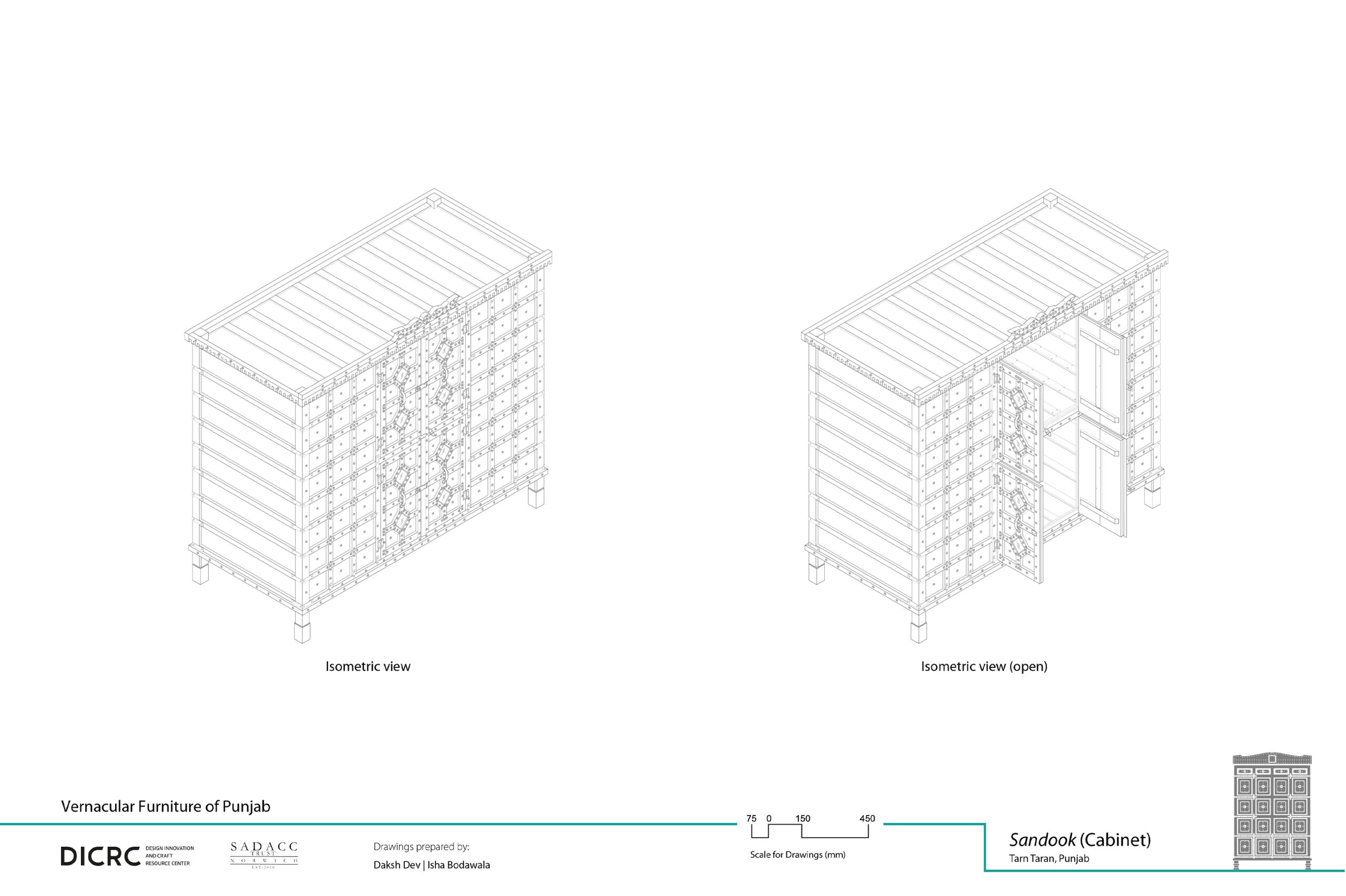
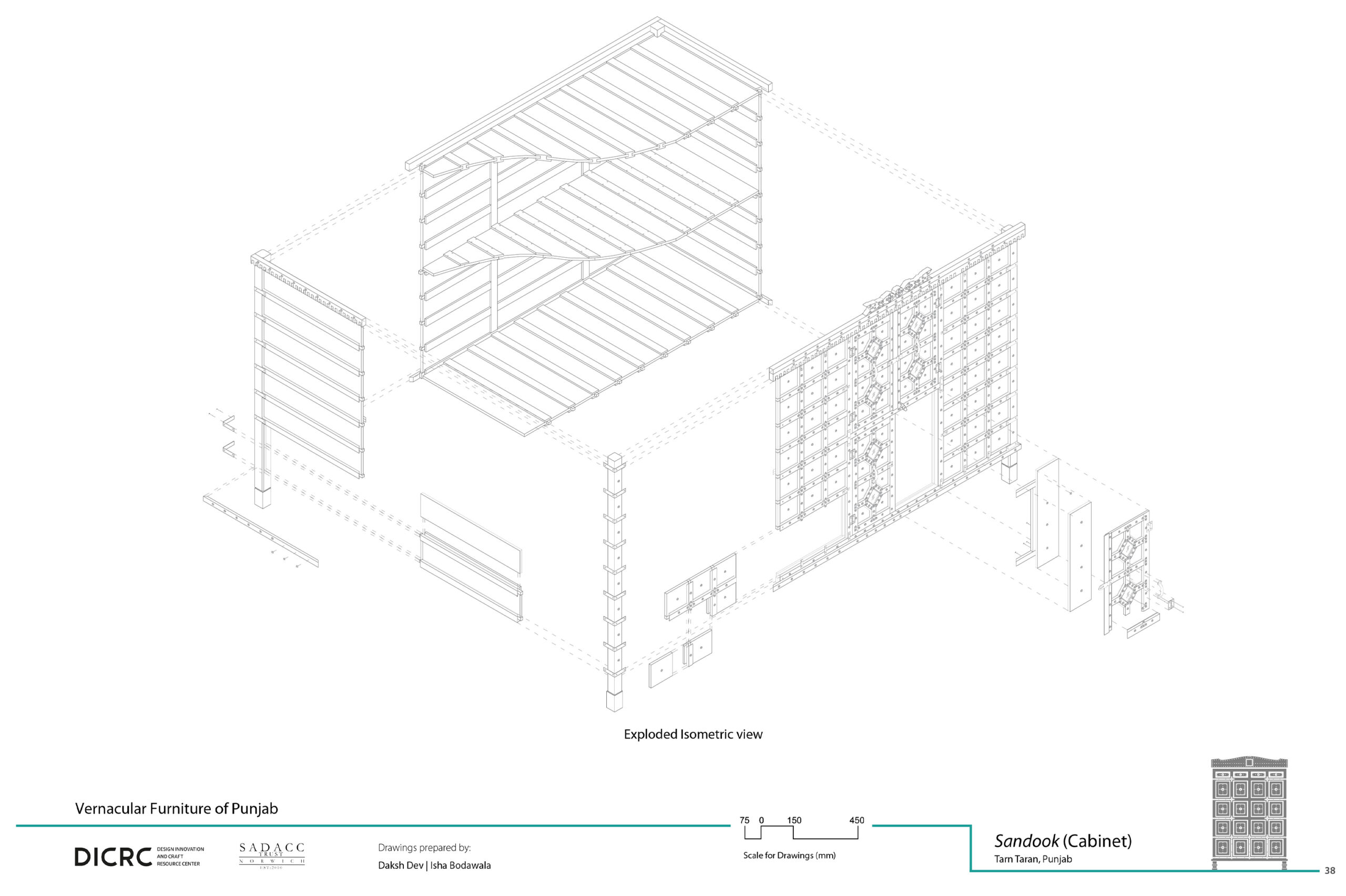
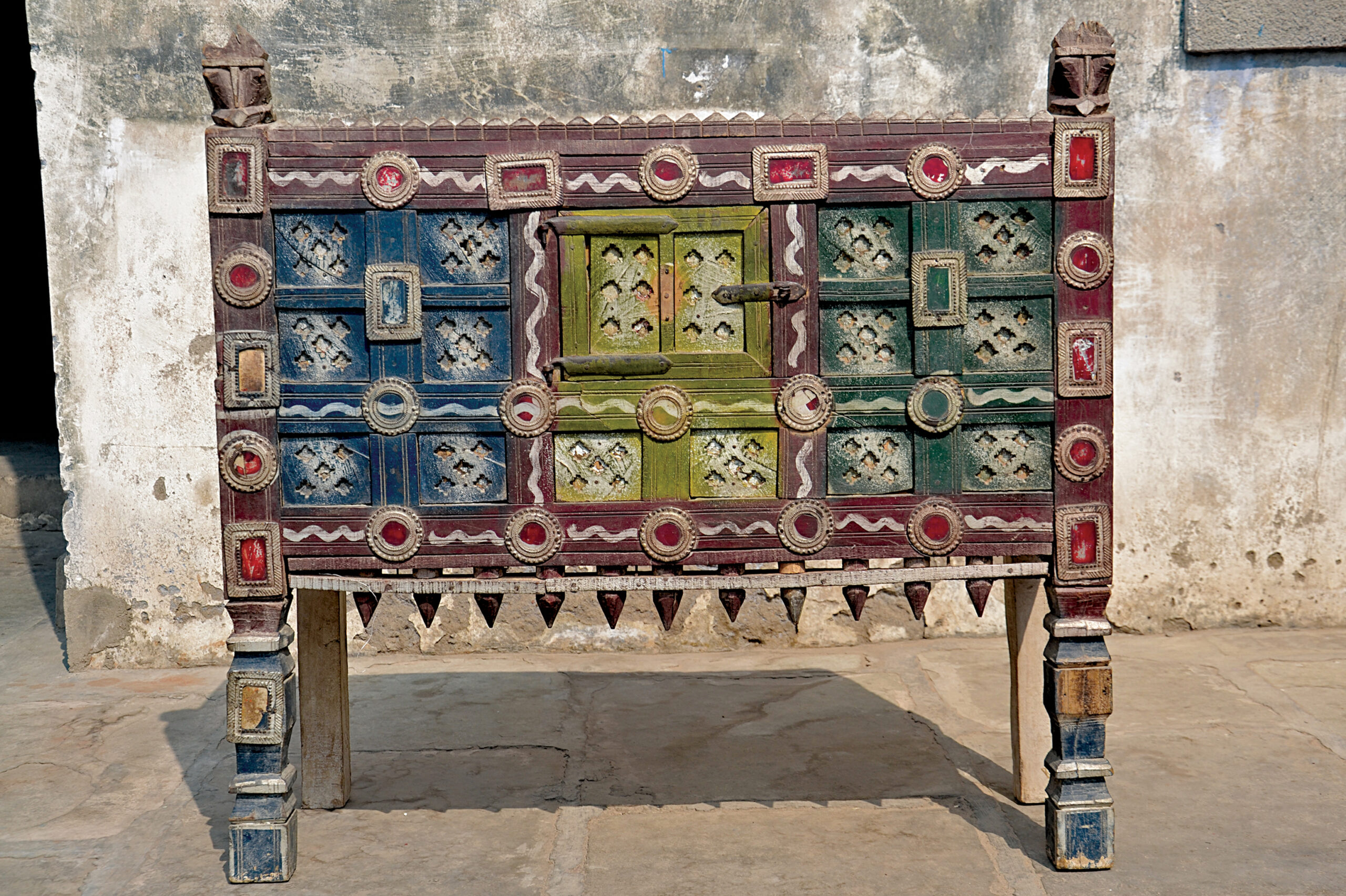
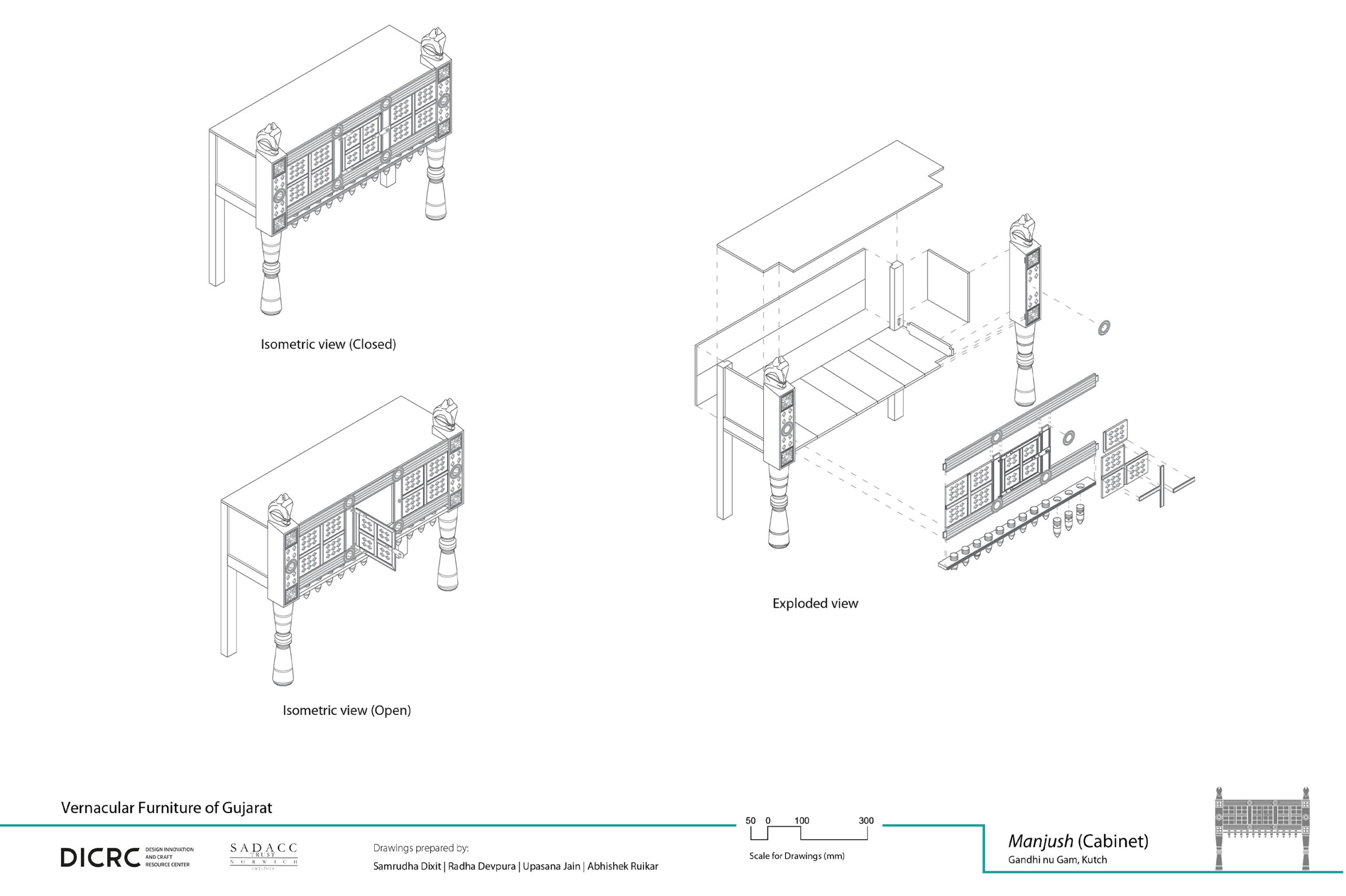
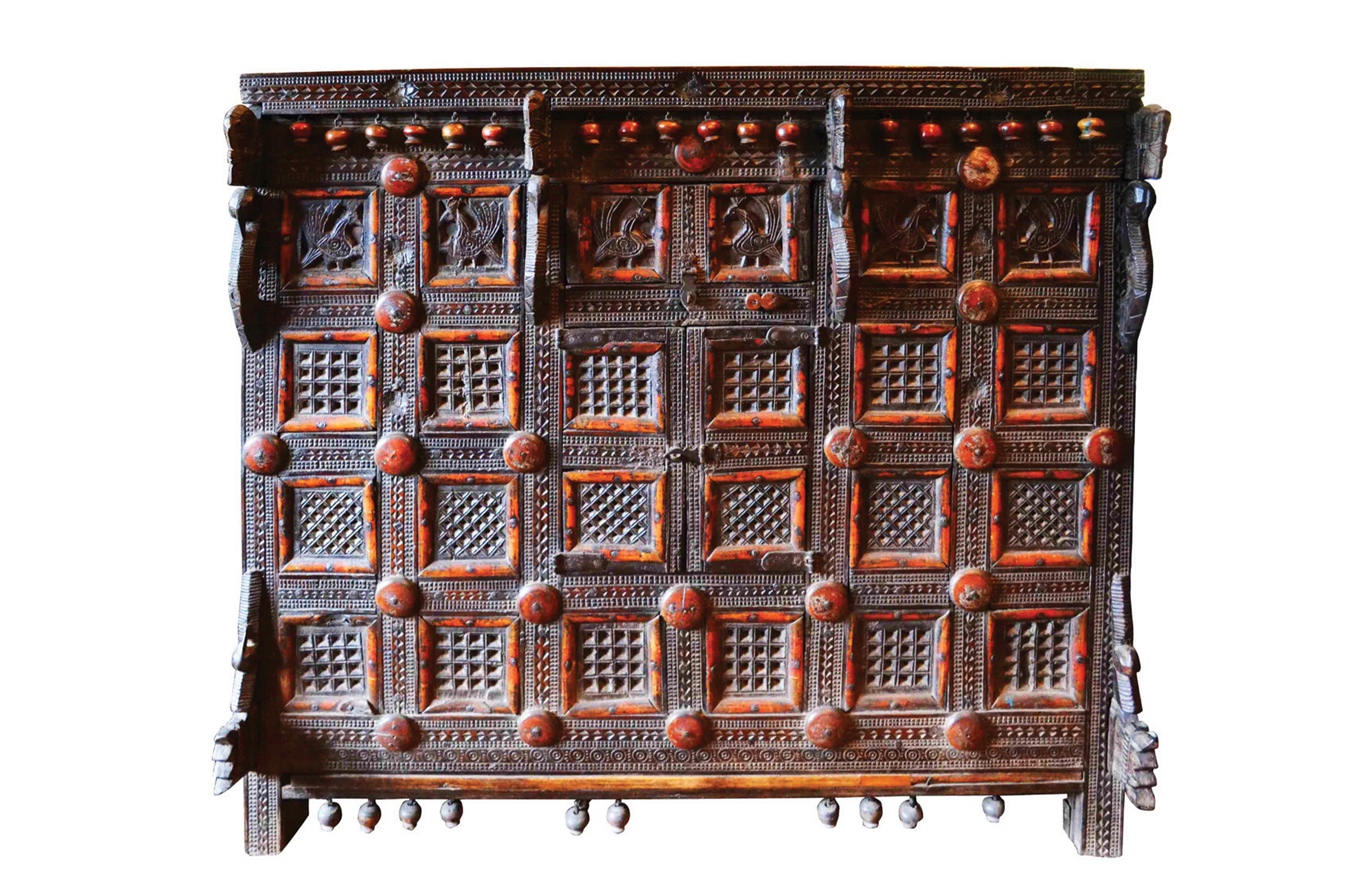
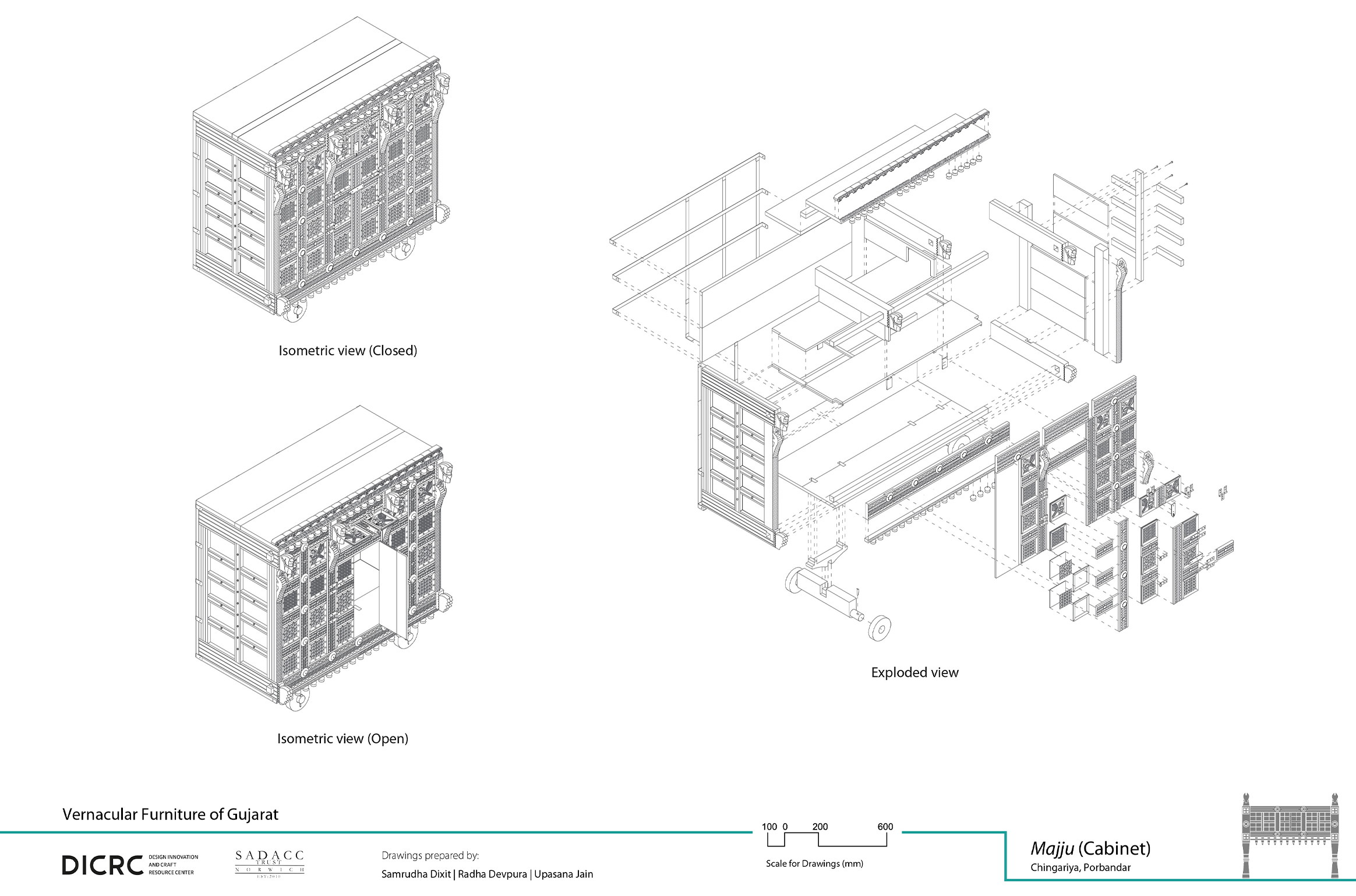
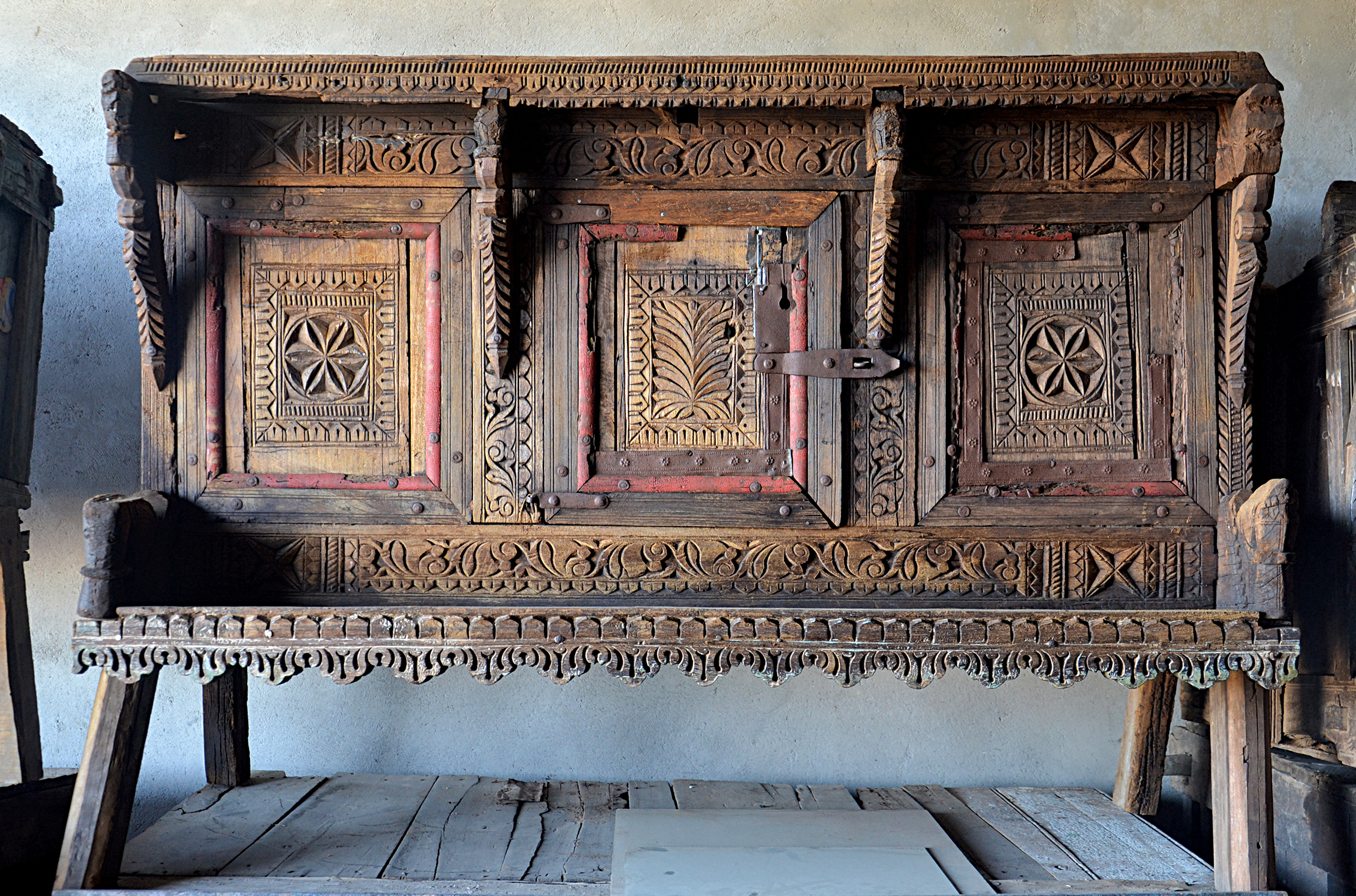
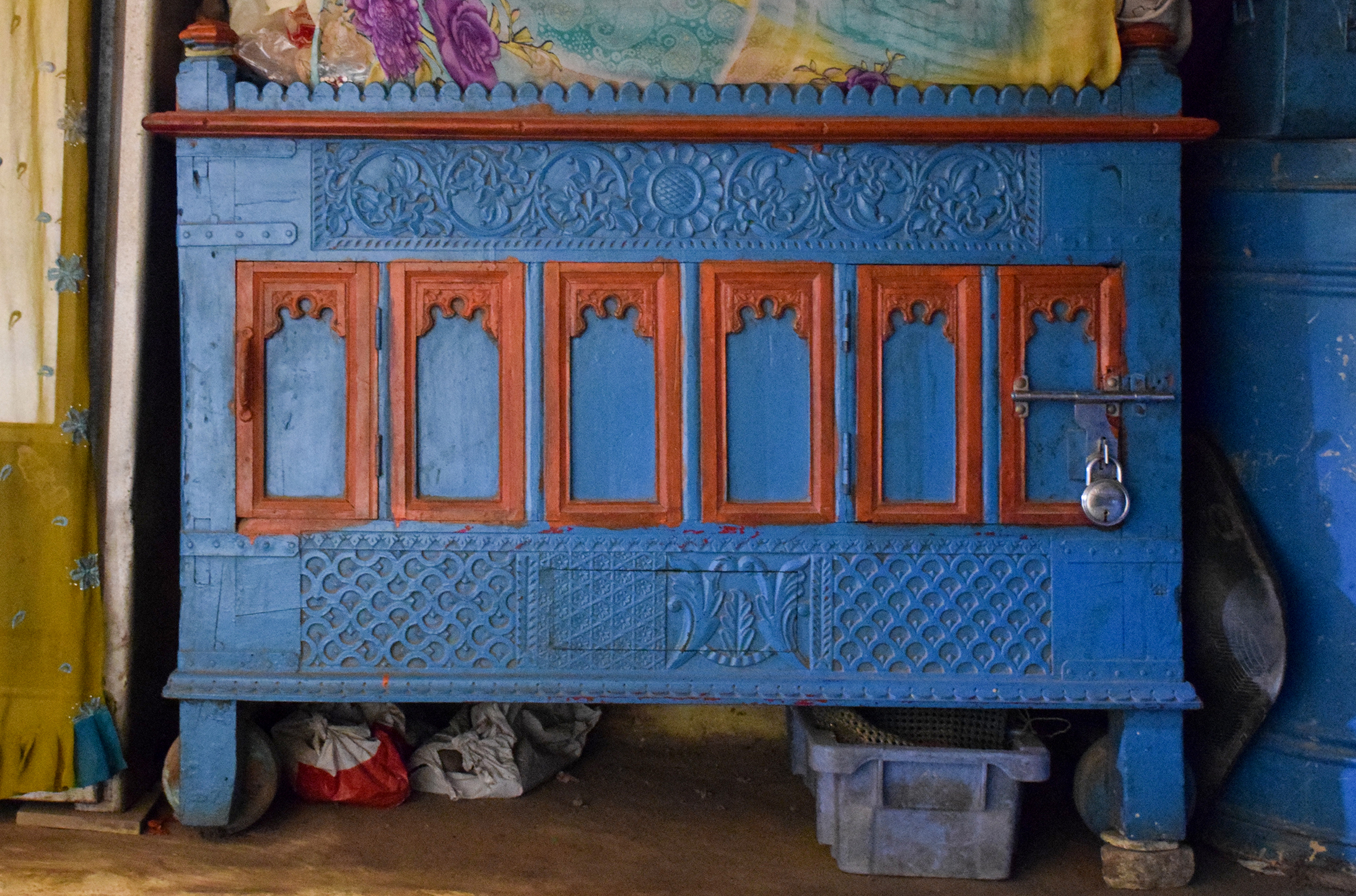
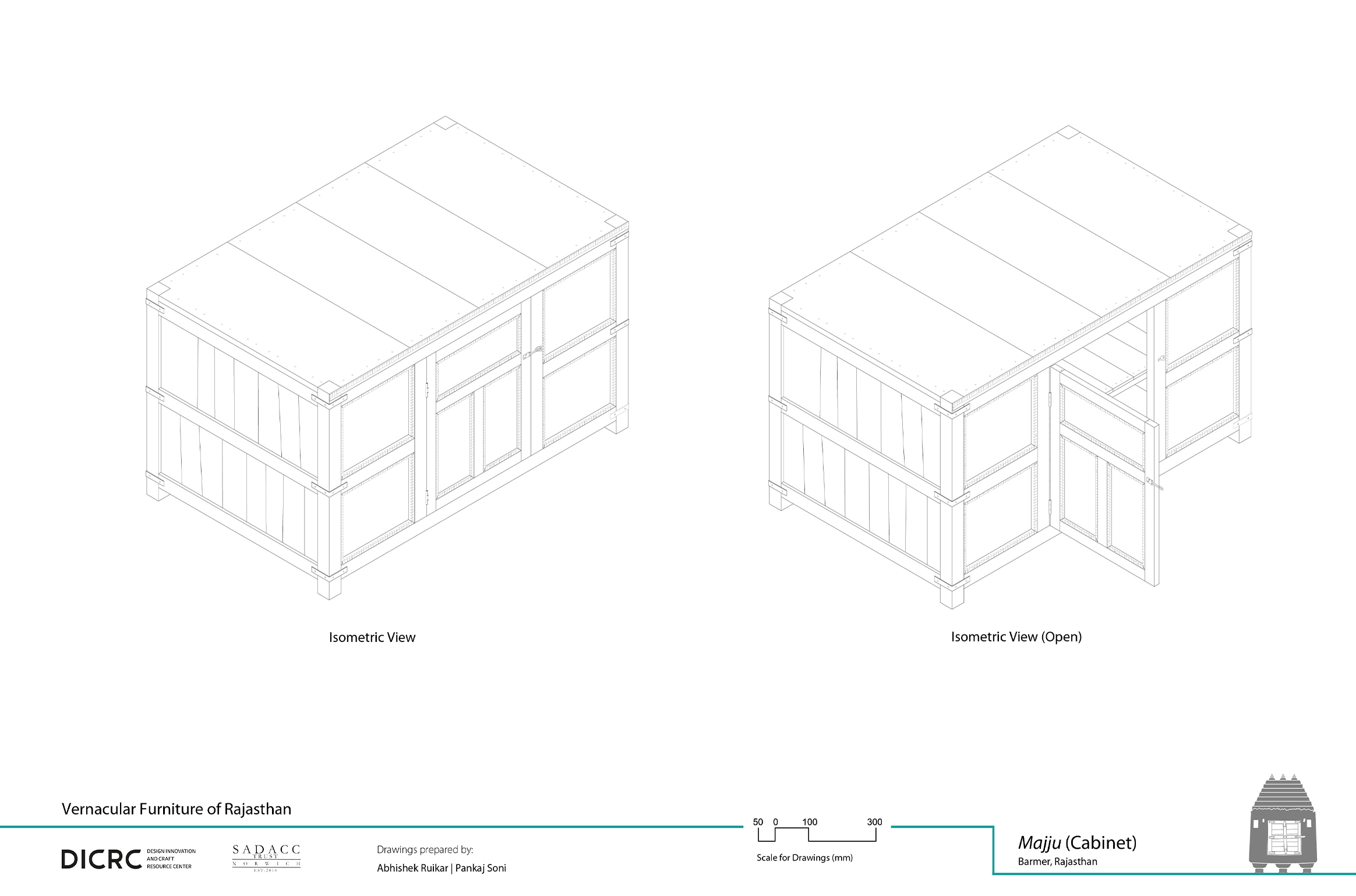
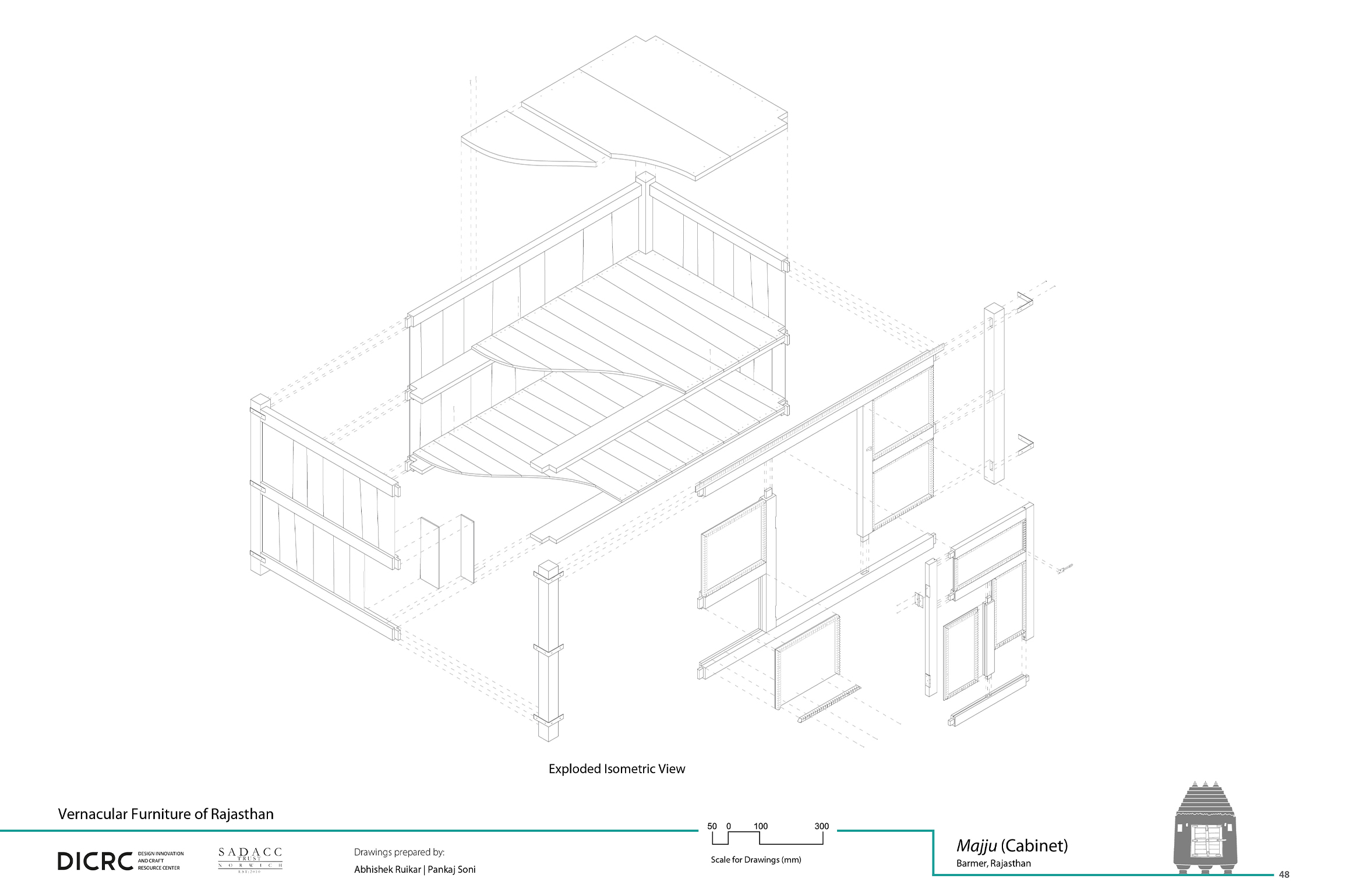
In Punjabi sandook and the Rajasthani majju, mortise and tenon joints are used for the frame, into which wooden panels are slotted, often using a tongue and groove technique. On the front facade, additional supports serve to separate the panels of the facade and are often surmounted by ornamental finials. The rear of the Gujarati majju is braced by iron strips nailed onto its surface. The legs are extensions of the corner supports and are typically quite short, elevating the cabinet just enough so the space under it may be cleaned; those of a Gujarati majus are usually angled outward. The kothla majus is made mobile with a sturdy set of wooden wheels lubricated by vegetable oil or rice starch. In the Rajasthani majju, two sets of wheels are fixed on an axle between the legs of the cabinet, allowing it to be moved easily. Various arrangements of doors are used, though a common scheme used across regions features a tripartite facade with three doors, one on each panel. If there is one access door, it is usually located in the centre. Some Rajasthani majju may be fixed with a sliding door, pulled out of the side of the cabinet. The kothla majus often features a small lockable trapdoor on the top surface.
The detailing of the doors, compartments, and shelving provisions vary widely within and across regions, depending on the patron’s needs and budget; these are also opportunities for carpenters to demonstrate their skill and creativity. A common feature of these cabinets across regions is at least one concealed, often lockable compartment. A variety of complex mechanisms are employed to ensure that these compartments are difficult to open or even notice. They may be added in a number of places, such as at the bottom of the cabinet (in the case of the sandook), behind the top and bottom rails (in the majus), or behind flap doors above the central door (in the Gujarati majju). Valuables, family heirlooms, and other objects of personal significance may be stored here. In Rajasthan, it is often the case that only the carpenter and the eldest male member of the family commissioning the cabinet know the location of this compartment and how to open it.
Finials and brackets
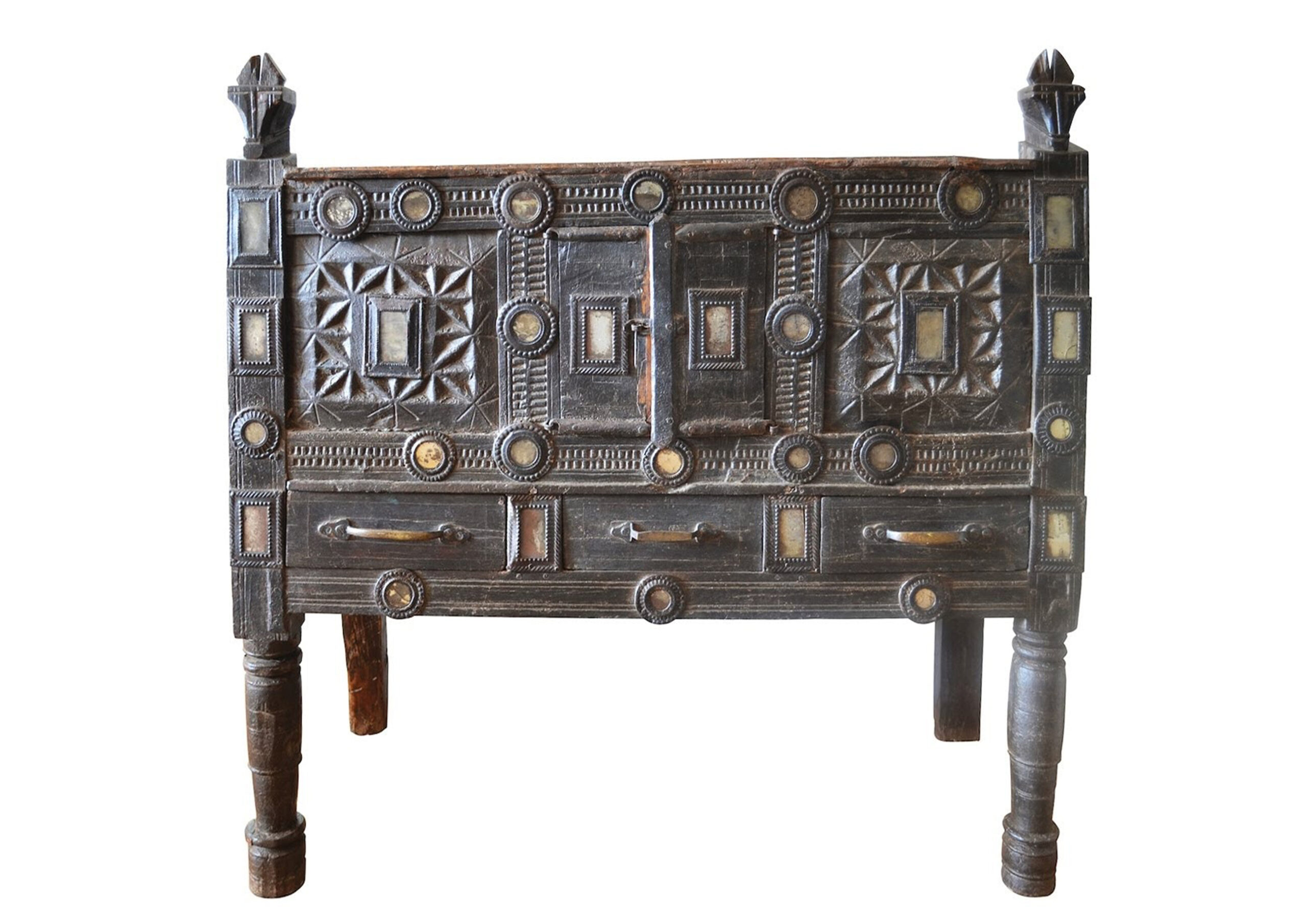
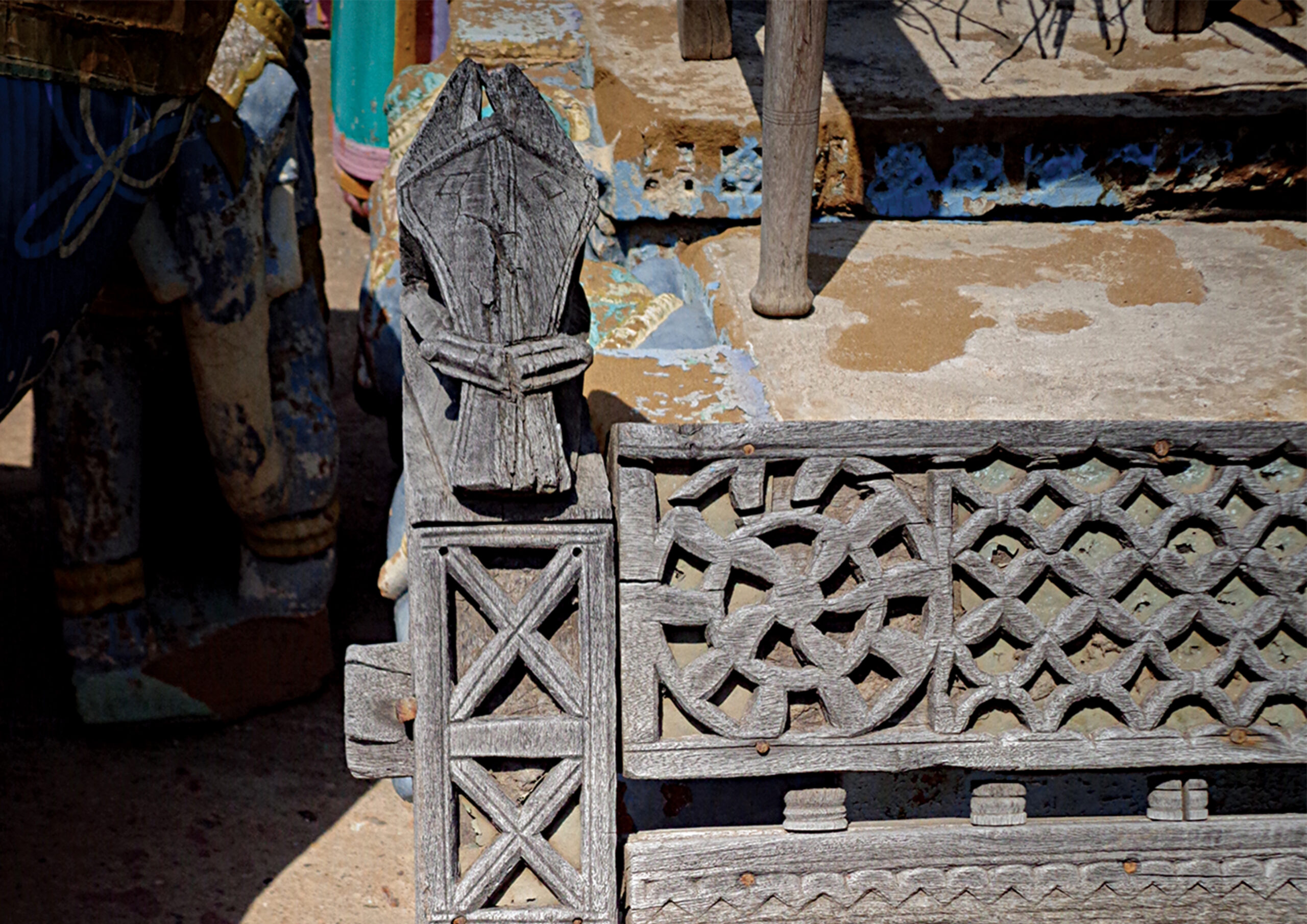
A common design scheme features ornamental finials located either at the top of the vertical supports or along the top and bottom rails of the cabinet. These are often accompanied by structural-ornamental details such as brackets or balustrades. As the cabinet-makers have traditionally been carpenters, joiners and carvers for both buildings and furniture, the design of these elements often derive from local architecture. Some Rajasthani majju feature finials resembling turrets rising from each top corner of the cabinet. More elaborate sandook in Punjab sometimes feature pillars and balustrades modelled on the architectural language of forts.
In Gujarat and Rajasthan, the finials often take the form of horse heads. The Kutchi manjush displays a wide variety of abstract horse heads surmounting the front supports; in the majus of central Gujarat and Saurashtra, the finials protrude from the horizontal side rails at the four corners of the facade and are more realistic than stylized. The Rajasthani majju is similar; here the stylized horse head carvings — four on the top rail and two on the bottom rail — appear on protruding ends of the horizontal structural supports. They may take the form of leaping horses tucking their hooves into their chests as they jump, with lips, teeth, bridle and saddle chiselled in miniature detail. In a Rajasthani majju, details of the frame joinery are often found to vary based on whether the cabinet features horse-head or other finials (though the two are not mutually exclusive) — the former feature on the ends of the top side members, which are fitted onto the tenon ends of the vertical members. The latter appear on the top front rail, with the side members bearing tenon ends that slot into mortises on the vertical members.
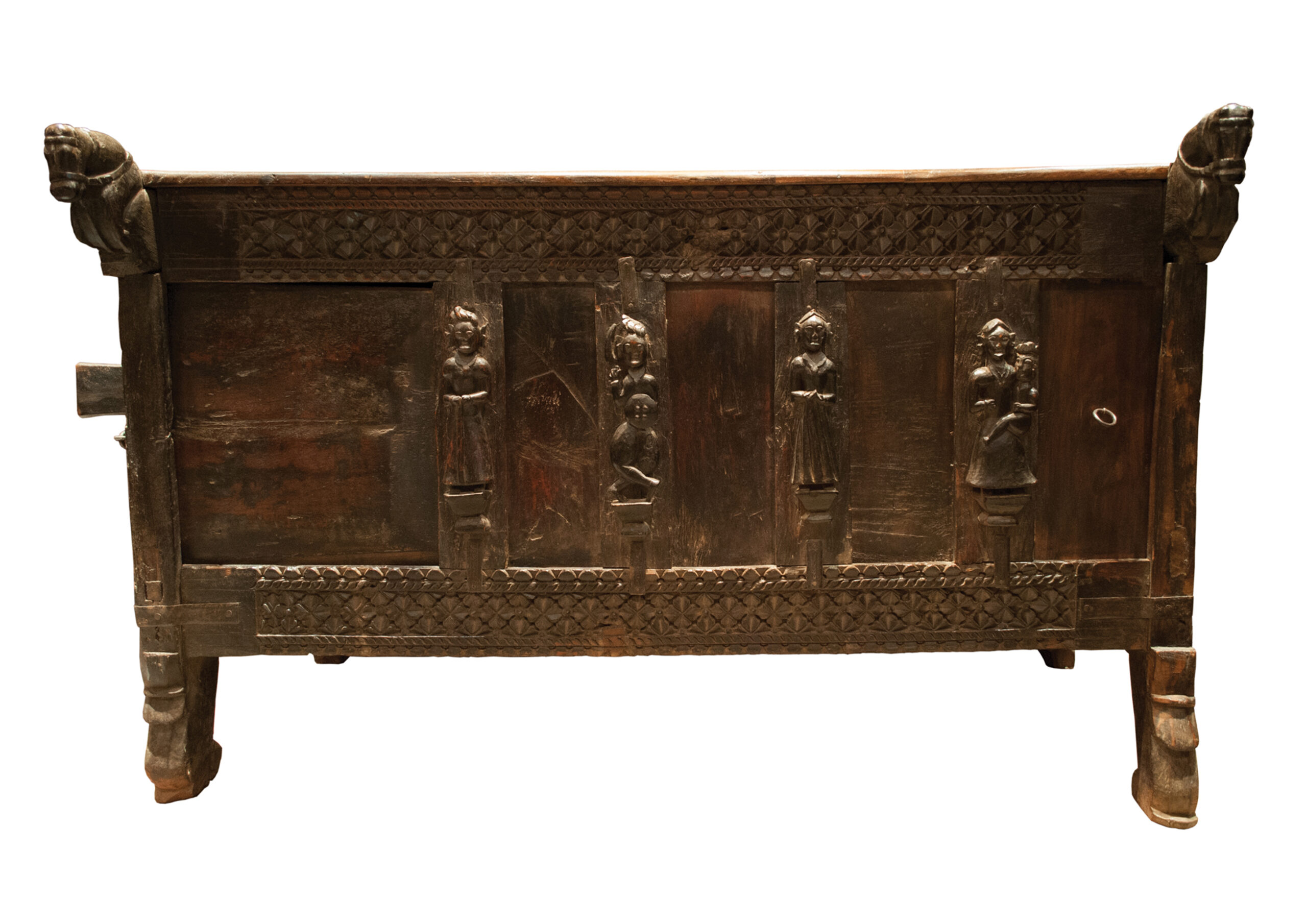
The accompanying ornamental brackets may be carved in various shapes; the Mer majju usually features brackets fashioned in the form of stylized parrots or peacocks, whereas the Rajasthani majju and other Gujarati majus also display an additional range of motifs, including the mythical gajavyala (an elephant-headed hybrid creature), figurines of dvarpala (door guards), gandharva (celestial musicians), and paniyari (woman carrying a water pitcher on her head). These and other carvings bear a noticeable resemblance to the wood carvings in traditional homes in the respective region, such as on door lintels and arched windows, and often appear to be crafted to a similar scale. The horse head finials of the Mer majju in Gujarat resemble the horse head carvings that adorn the lintel beams on the entrance door frame of a traditional Mer house — the horse is an auspicious symbol for the community, which is lauded as a distinguished warrior clan in their oral history and folklore, and identifies itself with the image of a horseman carrying a shield and sword.
Facade ornamentation
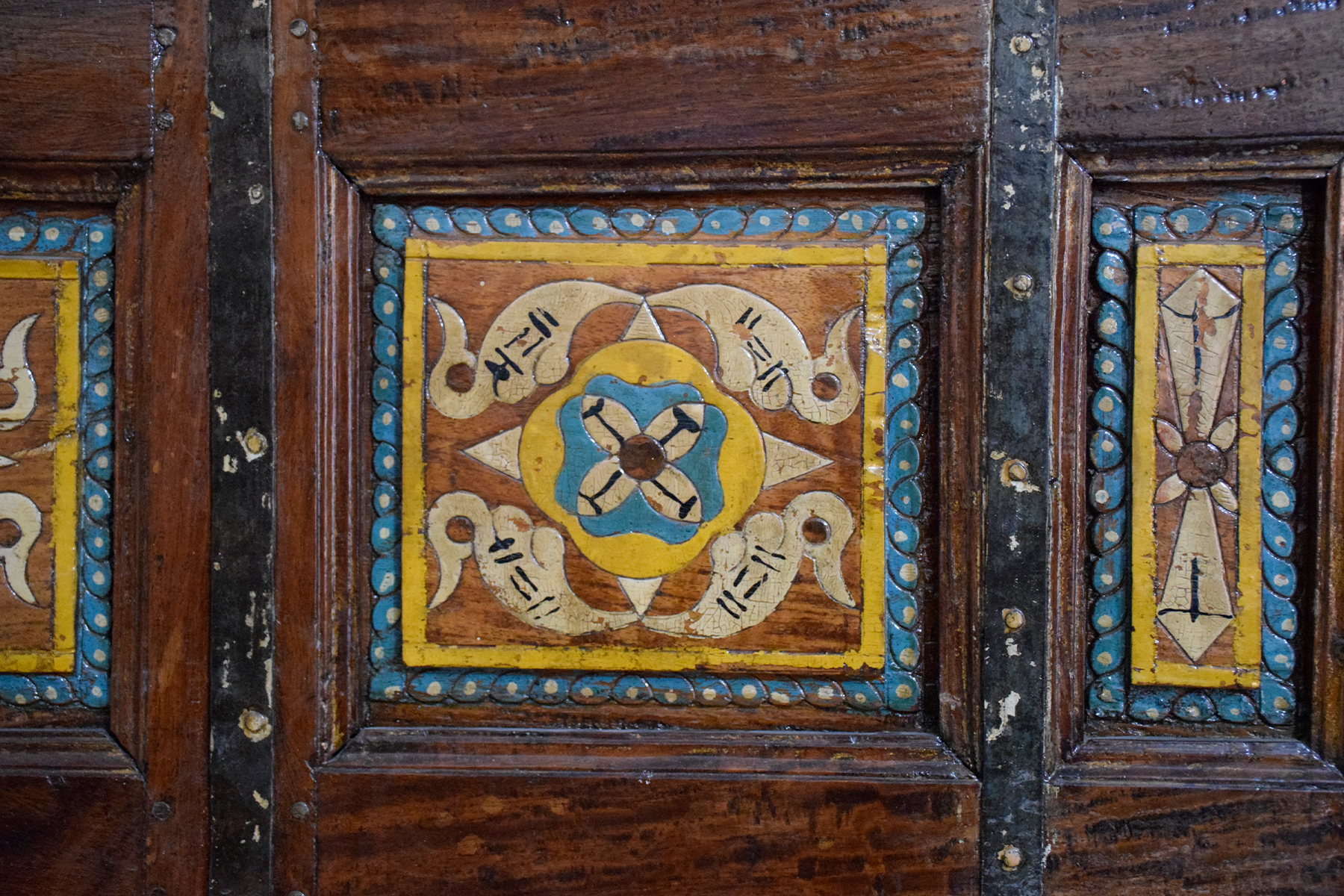
Some cabinets’ facades may be quite plain or minimally decorated; others may display carvings, painting, lacquering, and other types of ornamental work, depending on the region, locally available materials, market trends, and the needs of the people who craft and use the furniture. A carpenter making a manjush as a hope chest in Kutch, for instance, might incorporate the embroidery motifs of the bride’s family into its decoration, or design it to meet the tastes of her new marital family. In Rajasthan, it was said that the patron and the carpenter would choose the motifs after inspecting other wooden carvings in the village, in a competitive effort to outdo the majju of other families.
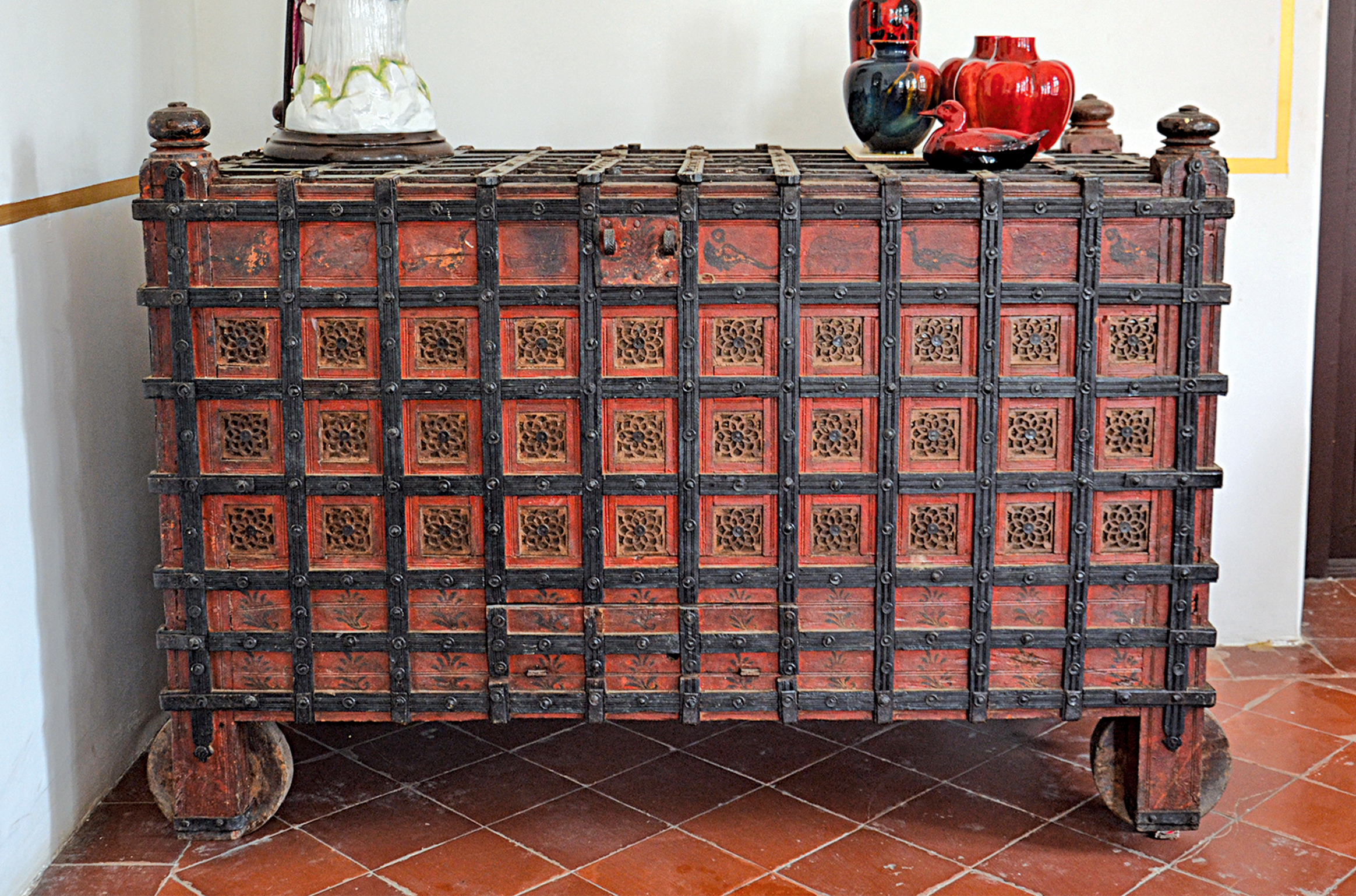
In the case of the Gujarati majju, kothla majus, and manjush, wooden strips are nailed onto the surface to create a uniform grid, sometimes only on the front facade (as in a typical manjush) or sometimes on all four sides of the cabinet (as in a typical kothla majus). The manjush and kothla majus’s grid may be further furnished with wooden panels bearing fretwork, and paint or varnish may be used as a final finish. The manjush also features geometric carvings and circular mirrors. Its two front vertical supports are either made of turned wood or carved with geometric motifs to match the facade. The majju’s grid is more elaborate: its quadrangular spaces are fitted with small, intricately carved wooden panels depicting figures such as the deity Ganesha (often symbolic of auspicious beginnings), a paniyari, peacocks, parrots, elephants and horses, amidst several perforated panels bearing geometric motifs. Every majju displays either one or a combination of these motifs. The Mer majju also features a woman-with-child motif on the facade.
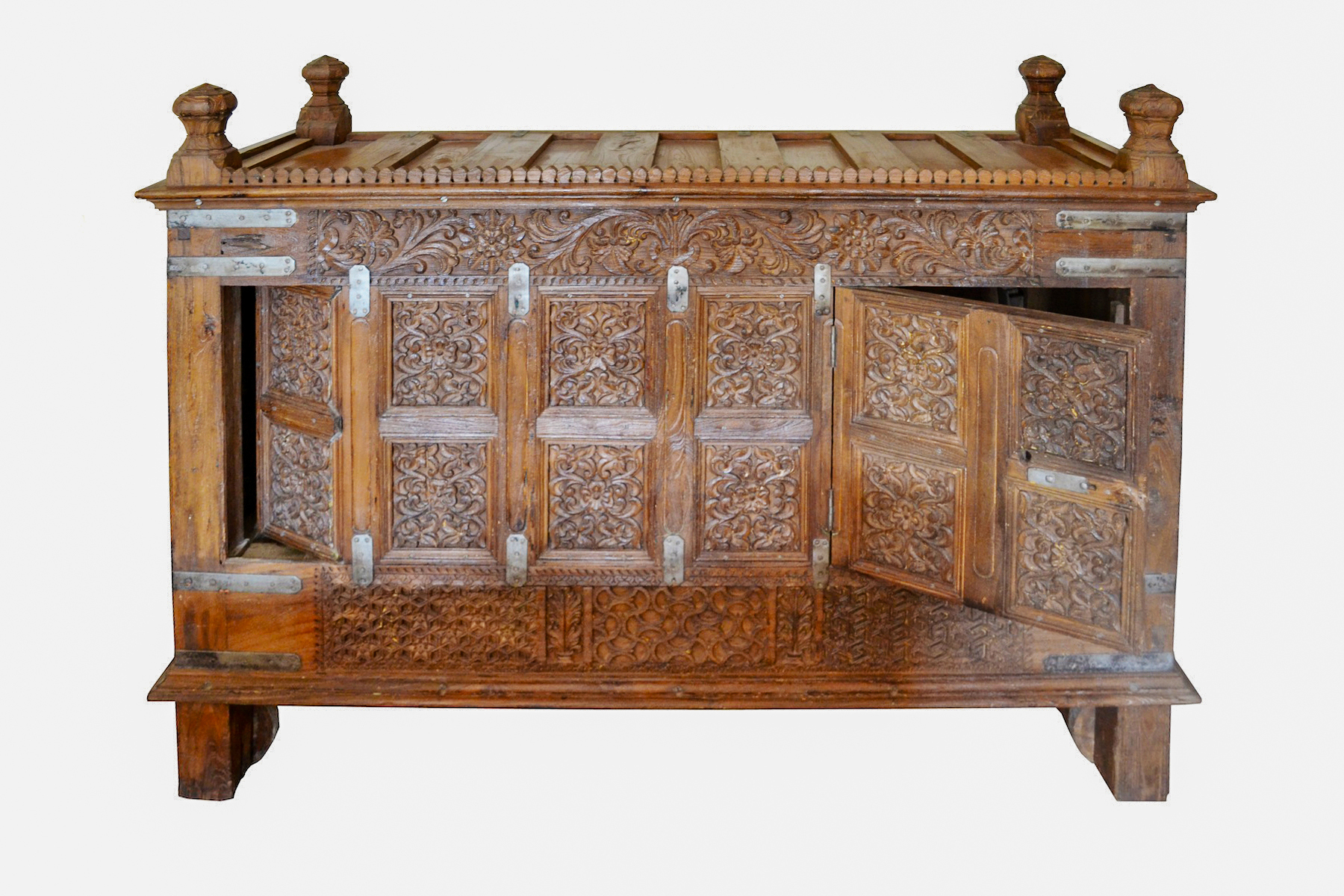
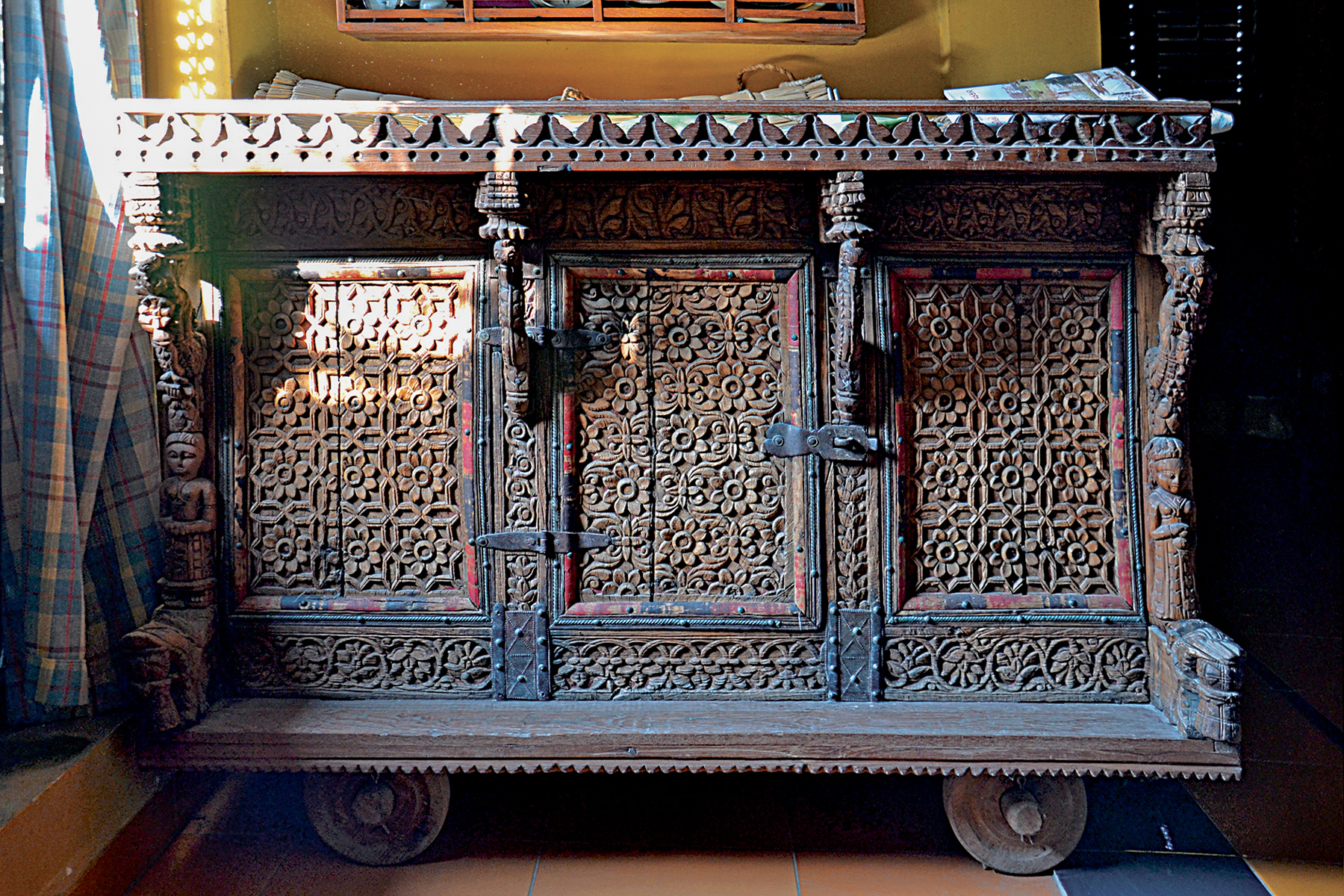
The decorative wooden panels are held in position by strips of turned and lacquered wood that frame the plates within the ornamental grid. The intersections of the grid are further adorned with hemispherical ornaments, also made of turned and lacquered wood. A series of tiny turned-wood danglers may be fitted on the projection above the top rail as well as below the bottom rail. The tripartite division of a majju, disguised by the ornamental grid, can be detected by referring to the horse heads on the top rail — the axis that runs downward from each of the four horse heads divides the facade into three parts. The door, like the tripartite division, is camouflaged, but the latch and hinges give away its position.
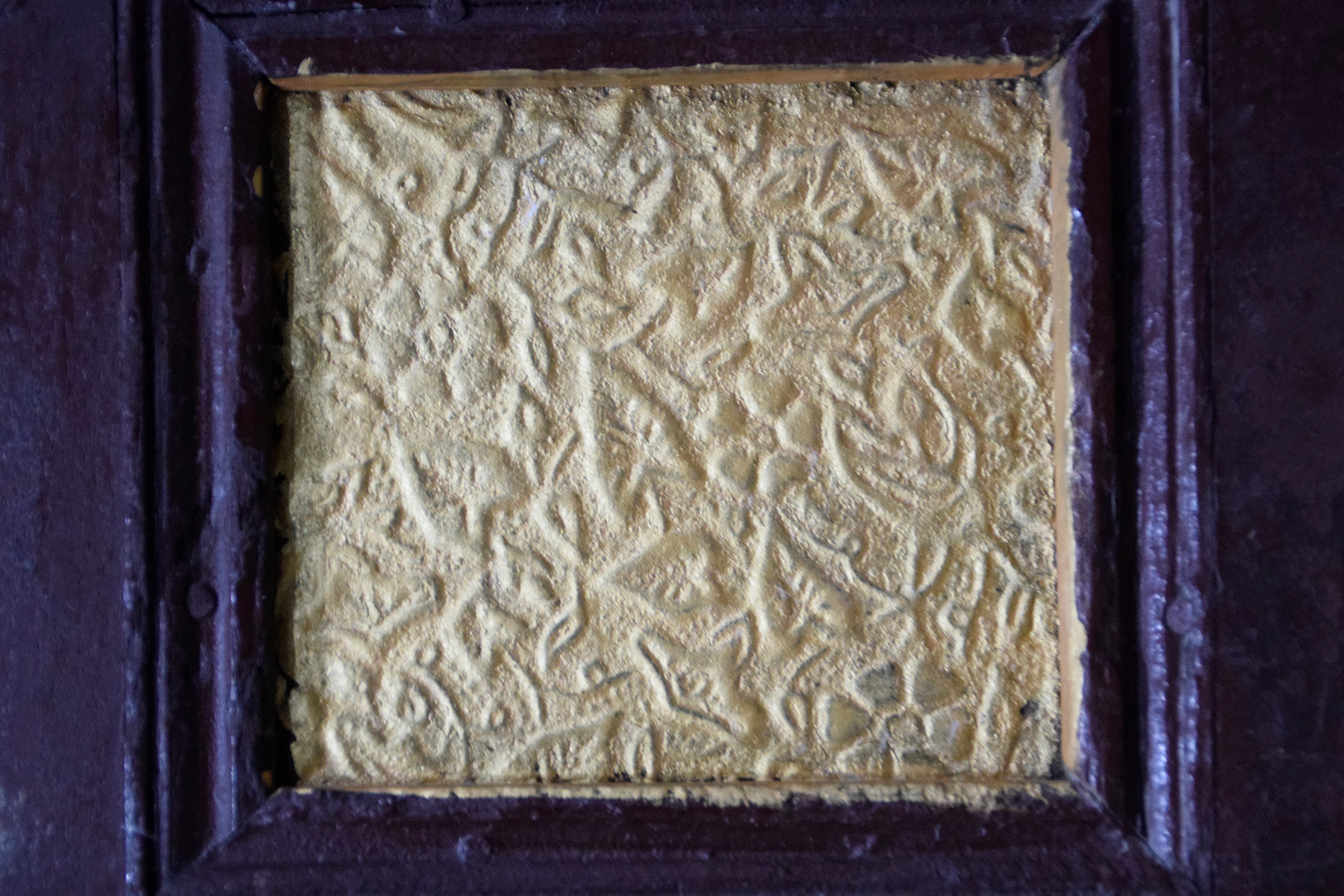
Other designs do not feature the grid and vary widely in style, technique, and material. The majus attributed to Rajput and other affluent communities in Saurashtra and central Gujarat is often elaborately decorated, often with unique designs for each majus, displaying carved designs, architectural elements and figures, the occasional use of lacquer, and so on. Some majus are fitted with two decorative balconies; one above the top rail and the other below the bottom rail. The Punjabi sandook shares similar features; also seen here are glass panels behind which printed images may be fixed. These panels might be carved or lacquered or have designs painted on them. They could also be fixed with mirrors, or brass embellishments may be fixed to the centre of each panel. Older Punjabi specimens sometimes have a projecting lip in the middle that can be used as a shelf for small items, like coins and keys. Some recent sandook in Haryana feature an elaborate top rail: a specimen housed at the Kurukshetra University Museum features an unusual top rail that includes framed images.
Design evolution
Historical specimens reflect some of the economic and sociopolitical developments of northwestern India. Manjush dated to the colonial period sometimes include drawers (often three below the tripartite front), possibly due to the influence of other forms of furniture in the region. In Punjab and some districts of Haryana, sandook made before 1947 — some of which were left behind by Muslim families who migrated across the border during Partition — show the characteristic craftsmanship of Muslim carpenters, many of whom also migrated. These are smaller in size, featuring austere line carvings and black lacquered panels, and sometimes just two shutters. Later sandook — often made by Sikh carpenters — are larger, more likely to have more than one shuttered opening, with elaborate carved details, mirrors and glass panels. Relatively few sandook were made in the region between 1947 and the 1960s, likely due to the loss of wealth experienced by agrarian families that moved to India during Partition. Punjabi sandook from the 1960s and 1970s are large, with side compartments and elaborate decoration; notably, these changes do not reflect in most of neighbouring Haryana, where contemporaneous sandook are smaller and do not feature side compartments or architectural embellishments. This may be because the sandook became an important cultural symbol in Punjab, signifying the lived realities of displacement during Partition, and therefore garnered more investment and importance for following generations.
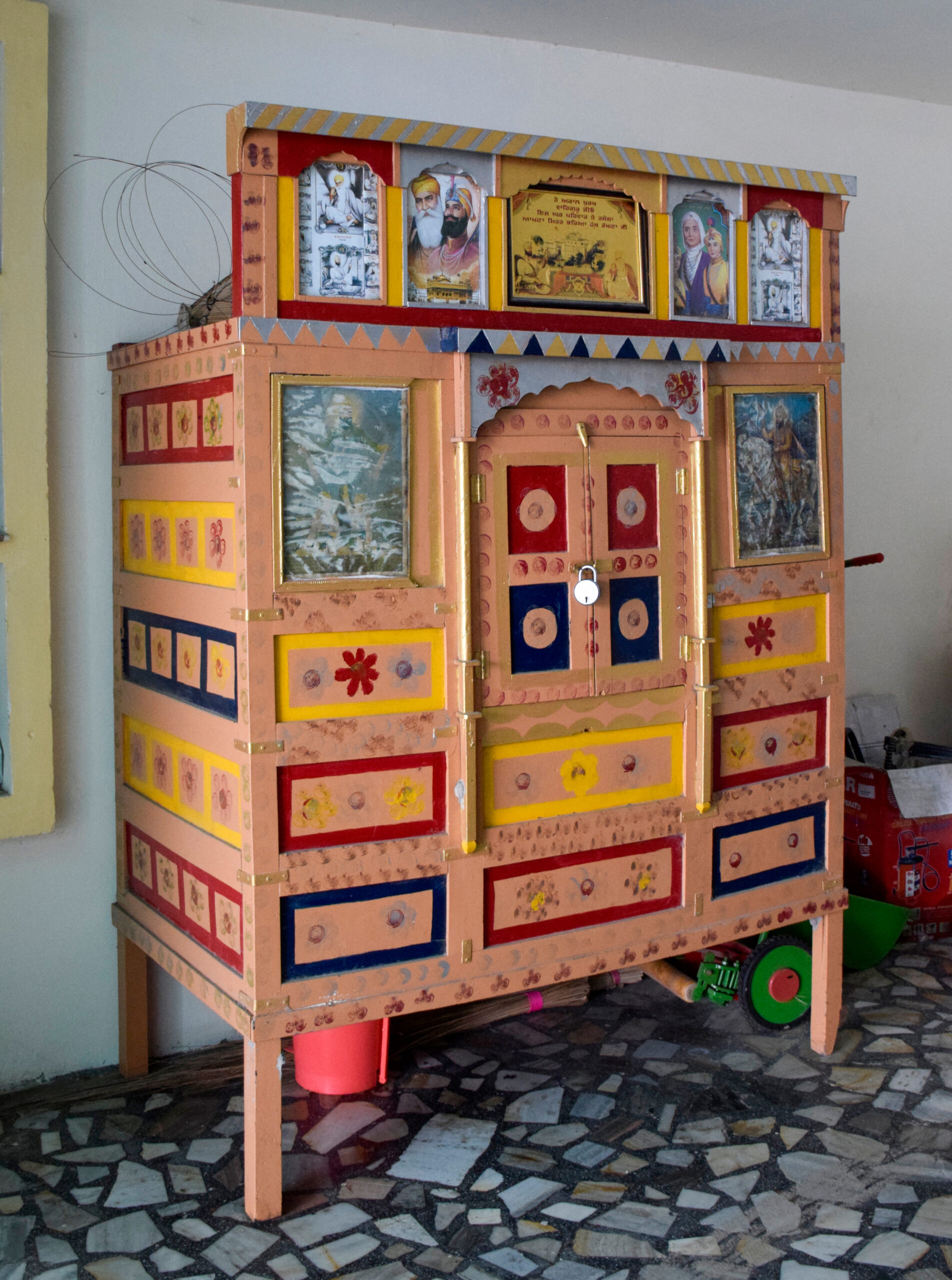
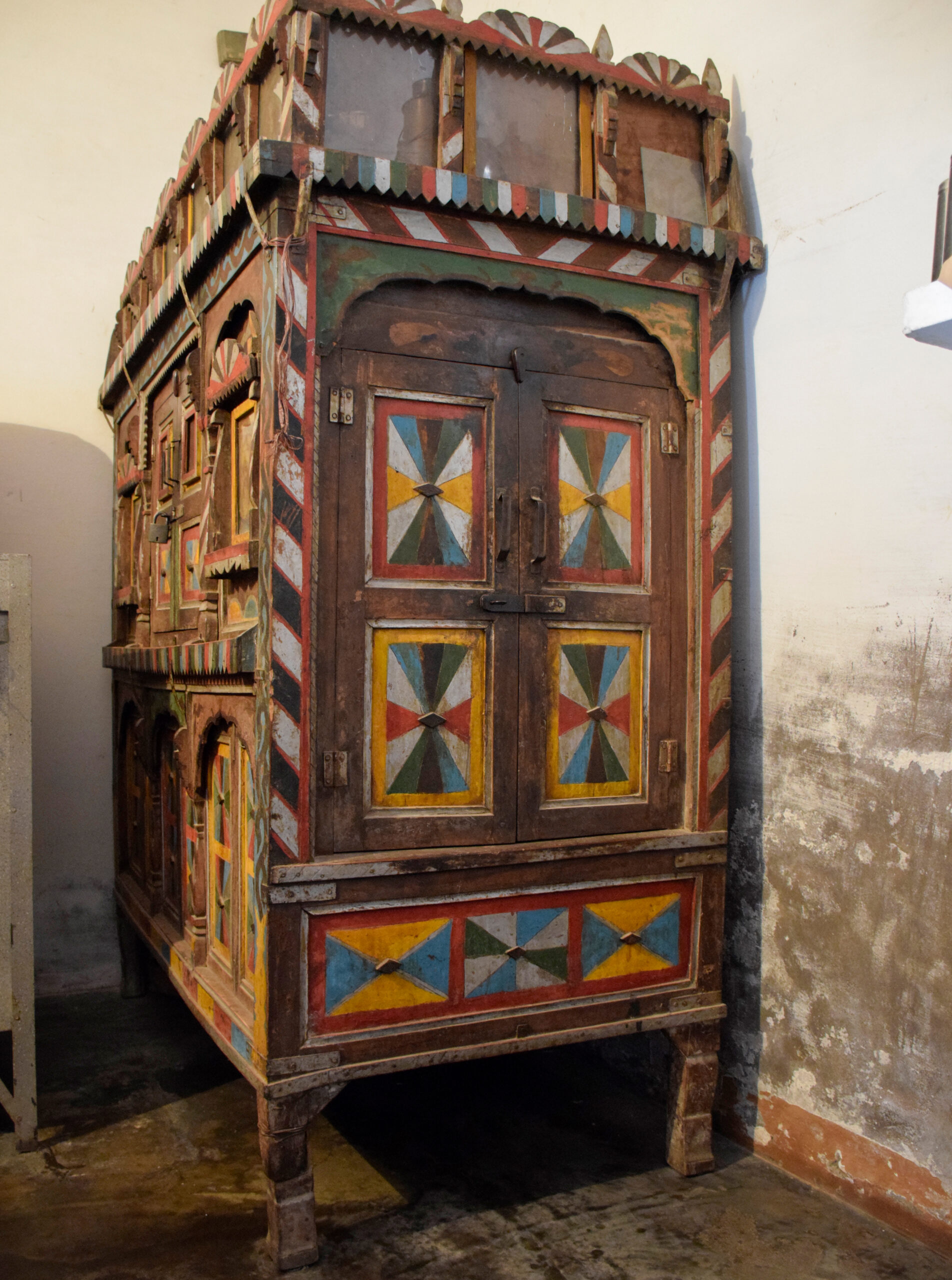
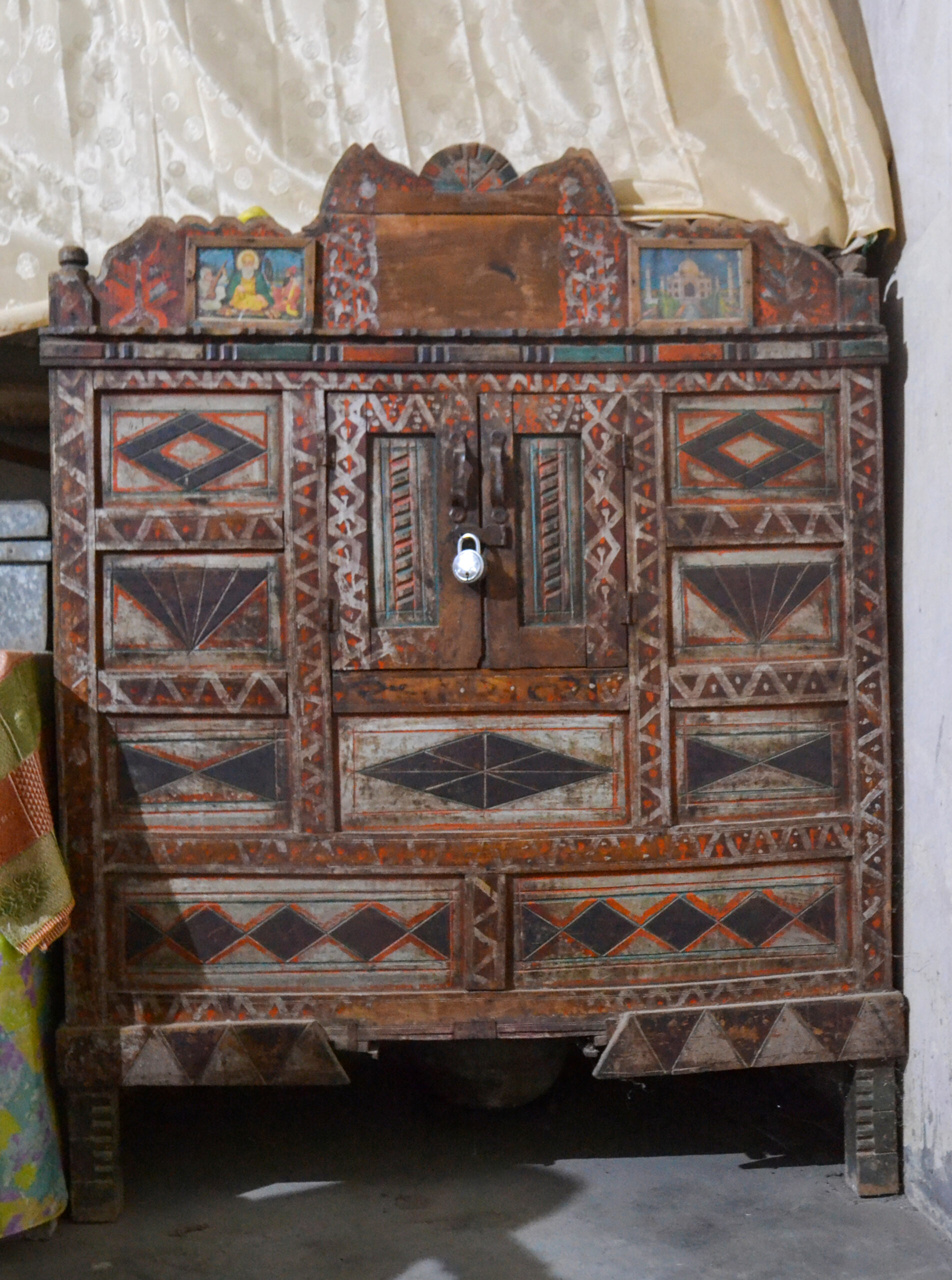
The design evolution of the Gujarati majju also provides insight into changes in the regional economy over the past century. In majju from between the 1940s and the 1980s the earlier decorative wooden panels on the facade are replaced by a combination of wood and decorative ceramic tiles — similar to those seen in a hindolo. These embossed and glazed tiles, also known as tube-lined ceramics, had come into fashion in Europe towards the start of the twentieth century. Following this trend, large numbers of tiles — many bearing Art Nouveau and Art Deco motifs — were imported from Britain and used in domestic interiors across India. The Japanese ceramic industry that replaced the British industry in the mid-1920s introduced new printed designs to suit the Indian market, including Hindu deities and other subjects from popular and widely available art prints. Majju from around the 1980s feature similar painted motifs.
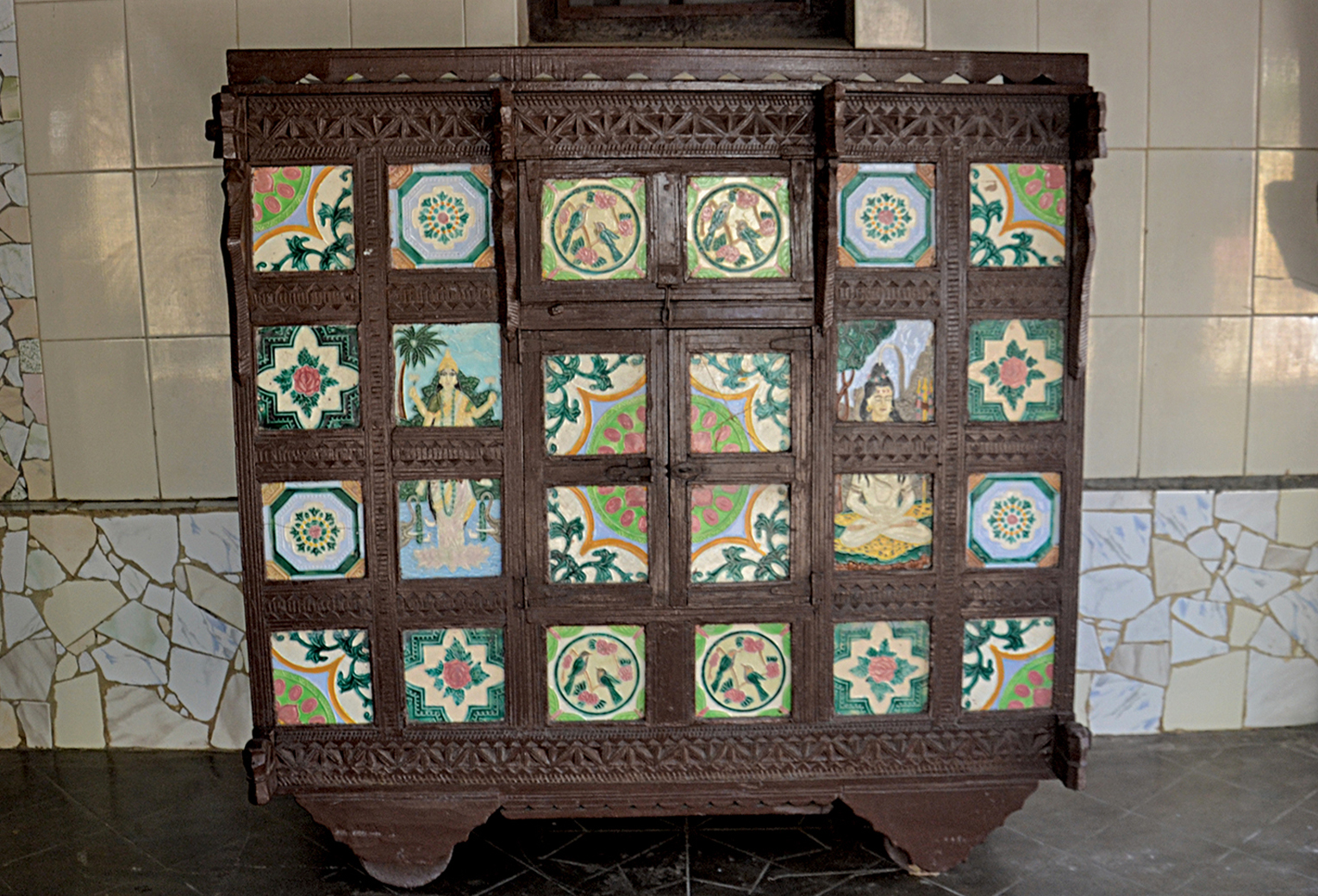
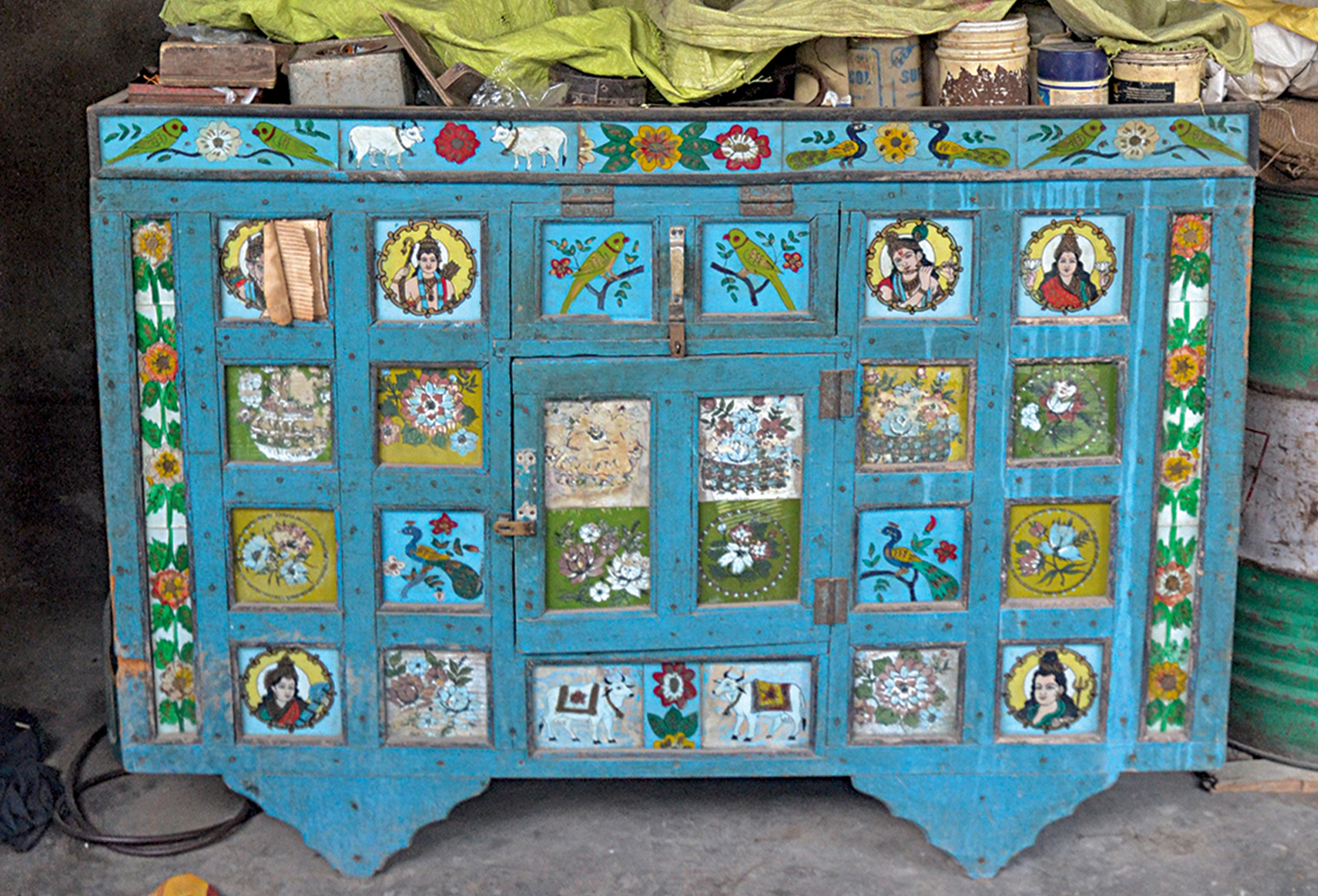
Majju made since the 1980s are built using a combination of wood and other ancillary materials such as ceramic tiles, glass, mirrors and plywood. They are slightly taller and broader, and without the characteristic horse heads, brackets, grid and other decorative features of its predecessors. They have three access doors, furnished with either a mirror, a reverse painted glass (featuring Hindu deities) or a veneer, and with a drawer below each door. The top rail and horizontal supports adjacent to the doors are fitted with a combination of imported and locally manufactured decorative ceramic tiles. Some of these majju are decorated solely with a combination of patterned veneers.
Ownership and use
The cabinet is traditionally a highly valued and treasured part of the household furniture, symbolic of the family’s wealth and status. It is an expensive item, requiring significant material, time and skill to make; agrarian families might sell many of their other belongings to have one made. The families as well as the craftspersons have a close relationship with the object, as reflected in the development of an extensive regional vocabulary to describe its various components — the tongue-and-groove joint, the chamfers on the panels, and so on; in Punjab sacred threads are tied to a part of the sandook.
The cabinet may be made for general use in a family — as is more common in Haryana, or commissioned as a hope chest for a woman on the occasion of her marriage, traditionally by her father. In the latter case, a bride may use the cabinet exclusively for her personal effects, or it may be used to store both bride and groom’s belongings in their marital home. Bringing a large, elaborately constructed cabinet to the home may elevate the bride’s position and the respect she commands there. Historically, planning for the cabinet’s construction often started years before a woman’s wedding, often at her birth; in Punjab, her father would select and care for the trees in his field that would provide the wood for the cabinet, and the carpenter was called once the marriage was fixed. He may have been paid in clothes, sweets, textiles or grain; from the 1960s and 70s on, cash payments became common. Here especially, a woman often has exclusive ownership of the cabinet throughout her life, with many older women being the sole bearer of keys; it contains her clothing, inherited jewellery and other items of her trousseau.
In addition to storing personal items and valuables, the cabinet is often used to store household bedding. In every state but Punjab, the mattresses and quilts are usually folded and stacked on the top surface. The women of the Mer community in Gujarat sew cloth covers for the quilts to safeguard them from dust; these are embroidered with motifs complementing the ones carved on the majju itself. Because the cabinet is used in this way, it is also often known as a damachiyo in Gujarat — a term that denotes furniture used to store or stack bedding.
The demand for new cabinets appears to have waned since the mid-twentieth century; many households now favour steel almirahs and factory-made cupboards, though they continue to value and conserve such cabinets belonging to older generations.
This article is adapted from the outcomes of Vernacular Furniture of North-West India — a collaborative research and documentation project by the Design Innovation and Craft Resource Centre (DICRC), CEPT University, India, and The South Asian Decorative Art and Crafts Collection Trust (SADACC), UK — shared with the Encyclopedia of Art through an Impart partnership. Explore more from this series in our Collection Objects Alive: Vernacular Furniture of North-West India.
First published: 15 May 2026
Image Gallery
Bibliography
Bais, Mitraja, Jay Thakkar, Samrudha Dixit, and Ben Cartwright. Sahaj: Vernacular Furniture of Gujarat. Ahmedabad: CEPT University Press, 2018.
Rao, Mansi S., Ben Cartwright, and Samrudha Dixit. Anaikya: Vernacular Furniture of Rajasthan. Ahmedabad: CEPT University Press, 2021.
Rao, Mansi S., Ben Cartwright, Jay Thakkar, and Abhishek Ruikar. Smarya: Vernacular Furniture of Punjab and Haryana. Ahmedabad: CEPT University Press, 2026.
Vernacular Furniture of India. Accessed February 20, 2026. https://vernacularfurnitureofindia.com/.
Feedback