-
ChicagoGupta, Aniruddha Sen. "The Activist Streak in Indian Comics." Impart Perspectives, October 16, 2026. https://imp-art.org/perspectives/features/the-activist-streak-in-indian-comics/
-
MLAGupta, Aniruddha Sen. "The Activist Streak in Indian Comics." Impart Perspectives, Oct. 16, 2026, https://imp-art.org/perspectives/features/the-activist-streak-in-indian-comics/. Accessed 16 Oct 2026.
-
HarvardGupta, A.S. (2026) The Activist Streak in Indian Comics, Impart Perspectives. Available at: https://imp-art.org/perspectives/features/the-activist-streak-in-indian-comics/ (Accessed: 16 October 2026).
The Activist Streak in Indian Comics
Meet the many voices of resistance that have thrived in the pages of Indian graphic novels since the 1960s.
By Aniruddha Sen Gupta
Link copied!
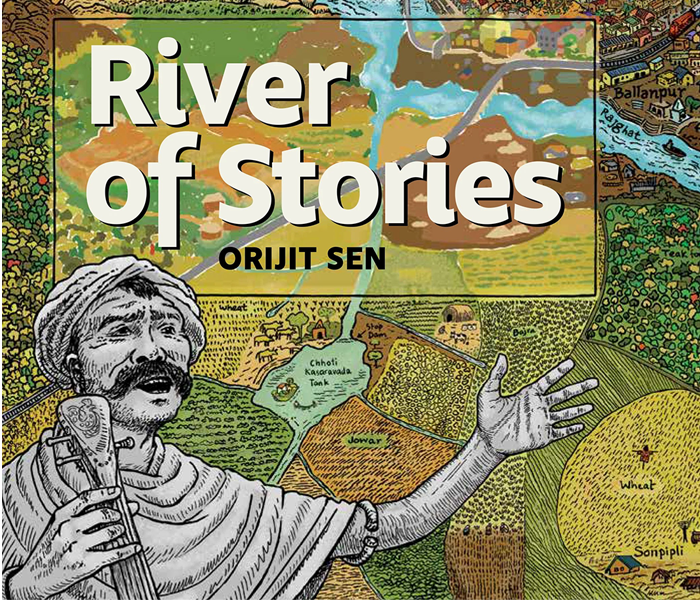
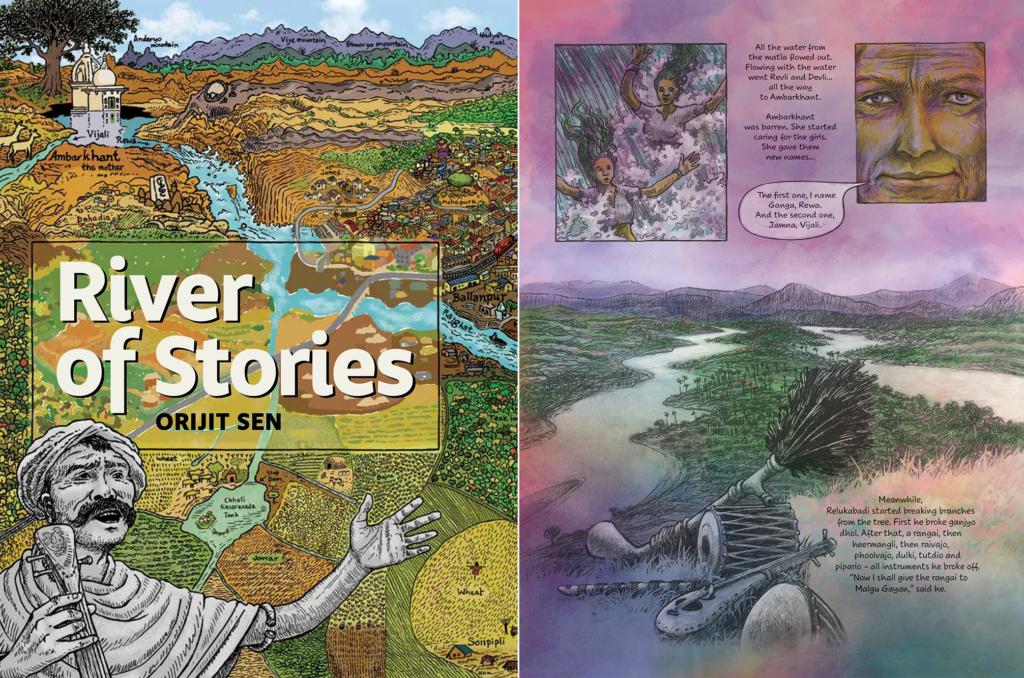
Cover of the 2022 edition of River of Stories by Orijit Sen, published by Blaft Publications. Courtesy the author
As someone with a lifelong obsession with comics and graphic novels, my bookshelves are host to a staggering number of titles across cultures, and on a variety of subjects. However, an informal survey of all that I have collected over the years revealed an intriguing pattern. More than half of the Indian ones, I found, had activist themes — political, social, environmental, feminist. One might assume that this was because of my personal preferences, but that’s not true. I pick up almost any graphic book that I encounter, both through my work as a consulting editor on Comixense as well as an avid comics reader in my spare time. And when I looked at the non-Indian volumes on my shelves, there was no such particular skew to be found. This observation reinforced my belief that most Indian comics have a decidedly activist streak.
And this is not a new phenomenon either.
The Early Years
Through the 1960s and early 1970s, the Malayali filmmaker G Aravindan used to write a comic titled Cheriya Manushyarum Valiya Lokavum (Small Men and the Big World) which satirised society and politics. Though it appeared as a series of one-pagers in the Mathrubhumi magazine, it had recurring characters, a defined narrative thread, plots and sub-plots — elements that have led to it being described as ‘India’s first graphic novel’, released serially. The strips have now been compiled and published as a book under the same title (DC Books, 2024).
The comic traces the development of its protagonist Ramu from an idealistic young man to a corrupt businessman in a changing India. The story is driven largely through conversations between the characters, whose words provide a diverse, often satirical and acerbic commentary on immediate events and current affairs. Since the stories featured actual historical incidents, the serial format highlighted the changes in the socio-political milieu that crept in over time in the compiled form. While Aravindan’s comic was featured in a mainstream magazine, the earliest English long-form graphic works emerged with the support of non-profit, private institutions.
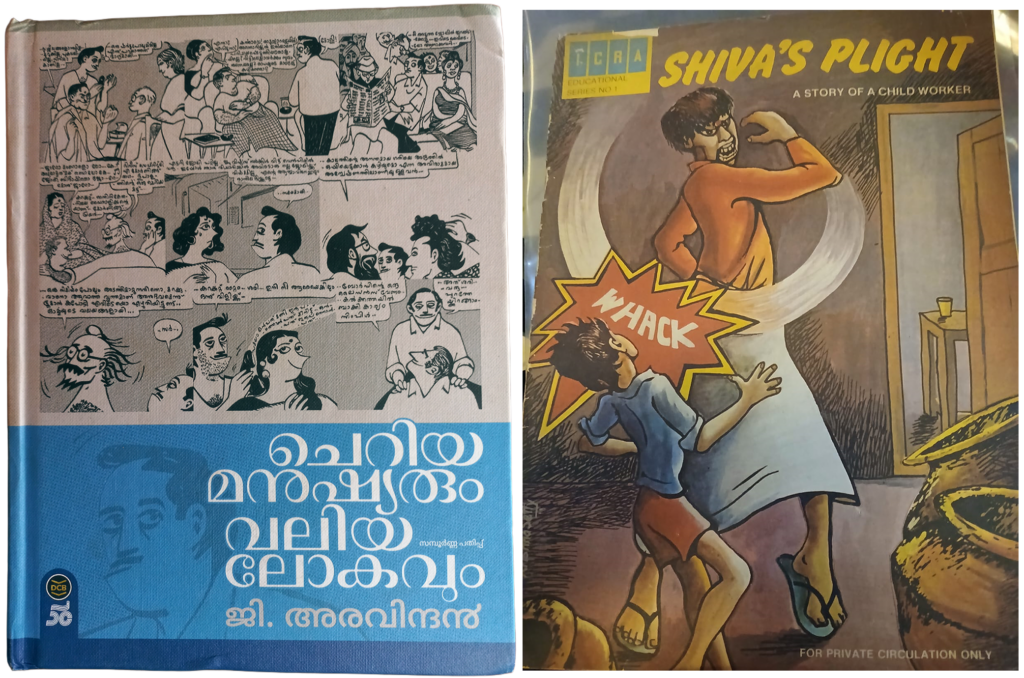
In 1985, the Bangalore-based Institute for Cultural Research and Action (ICRA) published Shiva’s Plight, a 40-page comic on child labour. In a rather heavy-handed and verbose manner — pretty typical of art whose primary purpose is to get a message across — it told the story of a young boy named Shiva who is driven by his family’s poverty and debt to move from his native village to a big city where he takes up menial work in order to survive.
About a decade later, River of Stories by Orijit Sen — widely regarded as the first mass-market Indian graphic novel in English — rose out of the struggles of the Narmada Bachao Andolan, and it was very much on the side of the andolankaris. Published in 1994 by the environmental non-profit Kalpavriksh, it barely caused a ripple when it first appeared with a limited print run of 800 copies. Over time, however, it acquired cult status, with tattered copies cherished by collectors, graphic artists and novelists, and ordinary readers alike. Even photocopied versions circulated in the absence of printed copies. In 2022, a 25th-anniversary edition was published in hardcover and a smaller size by Blaft Publications, with a foreword by Arundhati Roy, and it was received with great enthusiasm. My own foray into the medium, Our Toxic World: A Guide to Hazardous Substances in Our Everyday Lives (Sage Publications, 2010) — written by me and illustrated by Priya Kuriyan — was also born out of my association with an NGO, Toxics Link, that was working on environmental issues.
Around the time that ICRA came out with Shiva’s Plight, another organisation with a very different agenda had also cottoned on to the fact that comics were a good way to reach out to and influence young people. In the 1980s, Gyan Ganga Prakashan, a Jaipur-based publisher, brought out comics on KB Hedgewar, the founder of the Rashtriya Swayamsevak Sangh (RSS), and the outfit’s second chief and prominent leader, Madhav Sadashiv Golwalkar. The stories in these comics were told in the same vein and illustrated in the same style as the Amar Chitra Katha series that predated them by some two decades. The long-running series of popular Indian comics, one could argue, propagates primarily Brahminical attitudes and viewpoints and majoritarian Hindu culture in its selection of stories — be it Indian mythology, history or folktales. The protagonists are overwhelmingly male, fair-skinned heroes with a ‘Vedic’ mien; the villainous antagonists are often Muslim ‘invaders’ who are cruel and rapacious.
History in Pictures
In comparison to the mass-reach of Amar Chitra Katha, most Indian graphic novels published over the years have had limited print runs and niche popularity. They also symbolise a very different kind of subjectivity rooted in progressive politics as well as more thoughtful takes on India’s history.
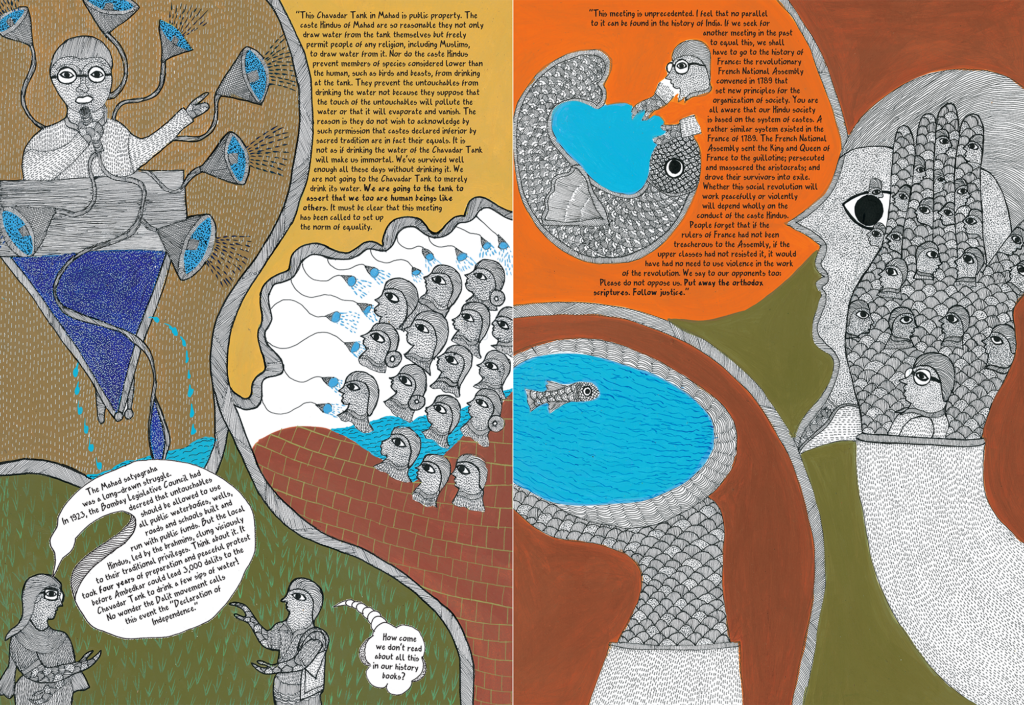
Prime examples are two volumes brought out by Navayana, a specialised anti-caste publishing house. Bhimayana (2011) is a graphic biography of BR Ambedkar, rendered in a fluid, panel-averse Pardhan Gond art style by Durgabai Vyam and Subhash Vyam, based on a script by Navayana founder and publisher S Anand, and novelist Srividya Natarajan. The latter teamed up with graphic designer Aparajita Ninan to create A Gardener in the Wasteland (also 2011), which effectively brought to visual life Gulamgiri (Slavery), the seminal treatise on the caste system written in 1873 by Jotiba Phule.
While the Navayana books approach their subjects in all seriousness, that’s not everyone’s way of highlighting contentious issues. Sumit Kumar, publishing under his own banner, Bakarmax, uses streetwise and sometimes juvenile humour to do that. In Amar Bari, Tomar Bari, Naxalbari (originally published by Horizon Books in 2015) — named for a popular Bengali Naxal slogan from the 1970s — he dissects the Maoist movement. The storyline jumps back and forth in time and space, from the village of Naxalbari in Bengal to pre-Independence Hyderabad, Andhra Pradesh of the 1950s and 1960s, and the jungles of Dandakaranya in the present day.
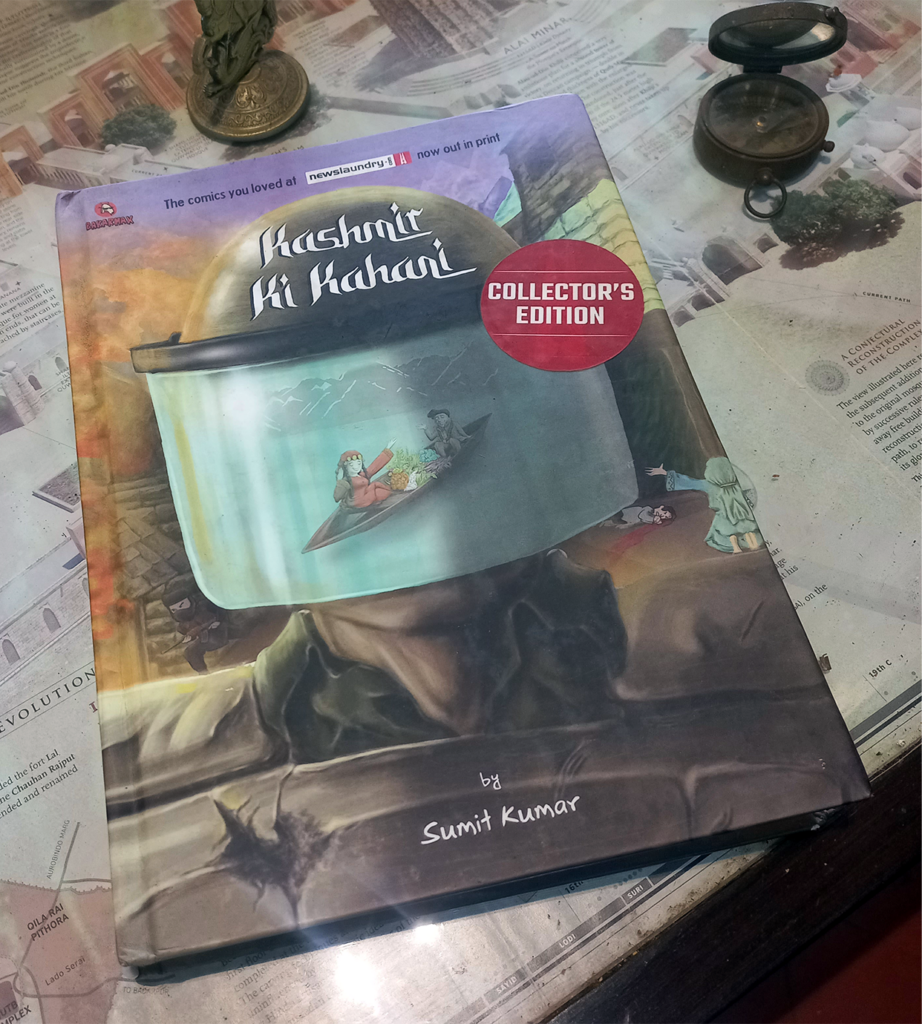
Kumar has also compiled a series of comics he did for the NewsLaundry online media site into a hardback volume titled Kashmir ki Kahani (Bakarmax, 2012), which takes a similar absurdist approach to telling the tale of “one of the world’s most protracted geostrategic and political conflicts”. Not surprisingly, the multi-layered tragedy that is Kashmir has birthed other graphic books as well. The best- known among them is probably Munnu: A Boy from Kashmir by Malik Sajad (Fourth Estate, 2015). Munnu is a poignant, powerful coming-of-age story of a boy growing up in a Kashmir torn by strife. Taking a visual leaf out of Art Spiegelman’s Maus, Sajad depicts the Kashmiri people as endangered Hangul deer. The woodcut-like art style works to emphasise the fractured, sharp-edged nature of life in the Valley and the menace of the ubiquitous Indian army men.
An earlier examination of the Kashmir problem, which delves into the radicalisation of the youth, is Kashmir Pending (2007). This comic, written by Naseer Ahmed with art by Saurabh Singh, was published by Phantomville, an imprint set up by well-known graphic novelist Sarnath Banerjee. Another of Phantomville’s titles, The Believers (2006) by Abdul Sultan PP (text) and Partha Sengupta (art), also explored Islamic radicalisation, but at the other end of the subcontinent — in Kerala.
While the works cited in the previous couple of paragraphs examine history at its most divisive, there is one extraordinary work that attempted to bridge the sub-continent’s greatest divide — the Partition. This Side That Side: Restorying Partition (‘TSTS’, Yoda Press, 2013), brought together writers and artists from India, Pakistan, and Bangladesh to tell stories that gingerly probed the still-festering wounds of 1947 and its aftermath, and in most cases applied a healing balm on them. Given how the gaps have opened on all our borders in the past decade or so, this book still feels like a miraculous accomplishment.
The ‘TSTS’ anthology was curated by comics creator Vishwajyoti Ghosh, who had earlier authored Delhi Calm (Harper Collins, 2010). That book cast a keen eye on another point of upheaval in India’s history – the Emergency of 1975 imposed by Indira Gandhi. It unfolds around the trials and tribulations of a young mediaperson in those troubling times. Ghosh’s use of masked anonymous faces for many of the characters gives all the events an air of chilling menace.
Feminist Frames and Marginal Voices
Another familiar thread in the Indian comic space has been all-female collaborations on feminist projects. Rage over the 2012 Nirbhaya case spilled on to the pages of Drawing the Line: Indian Women Fight Back (Zubaan Books, 2015), an anthology about women, written and drawn by women. It emerged from a week-long workshop and residency called ‘Graphic Girls’, held at the Goethe-Institut in Delhi in April 2014, led by comic illustrator Priya Kuriyan along with two German artists, Ludmilla Bartscht and Larissa Bertonasco. The 14 stories in the book represent the workshop participants’ responses to the violence they faced everyday. A similar book project, Eat the Sky, Drink the Ocean (Young Zubaan, 2014), was published in collaboration with the Australia Council for the Arts. As with Drawing the Line, it’s an anthology of pieces — both illustrated and textual—created in response to stories of assault.
Taking on the patriarchy embedded in epics that shape cultural norms that normalise such violence, two projects foregrounded the character of Sita — deploying her in transgressive narratives. In the Sita’s Ramayana (Tara Books, 2015), Samhita Arni offers a retelling of the Ramayana from Sita’s viewpoint, while Moyna Chitrakar, who is a Patua scroll painter from Bengal, renders the story in a vivid style that merges a traditional art form with a modern medium. The result is spectacular. In Sita and Helen (Tulika, 2023) by Shailee and Priyadarshini Banerjee, Shailee’s text and Priyadarshini’s illustrations explore Hindu and Greek myths from the point of view of these two heroines — both of whom were made ‘responsible’ for wars men started over them.
Women creators have also contributed volumes to the Indian comics canon when it comes to contemporary social justice issues. Comics maker and educator Ita Mehrotra’s Uprooted (Context, 2025) takes the reader deep into the forests of the Uttarakhand Terai, foregrounding the views of the Van Gujjars and the Taungyas who are being forced to renegotiate their centuries-long relationship with the jungles they call home because of new legislations and state antagonism. Mehrotra had earlier published Shaheen Bagh: A Graphic Recollection (Yoda Press, 2021).
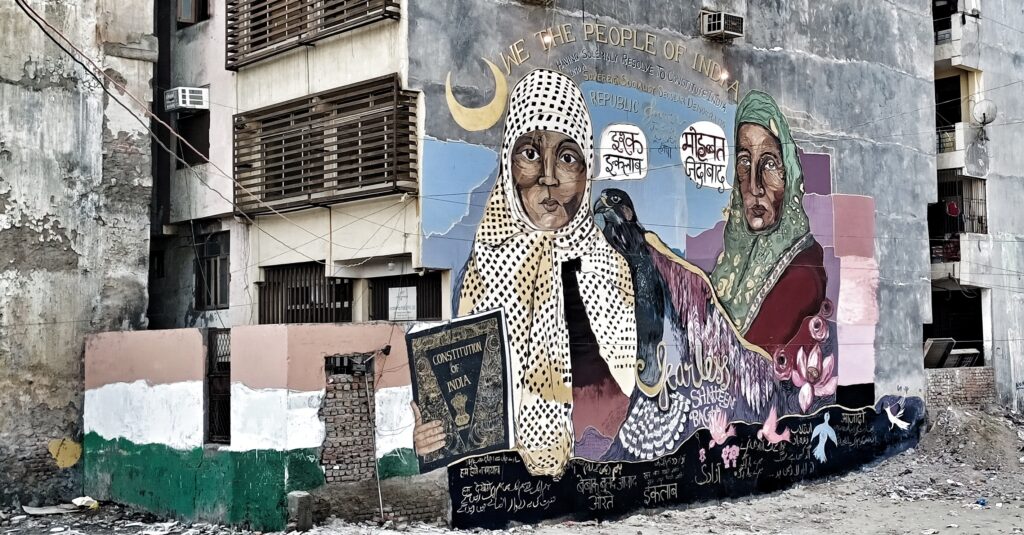
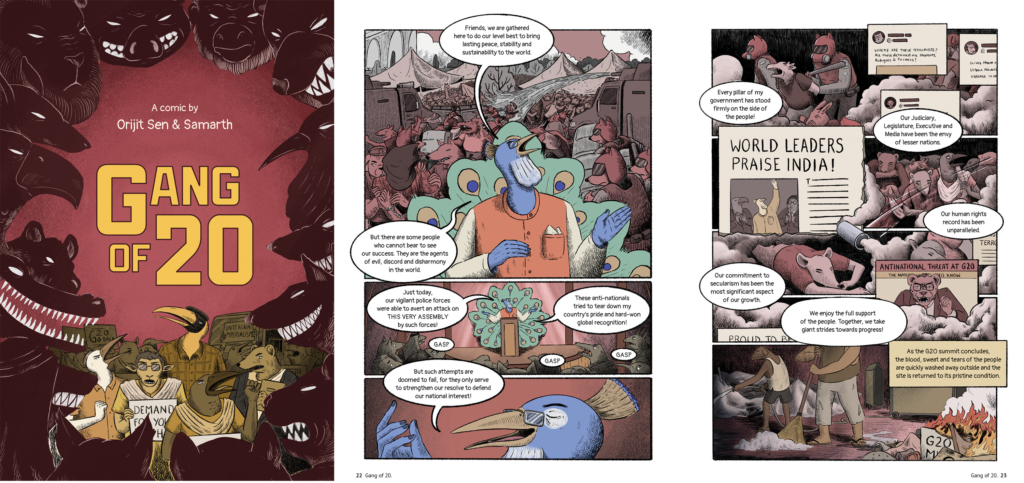
As India has turned towards the right, socially and politically, many of its citizens — comics creators amongst them — have mobilised in creative ways. Writer-artist Vidyun Sabhaney was personally involved in documenting and publicising the months-long farmers’ protests against the three farm laws passed in Parliament in September 2020. Her experiences led to her collaborating with Orijit Sen and artist Harsho Mohan Chattoraj to come up with Food & Farming: A Journey Through India in Comics (Leftword Books, 2024). The book navigates the complicated terrain of its subject matter through characters who are bound to the soil and the sustenance it has to offer. The corporatisation of farming is dissected, and its harmful effects demonstrated. Sen, whose strident voice for human rights is well-established, also worked with graphic novelist and researcher Samarth on Gang of 20 (Centre for Financial Accountability, 2022), a take on India’s Presidency of the G20 and hosting of the group’s Global Summit in 2023.
Meanwhile, the power of social media has helped boost the popularity of satirical webcomics, such as the Sanitary Panels by Rachita Taneja, and Falah Faisal’s Musalman. Many of these creators have massive followings that have helped them secure book deals. By its very nature, satire is not easily contained — attempts to do so are often met by the emergence of memes and cartoons that reach even more viewers.
The quarterly comics magazine, Comixense, published by the Ektara Trust — of which Sen and I are two of the editors — also regularly amplifies voices that are otherwise pushed to the margins. Suhail Naqshbandi makes comics for the magazine that tell stories of his native Kashmir. Arun Ferreira, who has spent years in jail on trumped-up charges, wrote a comic about how the POCSO Act, useful as it is in many cases, is sometimes exploited with casteist intent. Author Hansda Sowvendra Shekhar’s award-winning short story The Adivasi Will Not Dance, which highlights the exploitation of tribal people and lands by an unscrupulous system, was adapted into a comic in one of the early issues of the magazine. In the latest issue, Assamese comics creator Amalendu Kaushik has done a piece on the lingering traces of the ULFA militant group. These are just a handful of the many such stories that have featured in the magazine through its publication history, currently five years long. While there is much to despair about in the current climate, the good news is that resistance is also thriving, and a lot of it is graphic in nature.
______
The exhibition, A Moving Line: 1500 Years of Indian Visual Storytelling, is on view at the Museum of Art & Photography (MAP), Bengaluru, until November 15, 2026.
First published: October 16, 2026