-
ChicagoMangla, Lagan. "Shifting Frames: Activism and the Indian Documentary Form." Impart Perspectives, April 17, 2026. https://imp-art.org/perspectives/features/shifting-frames-activism-and-the-indian-documentary-form/
-
MLAMangla, Lagan. "Shifting Frames: Activism and the Indian Documentary Form." Impart Perspectives, Apr. 17, 2026, https://imp-art.org/perspectives/features/shifting-frames-activism-and-the-indian-documentary-form/. Accessed 16 Oct 2026.
-
HarvardMangla, L. (2026) Shifting Frames: Activism and the Indian Documentary Form, Impart Perspectives. Available at: https://imp-art.org/perspectives/features/shifting-frames-activism-and-the-indian-documentary-form/ (Accessed: 16 October 2026).
Shifting Frames: Activism and the Indian Documentary Form
With the diversification Indian documentary practices, there has also been a deeper shift in how political cinema is conceived, authored, and circulated.
By Lagan Mangla
Link copied!
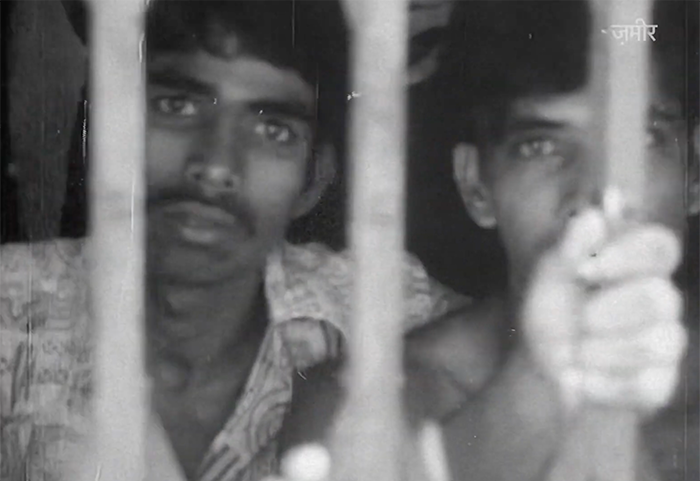
Film still from Prisoners of Conscience (1978), directed by Anand Patwardhan. Courtesy YouTube/@anandpatdocu
In recent years, documentaries from India have made significant headway in attracting attention for their storytelling craft on the global stage. Films like The Elephant Whisperers (2022), All That Breathes (2022), Writing With Fire (2021), While We Watched (2022), and A Night of Knowing Nothing (2021) have bagged honours at prestigious international film festivals, including the Academy Awards. However, the domestic distribution of documentaries in India remains severely restricted due to a combination of factors: the absence of a viable theatrical market, the requirement of censorship certification even for limited theatrical exhibition, and the near-total collapse of domestic institutional platforms dedicated to documentary financing. Filmmakers often struggle to secure a theatrical release for their documentaries, both domestically and internationally. Nevertheless, the films do manage to tour the world and also become available in India through film festivals, streaming platforms, and a thriving underground market for pirated films. Even these types of distribution are dependent on the acclaim garnered by the documentary on the world stage, powered through the emerging phenomenon of films being mounted as international co-productions, primarily with European countries.
Popular imagination sees Indian documentaries with political or activist themes as being closely linked to the cinéma vérité school of filmmaking, but it is rather difficult to define what qualities define this genre in India. The form has constantly evolved in response to technological, political, and aesthetic changes. It is even more difficult to map the collective trajectory of such documentaries, given that they are the work of independent filmmakers operating outside mainstream funding and production frameworks. Nevertheless, a closer look at the Indian documentary landscape reveals significant changes in filmmaking practices — an evolution closely linked to institutional mechanisms at play, along with technological developments, and the larger socio-political discourses around the world and in India.
Documentary production in the Indian subcontinent has its roots in initiatives launched during British rule. Foremost among them was the formation of the Film Advisory Board in 1940. Previously, there was little that differentiated fiction and non-fiction films, as both were exhibited commercially in cinema halls. After the creation of the Board, the colonial government began exercising full control over all kinds of film screenings. It became mandatory for theatre owners to screen government-approved short documentaries with educational or propaganda themes before the start of any film. This practice continued post-independence with the creation of the John Grierson-influenced Films Division (FD) in 1948. The Griersonian documentary genre dictated that filmmaking’s imaginative work must fit within the framework of the government’s duty to serve the nation’s populace. By the late 1950s and 1960s, movements such as cinéma vérité in France and Direct Cinema in the United States were questioning the ethics of authorial certainty, replacing explanation with observation and presence. Indian documentary, in contrast, retained a strong rhetorical address well into the post-Independence period as the form demanded clarity over ambiguity. Thus, FD films responded to this unique position of the Indian audience.

In its early years, FD’s use of documentary films centred around disseminating information about State-sponsored welfare programmes, and civic messaging oriented towards nation-building and inculcating ideas of patriotism and nationhood. Even though filmmakers began incorporating experimental techniques, political themes, and even critical standpoints from the mid-1960s to the mid-1970s, they were well within FD’s “public service” mandate. In these years, under the supervision of Jehangir Bhownagary, filmmakers and artists like Pramod Pati, SNS Sastry, and S Sukhdev increased the scope of experimentation of what could be done through documentaries and the filmic form. Film scholar Ritika Kaushik notes that in doing so, these makers found ways to creatively raise dissident voices against the State while continuing to be under the aegis of that very State’s institutional framework. Films like Pati’s Explorer (1968) and Abid (1972), Sastry’s I am 20 (1967), and Sukhdev’s India ‘67 (1967) all replace the didacticism of documentary with ambiguous montages and people speaking out openly about their problems. This is also the period when FD invited renowned painter MF Husain to direct a film, Through the Eyes of a Painter (1967), that went on to win the National Award for Best Experimental Film that year.
By the 1970s, the hegemony of FD in documentary filmmaking was challenged by filmmakers like Anand Patwardhan and Deepa Dhanraj, in part because by the increased accessibility to film equipment and technological innovations like smaller video camera models that were easier to film with. Patwardhan took the Super 8 camera to film the student protests in Bihar, prior to the Emergency in 1975. Inspired by the New Latin American Cinema — dubbed as Third Cinema — filmmakers like Patwardhan were drawn to the possibility of capturing the discontent of the masses. This use of cinema as an instrument of social intervention marked a clear shift from the Griersonian way of filmmaking, which had suited the Nehruvian idea of nation-building.
In India, this gave rise to filmmakers using the expository documentary mode with the “Voice of God” narration technique. Often employed in activist documentaries, the expository style uses an authoritative, omniscient voiceover to provide context, explanation, and commentary. In essence, this mode of filmmaking handholds the audience through the narrative. In 1977, Patwardhan returned to India and the “omniscient narrator” technique to present the testimonies of political prisoners who faced brutal torture and imprisonment during the Emergency.
Interviews with activists, politicians, and journalists form the narrative core of Prisoners of Conscience (1978) but it is the filmmaker’s voice-over that connects these testimonies with the larger political discourses of the time. The visuals are often interspersed with newspaper clippings, protests, and ironically, scenes from the Republic Day Parade in New Delhi. Scholar Dennis Hanlon describes how, in Patwardhan’s films, the interviews are more important than the voice-over, ensuring that the subjects of the film and their stories determine the film’s overall narrative. However, what is retained and what is edited out, how these interviews are contextualised through narration and supplementary clips, and the order of presenting these interviews — all the elements that collectively determine the film’s final point-of-view — remain the filmmaker’s prerogative.

Pathwardhan’s stylistic and narrative choices in Prisoners of Conscience were crucial to presenting a counter-narrative to the existing State propaganda projecting the Emergency as a period of strong leadership and rapid social development. FD’s films, released between 1975-76, such as Naya Daur/New Era (1975, S.N.S. Sastry), We Have Promises to Keep (1975, S.N.S. Sastry) For You and Me (1976, J.S. Bandekar) Help Them, Help You (1976, B.G. Devare) True Stories (1976. S.P. Ganguly) The New Wave (1976, Chandrashekhar Nair), had all toed the party line to show the actions of the repressive government in a positive light. Even though Patwardhan is more recognised for his work on the rise of communalism in India, these first two films — Waves of Revolution (1975) and Prisoners of Conscience — despite their technical inadequacies, set the template for both his own documentary practice as well as how the country perceived and understood independent documentaries at the time. Apart from the direct political character of his films, Patwardhan’s constant battle with the Central Board for Film Certification (CBFC) to allow the screening of his films on national television, and the subsequent legal battles, garnered significant public attention. In a context where mainstream media either erased or distorted dissenting voices, the insistence on direct address functioned as a profoundly relevant intervention on behalf of the country’s citizenry in the historical conditions of the day. Thus, Patwardhan’s style of documentary became one of the most publicly consumed documentaries of the time.
In contrast to what was happening domestically, international documentary practice at the time had already undergone a decisive turn toward reflexivity and self-interrogation. The “essay” format, which employed a first-person voice and explicitly questioned representation itself, had gained legitimacy in global art and festival circuits. Following India’s economic liberalisation during the early 1990s, documentary filmmaking in India witnessed shifts in line with these international documentary practices. As Indian filmmakers began securing foreign funding, they adopted narrative and stylistic choices that helped them gain traction in international markets, and increased their global reach.
For instance, Deepa Bhatia’s Nero’s Guests (2009) follows journalist P Sainath as he uncovers the agrarian crisis. The limited third-person narrative positions Sainath as the film’s narrator-protagonist. The film’s scenes jump from lecture halls, where he delivers fiery speeches to the urban elite, to the homes of deceased farmers as he maps the agarian crisis behind rising suicides in rural areas, to the journalist’s own home from where he files his news reports, taking on the people in power. In its narrative form, Nero’s Guests has striking parallels to While We Watched, where filmmaker Vinay Shukla follows senior TV journalist Ravish Kumar. Both Sainth and Kumar fiercely question the state of mainstream media, the latter while being part of the very same system he was critiquing when the documentary was being filmed. In Shukla’s film, however, we see an interest in Kumar’s own life trajectory, whereas Bhatia’s focus is only on Sainth’s role in spotlighting rural indebtedness and poverty. The difference is significant as the shifting film language shows themes of individualism overtake societal-level themes in the documentary format within the neoliberal world order.

Bhatia does away with the familiar Voice of God narration used in such films, as she finds a single central figure to drive the story forward. Sainath, as the “expert” narrator, guides the audience and ultimately shapes how the audience perceives the agrarian crisis. In the process, the film documents Sainath calling out a member of the film’s international crew for overlooking the contributions made by so-called “Third World” nations that had made their lives better. Sainath’s speeches, laced with sharp humour, remind the audience not to see the agrarian crisis in isolation from other developments in their lives. He repeatedly highlights class and caste hierarchies that impoverish peasants while also implicating First World countries and their neoliberal policies that have changed India for the worse for a vast majority of the nation’s populace. Bhatia’s film seems to be directed at the elite and middle-class, who are better placed to challenge the status quo, when it urges its audience not to remain silent spectators. This directness and urgency of Nero’s Guests and its brand of “activist filmmaking,” slowly start to disappear when we examine the films that come after it.
The disproportionate ratio of the rich variety of potential subjects for documentaries to the lean funding sources available domestically has meant that Indian filmmakers have increasingly had to tap international film markets and funders to cover production costs. This is a sharp deviation from the time of activist documentaries, post-independence, where Europe was primarily seen only as a site of exhibition. In line with neoliberal economic reforms, by the 2010s, filmmakers began actively collaborating with European production houses.
International collaborations have not only helped filmmakers secure higher budgets but also provided networking opportunities with foreign filmmakers and technicians, and opened up global opportunities for film sales and distribution. Filmmakers draw from European Government funding sources, national film funds of various countries, like the CNC of France or FFA and DFFF of Germany, among others, as well as film festival-linked initiatives like the World Cinema Fund at Berlinale or the Doc Alliance to mount their film productions, generally also accommodating many of the film crew from the respective funding countries, a prerequisite for co-productions. The dream run for Shaunk Sen’s All That Breathes, winning major awards at Sundance and Cannes and culminating in an Academy Award nomination, reflects how international collaborations can give a film global visibility.
However, these co-productions develop their own notions of documentary, which, although not spelt out, are evident in the form taken by the Indian documentaries mounted as co-productions. Indian productions, influenced by Patwardhan’s activist tradition, emphasise the collective in representing the subject. We see collective, group interviews held in public spaces, featuring multiple talking heads. The Western documentary tradition, on the other hand, relies on individual protagonists, private spaces, and character-driven narratives. Such editorial pressures in international co-productions led Khushboo Ranka and Vinay Shukla to withdraw from a co-production with a French producer for An Insignificant Man (2016) after feeling that the creative integrity of their work was being compromised.
Irrespective, filmmakers in India, faced with a dearth of financing and distribution avenues, have had to seek international collaborations. Thus, Nero’s Guests is a co-production between India and Finland, while Payal Kapadia’s A Night of Knowing Nothing was realised in collaboration with France, which premiered and won the Best Documentary Film award at the 2021 Cannes Film Festival. The film explores university life in India and follows a hybrid format, blending fictional and non-fictional elements. Using the second-person narrative, the film’s story uses the storytelling device of love letters written by L., a student at the Film and Television Institute of India (FTII), to her estranged lover. The letters document the drastic political changes happening in FTII, a long-held bastion of progressive thought and activism. Starting with protests against the politically motivated appointment of the chairperson at FTII to wide-ranging student protests sparked by Rohith Vemula’s suicide, increasing cases of mob lynching targeting minorities, and the Citizenship (Amendment) Act (CAA), the film frames the Indian university as a space of resistance against casteist and divisive anti-minority ideology.
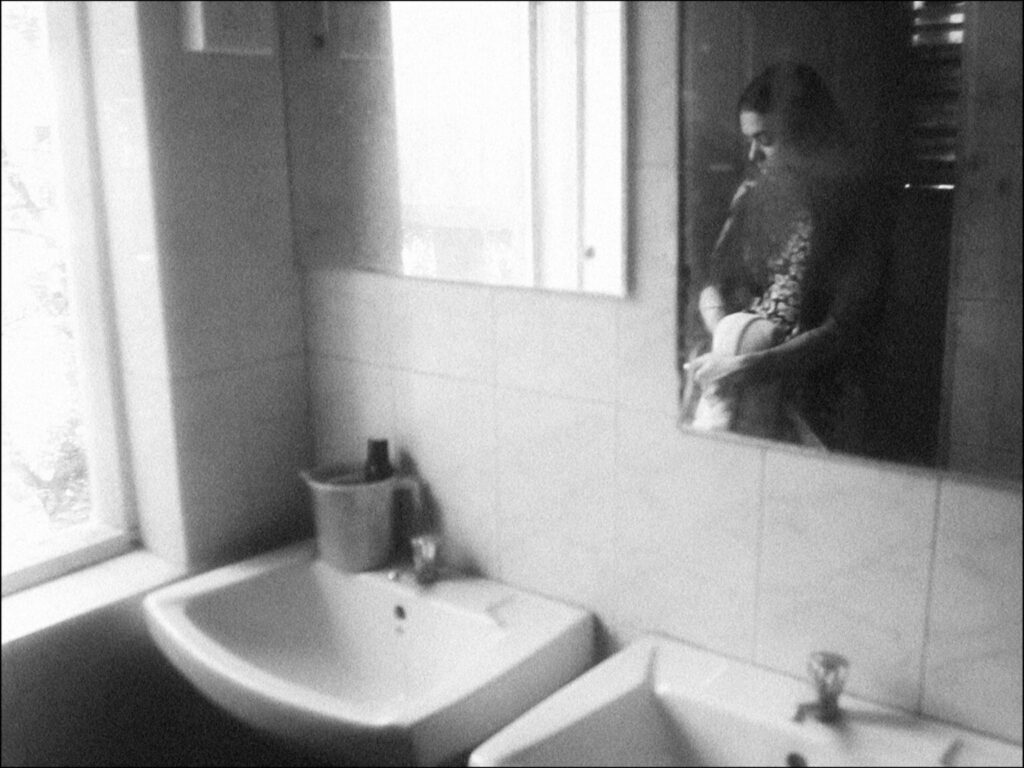
The scope of Kapadia’s film is quite vast. Instead of focusing on a particular incident, A Night of Knowing Nothing ambitiously seeks to capture the throbbing pulse of the student protests that rocked India following the strike at FTII in 2015. Rather than adopting a tone of instruction, it tries to “show” the realities of student life in India following the ascent of the BJP and the changes within the FTII campus following the change in leadership at the Centre. In doing so, the film also emphasises the individual or the personal. The personal becomes political.
We discover that L.’s lover left her because his family pressured him to cut relations with a lower caste person. L., in one of the sequences, boldly questions her lover’s choice of taking on the institute administration and the government, but not questioning his own family for their regressive thoughts. In doing so, it subtly challenges the viewer to identify and confront their own double standards. A far cry from Nero’s Guests, which is far more direct about challenging the viewer to be more proactive, Kapadia cloaks her activist message within the fictional but very true-to-life plotline. It is a directorial choice that doesn’t spell out the film’s politics as much as it gently gestures at the fault lines that we, the audience, would otherwise resolutely ignore. Despite its experimental take, the film undoubtedly falls within the activist documentary subgenre.
Similarly, in Land of My Dreams (2023), the personal is political. The film sees filmmaker Nausheen Khan tracing her identity as a Muslim woman as protests rage against the CAA all across Delhi in the winter of 2019-20. Using a first-person narrative allows Khan to question aspects of her own upbringing, in particular the place where she studied, Jamia Millia Islamia. The evolution of this place is contrasted with the rise in religious fundamentalism in the country as Khan positions herself not merely as a filmmaker but also of a protagonist narrating the story of one of the biggest citizen protests faced by the BJP government. In doing so, Khan poses the central question of her film — what is this ‘land of her dreams’ supposed to represent? The form of the film also allows Khan to delve into the representation of Muslims in Hindi cinema.
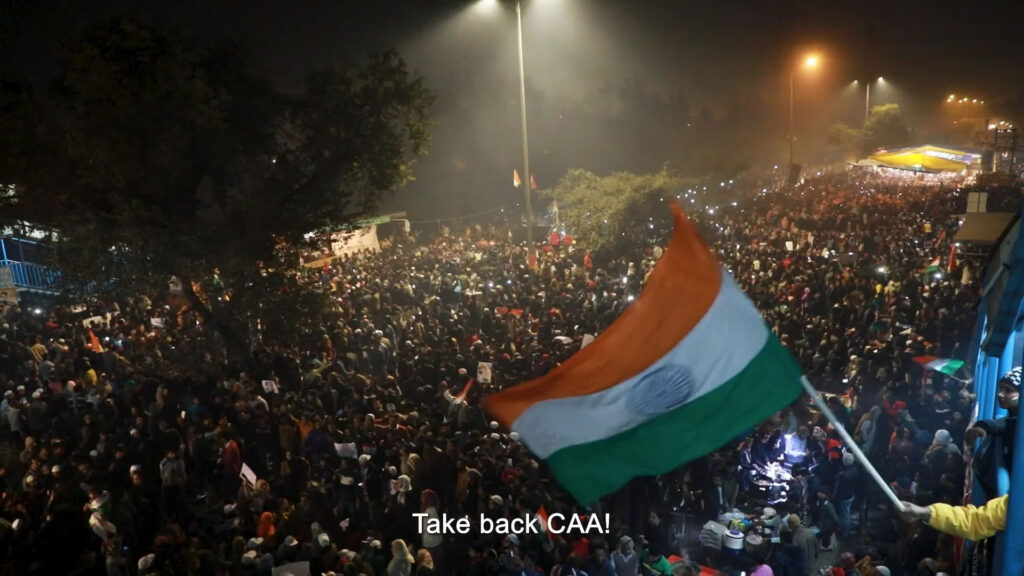
In keeping her identity, a Muslim woman in India under the sway of the BJP’s anti-Muslim, Hindutva rhetoric, at the centre of the film’s narrative, Land of My Dreams strays into the realm of the “autobiographical documentary.” Scholar Michael Renov refers to this shift in the documentary genre, which first emerged in the 1980s and 1990s in America, in The Subject of Documentary. Instead of pointing the camera outward, the filmmaker enacts their identities for the camera — “fluid, multiple, even contradictory—while remaining fully embroiled with public discourses.” What is new about this subjectivity in the autobiographical documentary genre, he explains, is that it does not reject the collective. For instance, Khan, by foregrounding her identity, reveals the specific contours of marginalisation faced by those who share her gender and religion.
What emerges from this trajectory is not simply a diversification of themes or identities within Indian documentary practice, but a deeper transformation in how political cinema itself is conceived, authored, and circulated. The gradual movement from the declarative, third-person activist documentary toward more reflexive, affective, and formally hybrid modes must be understood in relation to parallel developments in global documentary culture. The rise of the essay film, observational intimacy, and first-person reflexivity in international documentary practices is profoundly shaping the conditions under which Indian documentaries are imagined and realised.
With receding state patronage, filmmakers increasingly engage with global narrative grammars through international collaborations, leading to a recalibration of formal filmmaking choices. Indian documentary films are no longer addressed solely to the domestic public but to transnational audiences trained to read politics through subjectivity, ambiguity, and aesthetic restraint. In this context, activist documentaries with political leanings continue to be made in India, but the genre’s contours are no longer fixed. After over 45 years, Patwardhan also challenges his own template for activist documentary with his latest film, The World is Family (2023), turning the camera on himself and his family, albeit without international funding. Yet the ‘activist’ part of his filmmaking credentials remains intact through this new venture as well. There is no dilution of politics, but a shift inwards. Rather than asking whether the activist documentary still exists, it may be more productive to ask how activism has migrated across registers under conditions of global circulation, market expectations, and heightened surveillance. The genre has not dissolved; it has been transformed by the very international networks that now sustain it.
First published: April 17, 2026